
Cushman & Wakefield’s Growth Rebound Confronts Debt and Macroeconomic Uncertainties
Robust operating income growth contrasts with subdued net income amid substantial leverage and evolving real estate market dynamics.
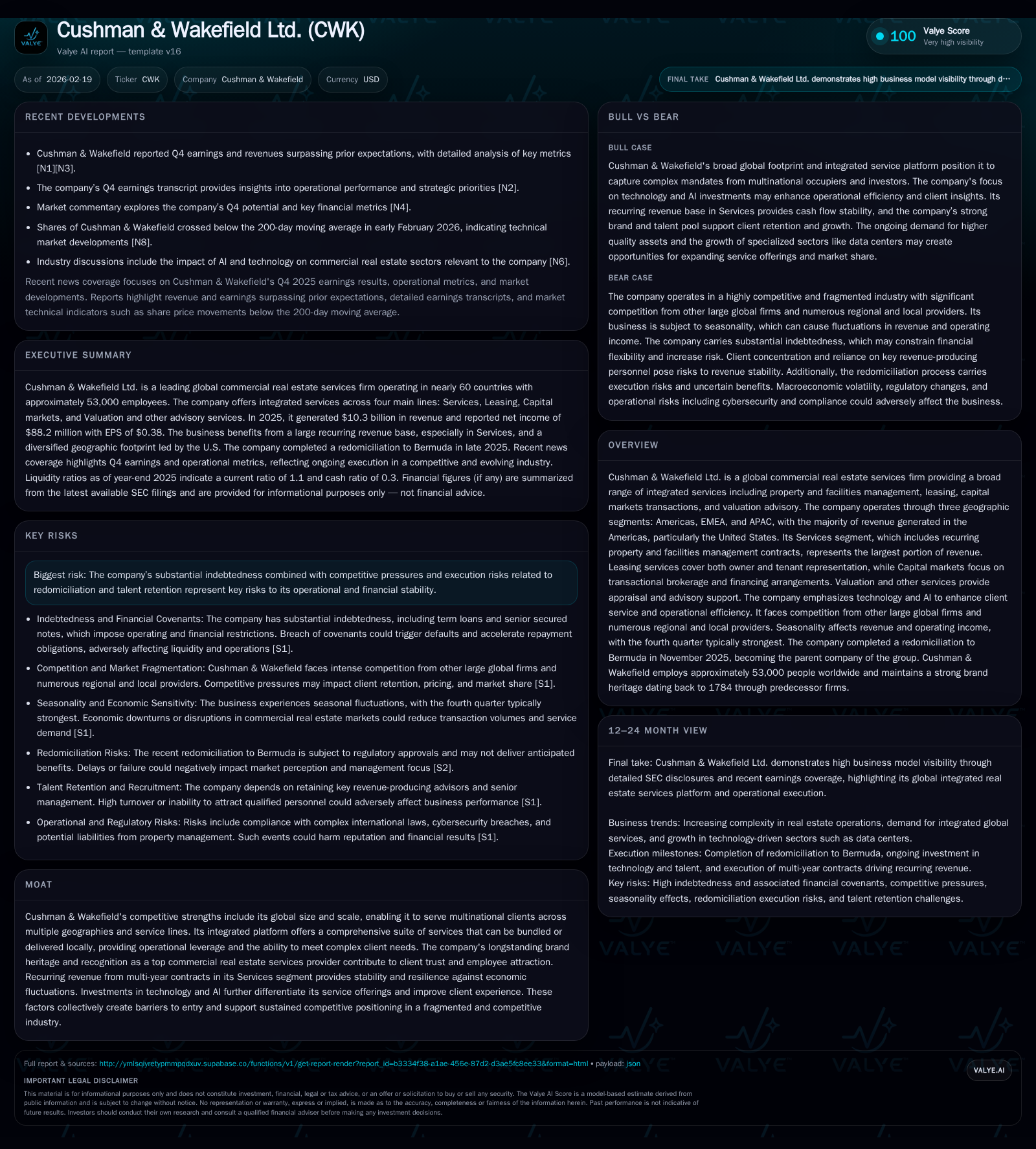
Cushman & Wakefield Ltd. (CWK) demonstrated significant operational recovery in 2025, with operating income surging 33.5% year-over-year. This improvement was driven by broad strength across its integrated commercial real estate services platform, including recurring property management contracts and transactional leasing and capital markets activity. However, net income declined by nearly a third due to elevated expenses and financial costs linked to its high debt load. The firm’s growth prospects rest on continued expansion in services and high-growth sectors like data centers, supported by technology investments in AI and data analytics. Key risks include macroeconomic volatility impacting transaction volumes, challenges financing client deals due to tighter credit conditions, and the sizable indebtedness that limits flexibility and escalates refinancing risks.
Historical Performance
Cushman & Wakefield Ltd., a global leader in commercial real estate services with approximately 53,000 employees worldwide across nearly 60 countries, has shown a trajectory of recovering profitability following a difficult period. Operating income climbed significantly from $338.9 million in FY2024 to $452.5 million in FY2025 — a robust 33.5% increase — reflecting successful execution of operational improvements and revenue growth across its integrated platform [F1]. The firm’s diverse service lines encompass Services (property management and facilities), Leasing (owner/tenant representation), Capital Markets (brokerage of transactional real estate deals), and Valuation and Advisory services.
Net income told a more challenging story: it fell by approximately one-third to $88.2 million in FY2025 compared with $131.3 million in FY2024 [F1]. The decline is largely attributable to higher finance costs stemming from Cushman & Wakefield’s substantial debt burden of roughly $2.7 billion as of year-end 2025; rising interest expenses squeezed bottom-line returns despite operating gains [S4][S5]. Notably, operating cash flow improved dramatically (up 63.7% year-over-year to $340.4 million), supporting both operational health and partial deleveraging efforts.
Capex expenditures have remained relatively stable around $47 million annually representing less than 15% of operating cash flow—this conservative capital investment posture suggests management priority on cash generation over aggressive asset expansion [F1]. Equity has grown steadily but modestly from $1.66 billion in FY2022 to $1.96 billion in FY2025.
Historical performance (annual)
| FY | Net ($mm) | CFO ($mm) | OpInc ($mm) | Capex ($mm) | Net YoY |
|---|---|---|---|---|---|
| 2025 | 88 | 340 | 453 | 47 | -32.8% |
| 2024 | 131 | 208 | 339 | 41 | +470.9% |
| 2023 | -35 | 152 | 206 | 51 | -118.0% |
| 2022 | 196 | 49 | 535 | 51 |
Note: Omitted columns lack sufficient annual XBRL coverage in the provided tags (need ≥2 annual points): Rev, Div, Buybacks. Source: SEC companyfacts cache [F1].
Capital returns and efficiency (annual)
| FY | FCF ($mm) | ROE% |
|---|---|---|
| 2025 | 293 | 4.5 |
| 2024 | 167 | 7.5 |
| 2023 | 101 | -2.1 |
| 2022 | -2 | 11.8 |
Source: SEC companyfacts cache [F1].
Note: Revenue not provided; Dividends & buybacks unavailable from tags.
Business Model & Segments
Cushman & Wakefield operates through three primary geographic segments: the Americas generating approximately 73% of revenue with the U.S accounting for about 69%, followed by Asia Pacific at around 17%, and EMEA making up roughly 10%. This distribution highlights both the importance of North America to financial results as well as meaningful global diversification [S8][S26].
The dominant Services segment contributes about two thirds (66%) of total revenues—largely recurring fees tied to multi-year contracts for property and facilities management—injecting resilience into cyclical fluctuations common in Leasing (21%) and Capital Markets (8%) transactional businesses [S8][S23]. This strong base differentiates CWK from peers reliant predominantly on brokerage fees alone.
Leasing operations cover both landlord owner representation aiming at strategic leasing of available space under contract multi-months or years in advance, as well as tenant-side representation helping clients with renewals or relocations — an area exhibiting some defensive qualities given tenant needs irrespective of economic cycles [S23].
Capital markets fees remain tied closely to deal closing volume and value—areas sensitive to macroeconomic whims such as lending turbulence or geopolitical uncertainty impacting deal velocity [S11][S26]. Valuation offerings support financing decisions with appraisal expertise complementing transactional service lines.
Industry Trends & Competitive Positioning
Cushman & Wakefield stands among the top three global commercial real estate services firms alongside CBRE Group and Jones Lang LaSalle (JLL). Its competitive moat is built on global scale serving multinational clients who demand integrated service coverage across geographies combined with deep sector knowledge spanning offices, industrial/logistics facilities, retail centers, multifamily housing, healthcare properties, data centers, life sciences campuses among others [S27].
The sector is experiencing structural shifts driven by the increasing complexity of corporate real estate decisions affected by evolving work patterns—especially hybrid working—and technology adoption impacting space utilization directly [S11][S21]. Premium Class A properties show stronger leasing activity capturing occupiers seeking enhanced amenities aligned with sustainability themes which Cushman & Wakefield is positioned to capitalize on.
Data centers represent a notable growth vector fueled by AI deployment requiring specialized infrastructure — enhanced power density requirements coupled with cooling solutions drive demand for expert landlord representation plus facilities management where CWK leverages technology investments for competitive advantage .
Investment in digital tools leveraging AI-powered data analytics aims at providing deeper client insights aggregating multiple datasets across markets enabling proactive problem solving — a key differentiator versus more traditional firms reliant primarily on human relationships alone [S18][S27].
Future Growth Outlook
Growth prospects hinge upon several factors:
- Continued expansion of recurring Service contracts provides resilience.
- Expansion into fast-growing asset classes such as data centers could drive higher-margin advisory opportunities.
- Leveraging technology-enabled offerings may unlock new client segments or deepen wallet share within existing ones.
- Geographic mix optimization offers upside especially within Asia Pacific where economic growth remains robust compared with Western markets.
However, cautions persist:
- Macroeconomic headwinds including inflationary pressures, rising interest rates leading to higher capital costs suppressing transaction volume.
- Client delays or hesitations in committing to large capital transactions could impact Capital Markets commission flow.
- Structural shifts due to hybrid work may continue reducing overall office footprint demand affecting Leasing revenues negatively.
- Large indebtedness constrains financial flexibility limiting scope for acquisitions or aggressive reinvestment cycles while increasing vulnerability if refinancing conditions deteriorate further [S26][S25].
Management has articulated strategic priorities focused on profitable revenue acceleration coupled with measured deleveraging aimed at reducing dependency on external capital markets while maintaining investments in talent retention and technological leadership [N2][N11][S18][S20].
Returns & Capital Allocation
Cushman & Wakefield’s approximate return on equity stands modestly at ~4.5% based on trailing twelve-month net income over shareholders’ equity — indicating scope for improved profitability relative to invested capital levels [F1]. The company does not currently pay dividends owing partly to leverage covenants restricting distributions; instead retained earnings fund operations expansion along with debt repayments prioritized over shareholder returns at present [S20].
Free cash flow approximates $293 million (operating cash flows less capex) which supports ongoing deleveraging plans while preserving capacity for targeted organic investment spending aimed at technology platforms enhancing client service delivery effectiveness [F1]. Buyback activity is unreported though constrained likely by covenant restrictions linked to credit agreements covering about $1.7 billion drawn term loans plus around $650 million senior secured notes among others raising total obligations near $2.7 billion excluding lease liabilities—significant leverage given industry margins [S4][S10].
Risks & Challenges
Key risks articulated by the company include:
- Cyclical sensitivity: Demand for services tightly coupled with commercial real estate market health driven by macroeconomic variables such as interest rates volatility negatively impacting client transaction timing decisions.
- Redomiciliation uncertainties: Recent change in legal domicile introduces execution risks that may distract management or fail to deliver expected benefits despite completed shareholder approvals conditional on court consent [S2].
- Talent retention pressures: Competition for qualified personnel remains intense across all geographies exacerbated by workplace culture challenges arising from political polarization noted internally; workforce composition requires continuous investment in development programs.
- Litigation exposure: Given scale of managed properties involves legal risk related to negligent claims from clients or tenants alongside intellectual property infringement suits possibly affecting reputation/economics if materialized unexpectedly [S6][S7][S17].
- Debt burden effects: Covenant restrictions reduce strategic flexibility possibly hampering timely response to market opportunities or adverse scenarios including refinancing risk amidst changing credit environments potentially driving cost increases or accelerated repayments triggering defaults impacting liquidity severely [N13][N14][S10][S19].
- Foreign currency volatility: With nearly a third of sales outside USD zones performance comparisons complicated over time by exchange rate impacts contributing additional reported result fluctuations beyond business fundamentals alone [S15][S26].
What To Watch Next
Absent explicit forward guidance disclosed publicly beyond general management commentary discussed during recent earnings releases ([N1],[N3],[N11]), market observers should monitor:
- Quarterly trends in leasing volumes specifically within premium office segments echoing migration patterns post-pandemic.
- Capital markets transactional activity levels signaling broader investor confidence or tightening credit conditions.
- Progress toward debt metric improvements alongside refinancing initiatives mitigating refinancing risk premiums.
- Adoption pace of proprietary technology tools influencing reported client win rates or cross-selling effectiveness.
- Macroeconomic developments including interest rates trajectories aligning with Fed policy that indirectly affect client capital deployment decisions.
In addition, outcomes related to pending litigation cases should be observed closely given potential financial impacts although management currently views exposure as unlikely material at this stage[S7]. Strategic moves addressing competitive landscape dynamics such as potential partnerships or bolt-on acquisitions remain possible catalysts but currently unexpected given leverage constraints.
Conclusion
Cushman & Wakefield exemplifies a leading global real estate services firm balancing growth opportunities afforded by its broad integrated platform against tangible constraints imposed by high indebtedness amid uncertain macroeconomic conditions shaping client behaviors worldwide. Its demonstrated rebound in operating income highlights effective operational controls while reliance on recurring services underlines stability advantages uncommon among competitors dependent primarily on transactional brokerage commissions. Successful navigation ahead will require deft talent management fostering innovation adoption while prudently managing balance sheet risks inherent within the capital-intensive nature of global outsourcing driven commercial real estate advisory services.
This report is prepared solely for informational purposes without offering investment advice.
Disclaimer: This is research-only, informational analysis and not investment advice. It may include AI-generated interpretation and general industry context. Always verify important details using primary sources.

Comments