
Spyre Therapeutics Counters Clinical and Capital Constraints with Next-Gen Antibody Development
Spyre Therapeutics advances long-acting antibody combinations targeting IBD and rheumatic diseases amid sustained net losses and dependence on additional funding.
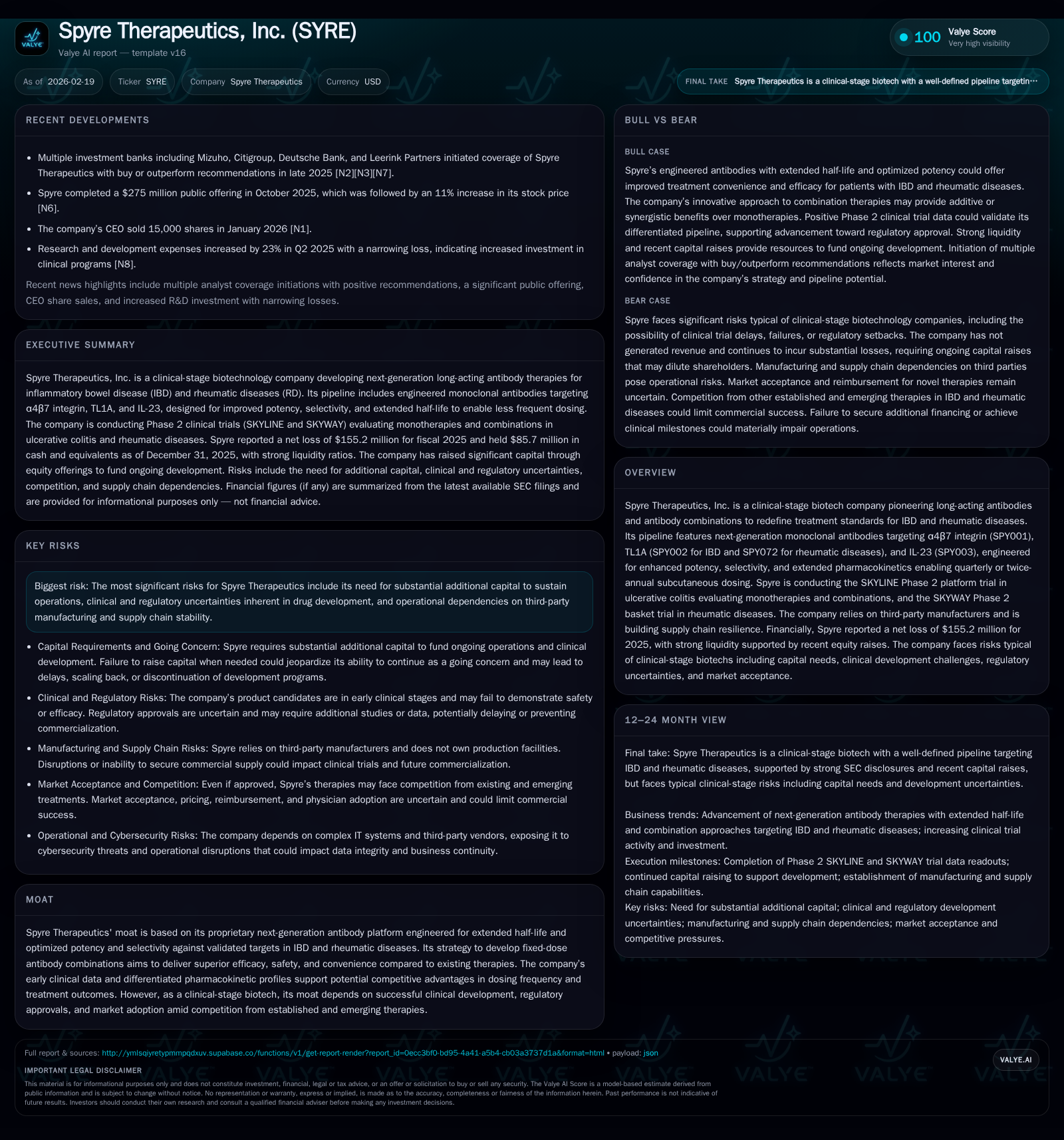
Spyre Therapeutics, a clinical-stage biotech focused on engineered antibodies for inflammatory bowel disease (IBD) and rheumatic conditions, continues to rely heavily on R&D investment without generating revenues. Its pipeline centers on next-generation monoclonal antibodies with extended half-lives, aiming for reduced dosing frequency via quarterly or biannual subcutaneous administration. Despite stable operating losses near $210 million in 2025, the company maintains a strong current ratio and raised capital recently, though future growth hinges on successful clinical trials in its SKYLINE and SKYWAY Phase 2 programs. Risks include regulatory uncertainty, third-party manufacturing reliance, and the need for further capital to sustain operations.
Company Overview and Strategy
Spyre Therapeutics operates as a clinical-stage biotechnology company specializing in next-generation long-acting monoclonal antibodies designed for inflammatory bowel disease (IBD) and an expanding set of rheumatic diseases. The company’s scientific platform focuses on modulating key validated immunological pathways by targeting α4β7 integrin (SPY001), TL1A (SPY002 for IBD; SPY072 for rheumatic conditions), and IL-23 (SPY003).
Their antibodies incorporate Fc domain YTE mutations that significantly extend half-life pharmacokinetics, permitting novel dosing intervals such as quarterly or biannual subcutaneous injections—a feature anticipated to enhance patient adherence and reduce healthcare burdens. The molecules are also optimized for increased potency and selectivity relative to first-generation benchmark biologics like vedolizumab or risankizumab.
Spyre's development strategy hinges on a three-pronged approach: advancing potent monotherapies within their portfolio against proven targets; pioneering fixed-dose antibody combinations aiming to deliver paradigm-shifting improvements in efficacy, safety, and convenience; and leveraging the anti-TL1A program across multiple indications beyond IBD—including rheumatoid arthritis (RA), psoriatic arthritis (PsA), and axial spondyloarthritis (axSpA) [S1].
Historical Performance: Revenue Absence Amid Steady Operating Losses
As expected in early-stage biotech companies lacking marketed products, Spyre has not reported any product sales revenue historically nor through fiscal year 2025. The company's financials reflect a sustained investment phase driven by research activities.
Operating income losses have hovered around $210 million in both FY2024 ($208.6M) and FY2025 ($209.6M), marking relative stabilization compared to a larger loss of $242.3M in FY2023 but still indicating persistent high operational expenditures primarily linked to clinical trial costs, personnel expenses, licensing fees for intellectual property rights acquired from Paragon Biotherapeutics, and drug manufacturing outsourcing [F1][S1][S2].
Net income similarly remains negative but improved from -$338.8M in FY2023 to -$155.2M in FY2025, reflecting some non-operating gains or expense reductions outside core operations [F1]. Operating cash flows are consistently negative given the pre-commercialization stage: -$169.3M in FY2025 with a slightly worsening trend versus -$157.4M in FY2024 [F1]. Capital expenditures are nominal or zero given outsourcing of manufacturing facilities.
The table below summarizes these key annual financial metrics:
Historical performance (annual)
| FY | Net ($mm) | CFO ($mm) | OpInc ($mm) | Capex ($) | Net YoY |
|---|---|---|---|---|---|
| 2025 | -155 | -169 | -210 | +25.4% | |
| 2024 | -208 | -157 | -209 | 0 | +38.6% |
| 2023 | -339 | -100 | -242 | 0 | -304.2% |
| 2022 | -84 | -80 | -85 | 38000 |
Note: Omitted columns lack sufficient annual XBRL coverage in the provided tags (need ≥2 annual points): Rev, Div, Buybacks. Source: SEC companyfacts cache [F1].
Capital returns and efficiency (annual)
| FY | FCF ($mm) | ROE% |
|---|---|---|
| 2025 | -21.7 | |
| 2024 | -157 | -40.2 |
| 2023 | -100 | -184.1 |
| 2022 | -80 | -166.6 |
Source: SEC companyfacts cache [F1].
Note: Revenue data unavailable from provided tags; capital expenditures negligible.
Financial Position & Capital Allocation
Spyre ended fiscal year 2025 with $85.7 million in cash and equivalents supported by an exceptionally strong current ratio of approximately 13x (current assets of $778M vs current liabilities around $58.7M), indicating substantial short-term liquidity cushion [F1]. This liquidity is critical given the ongoing requirement for capital infusion amid no product revenues.
Equity has expanded markedly—from $50 million in 2022 to over $715 million at end-2025—primarily fueled by sizable equity raises accompanying licensing deals for foundational intellectual property from Paragon Biotherapeutics [S2]. No dividends have been declared or paid, nor have there been share repurchases; such metrics are not available from provided tags [F1].
All available funds are currently allocated toward research and development efforts including pipeline expansion, clinical trial progression—especially the SKYLINE ulcerative colitis trial testing mono-therapies plus fixed-dose combinations—and the SKYWAY basket trial covering rheumatoid arthritis (RA), psoriatic arthritis (PsA), and axial spondyloarthritis (axSpA) under Special Protocol Agreement-like regulatory arrangements [S1][S2]. This reinvestment aligns with typical biotech development cycles where returns depend heavily on clinical validation.
Growth Outlook & Clinical Milestones
Spyre’s growth prospects revolve around demonstrating clinical differentiation through:
- Completion of Phase 2 SKYLINE trial data readouts assessing efficacy/safety of engineered antibody mono-therapies plus novel fixed-dose combinations enabling less frequent dosing.
- Expansion of the anti-TL1A program into rheumatologic indications broadening therapeutic reach beyond IBD.
- Progression toward pivotal Phase 3 studies aiming at regulatory approvals supported by patents expected to expire no earlier than 2044–2045 due to patent term extensions secured under licensing agreements [S1][S2].
However, significant risks temper growth expectations including clinical trial uncertainties typical of early-stage drug development; manufacturing outsourcing vulnerabilities; evolving pricing/reimbursement challenges; intellectual property litigation risks; regulatory complexities associated with biologic combinations; and the absence of explicit management guidance beyond disclosed trial progressions [N1][S3].
Returns & Cash Flow Analysis
Given the lack of revenue generation so far, traditional profitability metrics such as return on equity (ROE), dividend yield, or share buybacks do not apply meaningfully at this stage:
- Approximate ROE calculated as net income divided by stockholders’ equity for FY2025 is approximately -21.7%, reflecting ongoing net losses relative to equity base [F1].
- Operating cash flow remains negative at about -$169 million in FY2025 with a modest decline year-over-year (-7.5%), indicating sustained cash burn consistent with R&D investment [F1].
- Free cash flow cannot be precisely computed due to negligible capital expenditures but is effectively negative matching operating cash flows since capex is near zero [F1].
- No dividends or share repurchases were reported within available disclosures [F1].
Thus, Spyre continues as a pre-revenue entity reliant on external financing to support its operations.
Competitive Moat & Technological Differentiation
Spyre’s proprietary platform leverages Fc engineering (YTE substitutions) conferring prolonged antibody serum persistence—a significant innovation enabling subcutaneous dosing intervals longer than competitors limited to monthly injections or intravenous infusions [S1]. Additional advantages include enhanced selective potency aimed at improved safety profiles reducing off-target effects common in immunomodulatory therapies.
Development of fixed-dose combinational biologics targeting multiple immunopathogenic pathways seeks additive or synergistic therapeutic benefits unattainable by single agents alone—if validated clinically this could establish a competitive edge.
Risk Factors Summary From SEC Filings & Recent Developments
The company discloses extensive risk categories typical of early-stage biotechnology firms:
- Financial Risks: Continued net losses require further capital raises which may dilute shareholders; inability to raise capital threatens going concern status [S1][S4][S5].
- Development Risks: Clinical delays/failures including patient recruitment difficulties or drug supply interruptions could stall timelines; limited human data increases uncertainty [S6][S7].
- Regulatory Risks: Complex approval processes across jurisdictions coupled with device-related risks add uncertainty [S8][S9].
- Commercial Risks: Pricing pressures from government payors and competition from biosimilars may impair market uptake [S10][S20].
- Intellectual Property Risks: Patent disputes or failure to maintain exclusivity could damage commercial prospects [S11][S12].
- Operational Risks: Dependence on third-party manufacturers creates supply chain vulnerabilities; compliance with evolving data privacy/cybersecurity laws adds operational complexity [S16][S17][S18].
Recent insider activity includes CEO share sales noted without further context regarding company outlook [N1].
Conclusion & Investor Considerations
Spyre Therapeutics is positioned as an innovative clinical-stage biotech focusing on long-acting antibody therapies targeting immune-mediated diseases but remains pre-revenue with substantial cash burn balanced by strong liquidity at present.
Key upcoming catalysts include Phase 2 trial readouts from SKYLINE/SKYWAY which will be pivotal inflection points determining advancement toward registrational studies or program adjustments. Investors should monitor clinical progress closely alongside capital market developments given inherent volatility associated with early biotech enterprises.
Disclaimer:
This analysis is based solely on publicly available information as of February 19, 2026, including SEC filings ([N1], [S1]-[S29]) and news reports referenced herein without extrapolation beyond documented facts or financials explicitly provided ([F1]). It does not constitute investment advice nor endorsement of any securities mentioned.
Disclaimer: This is research-only, informational analysis and not investment advice. It may include AI-generated interpretation and general industry context. Always verify important details using primary sources.

Comments