
Guardant Health’s Quest to Translate Liquid Biopsy Innovation Into Profitability
Guardant Health drives strong revenue growth through FDA-approved liquid biopsy tests yet faces persistent operating losses and reimbursement complexities.
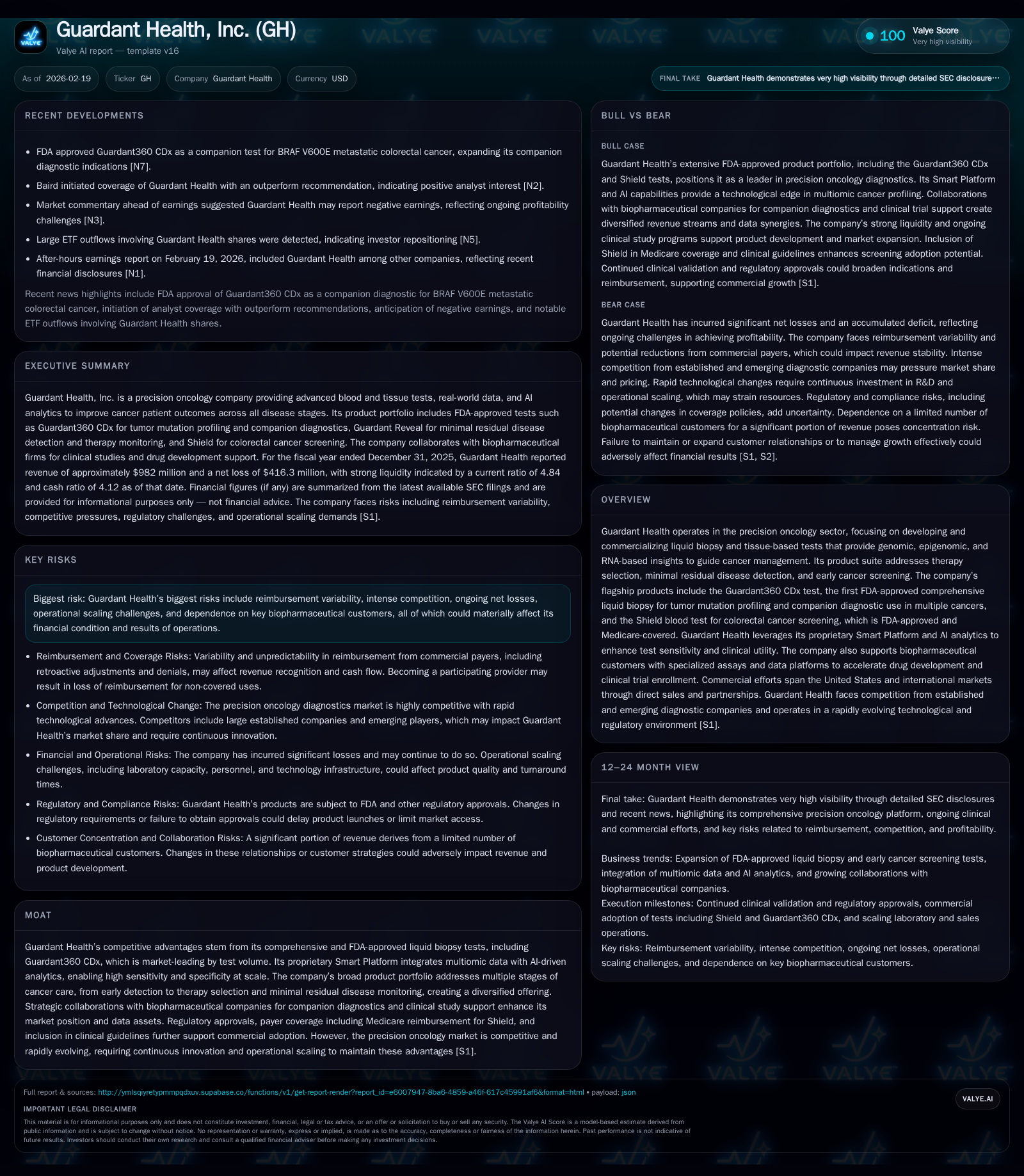
Guardant Health has pioneered liquid biopsy technology in precision oncology, establishing market leadership with FDA-approved tests like Guardant360 CDx and Shield. Despite a robust 32.9% revenue CAGR over the past four years driven by clinical innovation and expanded payer coverage including Medicare, the company continues to report significant net losses exceeding $400 million annually. Key challenges include scaling operational efficiency, navigating reimbursement variability, and addressing legal inquiries concerning government billing. Strategic biopharma collaborations and multi-cancer early detection programs offer growth avenues, but profitability remains elusive amid ongoing R&D investments and market adoption hurdles.
Historical Trajectory: Revenue Growth Amid Consistent Operating Losses
Guardant Health has exhibited impressive top-line expansion over recent years, achieving nearly a billion dollars in revenue by fiscal year 2025. The precise figures illustrate this trajectory: revenue climbed from $449.5 million in FY2022 to $982 million in FY2025, marking a robust 32.9% compound annual growth rate [F1]. This acceleration underscores solid market acceptance of Guardant's suite of liquid biopsy tests despite a challenging macro environment.
However, this topline momentum contrasts sharply with operating performance, as the company has consistently posted substantial operating losses each year. For instance, operating income moved from a loss of approximately $544 million in FY2022 to a slightly reduced operating loss of $437 million in FY2025 [F1]. Net income follows a similar pattern — a net loss of $416 million was recorded in FY2025 compared to $479 million in FY2023 — reflecting incremental progress but sizable deficits that have persisted since inception.
This persistent unprofitability can be attributed primarily to continued heavy investment in research & development, clinical validation efforts, and commercialization costs. These outlays are critical to maintaining Guardant’s technological edge yet press heavily on earnings.
Historical performance (annual)
| FY | Rev ($mm) | Net ($mm) | CFO ($mm) | OpInc ($mm) | Rev YoY | Net YoY |
|---|---|---|---|---|---|---|
| 2025 | 982 | -416 | -185 | -437 | +32.9% | +4.6% |
| 2024 | 739 | -436 | -240 | -444 | +31.0% | +9.0% |
| 2023 | 564 | -479 | -325 | -565 | +25.5% | |
| 2022 | 450 | -309 | -544 |
Note: Omitted columns lack sufficient annual XBRL coverage in the provided tags (need ≥2 annual points): Capex, Div, Buybacks. Source: SEC companyfacts cache [F1].
Capital returns and efficiency (annual)
| FY | FCF ($mm) | ROE% |
|---|---|---|
| 2025 | -233 | 419.2 |
| 2024 | -275 | 312.5 |
| 2023 | -345 | -302.1 |
| 2022 | -387 |
Source: SEC companyfacts cache [F1].
Note: Net income for FY22 not available in provided data.
Key Growth Drivers and Technology Differentiators
Central to Guardant Health’s market prominence is the Guardant360 CDx test—an FDA-approved comprehensive liquid biopsy assay delivering tumor mutation profiling across multiple solid tumor types including NSCLC, colorectal cancer, and breast cancer, authorized also as a companion diagnostic for targeted therapies [S1][N8]. This product leads by reported test volume within its category.
Technologically, Guardant leverages its proprietary Smart Platform which synergistically combines methylation-based epigenomic markers alongside genomic and RNA signals to enhance clinical sensitivity beyond traditional DNA mutation testing alone [S1][N5]. The integration of methylation profiling represents an industry-leading multimodal assay innovation that addresses key sensitivity-specificity tradeoffs necessary for effective cancer detection and monitoring.
Complementing assay chemistry advancements is the InfinityAI engine—an artificial intelligence analytics framework that refines signal detection amidst low-frequency circulating tumor DNA fragments.
These differentiated capabilities underpin the company's strong foothold both as a diagnostic tool for therapy selection and as a companion diagnostic partner supporting biopharmaceutical drug development pipelines.
Market Adoption Dynamics and Payer Reimbursement Landscape
Wider commercial adoption hinges substantially on payer reimbursement status—a mixed landscape marked by notable achievements and persistent challenges.
Medicare's decision to provide coverage for the Shield blood test targeting colorectal cancer screening marks a pivotal endorsement supporting broader U.S health system uptake [S1][S4]. Moreover, inclusion of Shield within national screening guidelines consolidates its clinical legitimacy.
Nonetheless, variability among commercial payers continues to temper scaling efforts—coverage decisions vary broadly across insurers with inconsistent contracting terms impacting revenue predictability [S4][N5]. Clinician adoption outside academic centers also evolves unevenly owing to entrenched practice patterns favoring tissue biopsies or alternative approaches.
This reimbursement heterogeneity contributes directly to the company's negative operating cash flows despite strong underlying demand signals [F1]. The intermittent lag between establishing clinical utility evidence and securing payer agreements elongates the path toward positive free cash flow generation.
Expanding Clinical Scope: From Colorectal Screening to Multi-Cancer Detection
For early detection, Guardant’s Shield test broke new ground as the first FDA- and Medicare-approved blood-based colorectal cancer screening assay for average-risk adults aged >=45 years [S1][N8]. This milestone established liquid biopsy utility beyond advanced-stage disease monitoring into population-level screening paradigms.
Further ambitions lie in multi-cancer detection (MCD), where Guardant has secured Breakthrough Device designation from the FDA—a regulatory pathway accelerating review timelines given promising early clinical data demonstrating the feasibility of detecting multiple tumor types simultaneously via methylation signatures on the Shield platform [S1][N8].
Industry-wide, MCD assays wrestle with balancing false positive rates against comprehensive cancer signal sensitivity—a dynamic that demands rigorous analytical validation alongside prospective outcome studies before commercial launch can scale fully.
Guardant’s integrated approach with AI-driven algorithms seeks to moderate these tradeoffs better than competitors while establishing an early mover advantage under regulatory fast-track provisions.
Financial Returns, Capital Allocation, and Cash Flow Insights
Despite significant net losses that persist into FY2025 (-$416 million), Guardant Health reports an anomalously high approximate return on equity (+419%) attributable primarily to a negative equity base (–$99 million at year-end) resulting from accumulated deficit rather than traditional profitability metrics [F1]. This elevated ROE figure thus reflects accounting effects rather than economic profitability.
Operational cash flow remains negative though improving steadily—from a burn of $309 million in FY2022 down to roughly $185 million deficit in FY2025—indicating incremental progress toward operational leverage amid expanded revenues yet still reliance on external funding or capital markets activities [F1]. Capital expenditures rose approximately 38% year-over-year in FY2025 to $48 million signaling investment focus on laboratory capacity expansion or technology infrastructure upgrade.
Interestingly, Guardant deployed capital for share repurchases totaling $45 million during FY2025 despite ongoing negative cash flows—somewhat unusual for loss-making companies—which may signal board confidence or opportunistic valuation-driven capital return strategies absent dividend issuance [F1][S2].
No dividends have been declared historically per available disclosures.
Regulatory Environment and Ongoing Legal Considerations
Guardant operates within a complex regulatory framework encompassing oversight by FDA medical device regulations as well as compliance mandates under CMS for Medicare billing protocols.
A salient legal risk factor is an active Department of Justice civil investigative demand issued in January 2022 probing False Claims Act allegations related to billing government-funded programs for the Guardant360 test panel [S5]. The company cooperates fully but outcome uncertainties persist which could result in substantial fines or administrative sanctions including potential exclusion from federal healthcare programs—an existential regulatory risk given Medicare coverage reliance.
Beyond this inquiry are broader compliance challenges arising from applicable federal healthcare fraud statutes including Anti-Kickback Statute (AKS), Physician Payments Sunshine Act reporting obligations, and state-level corporate practice of medicine prohibitions—all demanding stringent internal controls and ethical safeguards within sales operations and physician interactions [S4].
Failure to manage these risks adequately carries reputational harm potential alongside monetary penalties that could hinder ongoing commercial momentum.
Biopharmaceutical Collaborations as Strategic Growth Catalysts
Approximately 11% of Guardant's revenue derives from biopharmaceutical customers forming strategic partnerships around companion diagnostic development for biomarker-driven drug candidates as well as clinical trial enrollment services utilizing genomic profiling capabilities [S6][N5].
These relationships facilitate accelerated oncology drug development timelines through retrospective biomarker analyses and prospective patient screening leveraging Guardant’s liquid biopsy platforms—services tightly integrated into clients’ R&D pipelines.
While lucrative growth drivers, these contracts carry concentration risk since partner decisions depend heavily on their clinical study outcomes and regulatory approvals; any trial failures or shifts toward internal testing infrastructures can materially impact Guardant's contracted volume expectations.
Moreover, engagement scope spans target discovery via novel assays through real-world evidence generation leveraging vast sequencing datasets—a sector-specific nuance evidencing depth beyond conventional diagnostics vendors.
Watching Ahead: Milestones, Risks, and Analytical Takeaways
Looking forward into post-2026 horizons, several milestones warrant investor scrutiny though explicit management guidance remains absent necessitating analysis-based monitoring:
- Expansion of MCD assay indications successfully navigating FDA Breakthrough Device review phases potentially opening multibillion-dollar early detection markets.
- Broader payer coverage achievements beyond Medicare especially among major commercial plans critical for scalable reimbursement economics.
- Operating leverage driven by sales efficiencies offsetting high fixed R&D costs aiming toward breakeven or positive free cash flow generation thresholds.[N1][N2]
- Resolution status of DOJ False Claims Act investigation influencing regulatory risk profile.
- Continued diversification of biopharmaceutical partners minimizing customer concentration impacts amidst evolving drug pipelines.[S1][S4]
- Monitoring incremental improvements in cash flow burn rate aligned with capital spending trends aiming at long-term sustainability.
The confluence of pioneering multimodal liquid biopsy innovations with uneven reimbursement climates portrays Guardant Health as a high-growth but operationally complex oncology diagnostics leader wrestling with translating cutting-edge science into durable profitability—a nuanced balance between technological leadership and financial discipline requiring close ongoing observation.
Disclaimer: This analysis presents factual historical performance data sourced from SEC filings and market news without investment recommendations or price targets. Forward-looking statements are based solely on disclosed company plans or public information labeled as analytical views herewith.
Disclaimer: This is research-only, informational analysis and not investment advice. It may include AI-generated interpretation and general industry context. Always verify important details using primary sources.

Comments