
Grainger’s U.K. Exit and Segment Shift Reshape Growth Profile Amid Margin Pressures
W.W. Grainger accelerated strategic refocusing on North America and Japan, balancing high-touch and endless assortment segments amid operational cost increases.
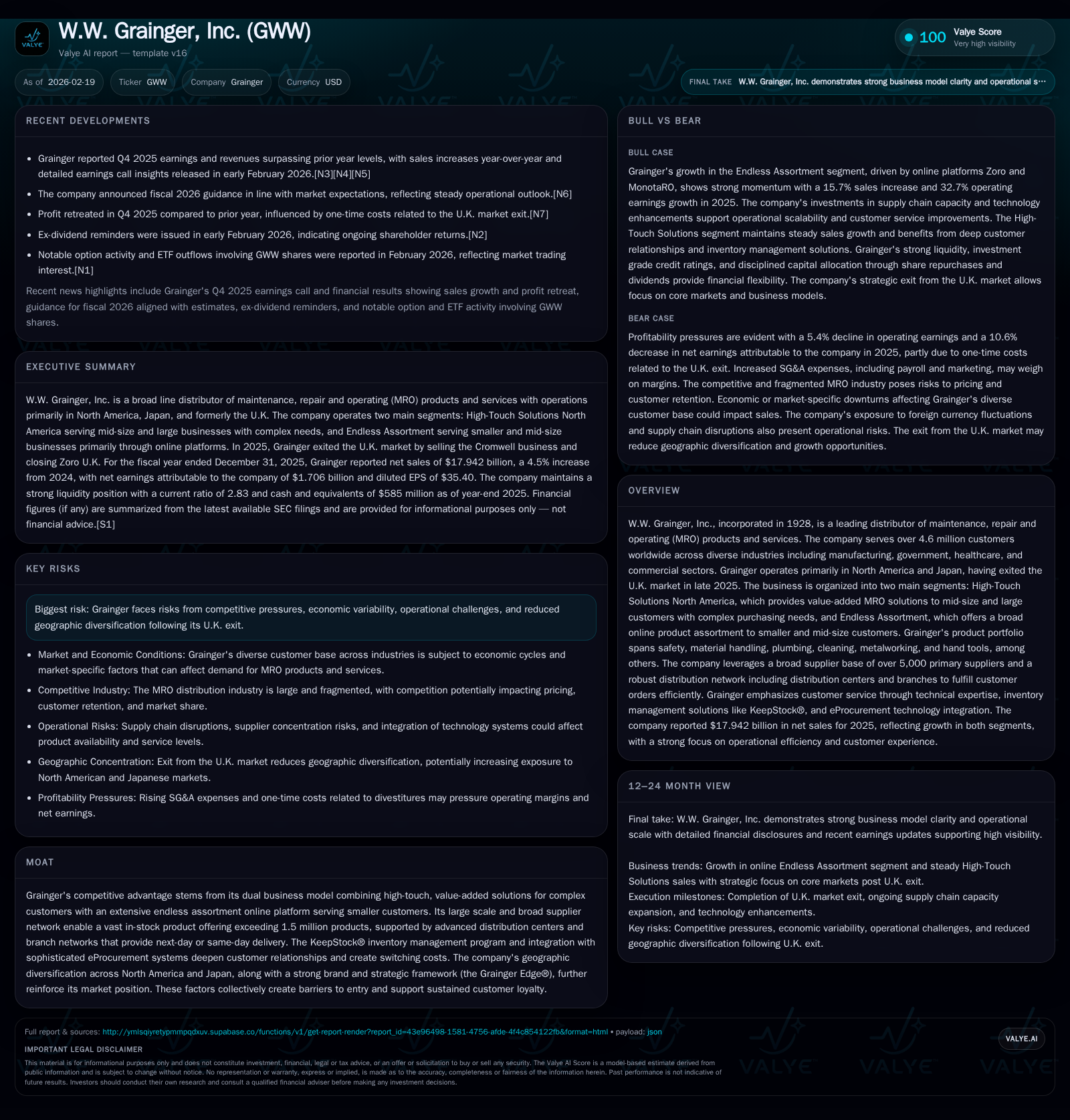
W.W. Grainger delivered modest top-line growth in 2025, underpinned by solid performance from its Endless Assortment segment and incremental gains in High-Touch Solutions North America. The company’s divestiture of its U.K. business marked a decisive portfolio reshaping, emphasizing core geographies while simplifying operations. Despite revenue expansion, operating earnings declined due to increased SG&A expenses and investments in supply chain infrastructure. Grainger continues to generate robust free cash flow, sustaining aggressive capital return programs including dividends and share repurchases. Looking ahead, growth derives largely from enduring customer relationships in complex MRO categories and digital channel expansion, but margin headwinds and the loss of geographic diversification pose risks.
Company Overview
W.W. Grainger, Inc., established nearly a century ago, is a leading distributor of maintenance, repair, and operating (MRO) products globally. It serves over 4.6 million customers across diverse industries such as manufacturing, government, healthcare, and commercial sectors primarily through two key business models: High-Touch Solutions North America (HTSNA) catering to mid-size and large customers with complex procurement needs; and Endless Assortment platforms including Zoro Tools (U.S.) and MonotaRO (Japan), focused on smaller businesses seeking broad online access to millions of products [S4][S5][S10].
The company exited the U.K. market entirely in late 2025 by divesting Cromwell and closing Zoro U.K., signaling a strategic retreat from less core markets to sharpen focus on its primary geographies — North America and Japan [N1][S10].
Historical Performance
Grainger’s revenue grew steadily over recent years culminating in $17.9 billion for FY2025, up approximately 4.5% from $17.2 billion a year prior [F1][S1]. This topline gain was fueled by both consumer segments despite the bumpy transition out of the U.K.
Historical performance (annual)
| FY | Net ($mm) | CFO ($bn) | OpInc ($bn) | Capex ($mm) | Net YoY |
|---|---|---|---|---|---|
| 2025 | 1706 | 2.0 | 2.5 | 684 | -10.6% |
| 2024 | 1909 | 2.1 | 2.6 | 541 | +4.4% |
| 2023 | 1829 | 2.0 | 2.6 | 445 | +18.2% |
| 2022 | 1547 | 1.3 | 2.2 | 256 |
Note: Omitted columns lack sufficient annual XBRL coverage in the provided tags (need ≥2 annual points): Rev, Div. Source: SEC companyfacts cache [F1].
Capital returns and efficiency (annual)
| FY | Buybacks ($mm) | FCF ($mm) | ROE% |
|---|---|---|---|
| 2025 | 1045 | 1331 | 45.7 |
| 2024 | 1201 | 1570 | 56.8 |
| 2023 | 850 | 1586 | 58.7 |
| 2022 | 603 | 1077 | 63.4 |
Source: SEC companyfacts cache [F1].
Operating income has contracted recently amid elevated SG&A (Selling General & Administrative Expenses), rising almost $400 million or about +10% in FY25 versus FY24 [F1][S1].
While gross profit increased moderately (+4%, reaching about $7 billion), margins softened slightly (-30bps). Higher SG&A reflected wage inflation, marketing spend growth, technology investments (primarily supply chain digitization), as well as costs associated with its strategic exit from the UK market [F1][S1][S21].
Diluted EPS was down about -9%, though adjusted figures showed modest earnings resilience for continuing operations when excluding one-time charges tied to Cromwell divestiture [S1][N13].
Segment Performance Breakdown
High-Touch Solutions North America
This segment remains Grainger’s backbone with $14 billion revenues (78% of total). It serves complex clients via integrated solutions combining product availability with value-added services like inventory management through KeepStock® alongside eProcurement integrations supporting streamlined purchases.
- Sales increased approximately +2% driven primarily by volume improvements rather than pricing power.
- Gross margins decreased marginally (-10bps) due to cost inflation.
- Operating income dipped slightly (-1%) impacted by rising payroll/benefits and marketing expenses [S19][S21].
Endless Assortment
Encompassing Zoro Tools (U.S.) and MonotaRO (Japan), this digital-first segment represented approximately $3.6 billion in sales (+16% YoY) with healthy contribution margins near ~30%.
- Rapid revenue growth supported by repeat buying patterns.
- Expanding enterprise customer base especially at MonotaRO.
- Operating profit jumped ~33%, benefiting from scalable platform economics despite increased SG&A spending driven by technology upgrades [S19].
Both segments leverage Grainger’s vast supplier network exceeding more than 5,000 suppliers providing an unparalleled product offering exceeding roughly 1.5 million stocked items along with countless third-party product extensions principally served through advanced distribution centers enabling same or next-day deliveries [S6][S9][S22].
Geographic & Strategic Developments
A key strategic shift occurred with Grainger completing its divestiture of Cromwell (U.K.) in December 2025 along with shuttering Zoro U.K., thus exiting the European market after several years attempting digital penetration there [N1][N12][S10]. This materially reduced geographic diversification but allowed reallocation of capital toward higher-return geographies where Grainger's competitive advantages — notably scale, robust distribution networks, proprietary inventory management tools — are strongest.
North America accounted for roughly $14.4 billion of revenue in FY25 while Japan contributed ~$2.2 billion marking rapid regional growth accompanied by localized supply chain investments including new DC expansion funded partially through low-cost Japanese yen-denominated term loans settled over coming decade [F1][S18][S8][S14].
Operational Investments & Capital Allocation
Capex more than doubled relative to early decade levels — stepping up significantly to $684 million in FY25 from $256 million just three years prior — reflecting intensive investments in supply chain automation, warehousing capacity augmentation across both North America and Japan, as well as digital commerce technology upgrades supporting enhanced customer experience across both business models [F1][S16][S26].
Cash flow from operations remained robust at just over $2 billion despite temporary headwinds from working capital inflation including inventory cost pressures reflecting broader macroeconomic trends impacting raw materials and logistics costs.
Grainger’s capital return policy stayed aggressive:
- Over $460 million returned via dividends.
- More than $1 billion deployed for share repurchases maintaining quarterly buyback cadence.
- Guidance for buybacks in the range of $950-$1,050 million for fiscal year ending Dec ’26 keeps shareholder yield a key focus area [F1][N12][S16][S25].
The company maintains a strong investment-grade credit profile with total debt-to-capital ratio improving post-repayment of lower-yielding notes maturing early in the year [F1][S15].
Competitive Moat & Industry Context
Grainger's competitive advantage lies fundamentally in its dual approach combining a high-service touch model for large complex accounts supported by sophisticated inventories integrated into eProcurement systems alongside an online endless assortment platform geared toward smaller companies desiring immediate eCommerce convenience. Additionally:
- KeepStock® inventory management programs provide non-trivial switching costs.
- Deep supplier relationships plus proprietary data analytics further lock-in customers.
- Comprehensive fulfillment capabilities ensure next-day or same-day delivery reliability unmatched by many competitors.
- Synergies between segments allow cross-selling opportunities—the company’s scale creates economies that prevent effective commoditization into pure price competition arenas. Industry analysis indicates broad MRO distribution remains highly fragmented; scale players such as Grainger enjoy persistent advantages owing to breadth/depth of stocked products combined with technical expertise delivered both digitally and onsite at customer locations .[F1]
Risks & Challenges Ahead
- Exit from UK trims geographic diversification leaving Grainger more reliant on cyclical North American/Asian markets.
- Rising input costs coupled with wage inflation pressure gross margin limits.
- Sustained elevated SG&A could compress operating leverage absent stronger volume gains.
- Competitive pressure from pure-play eCommerce MRO platforms may intensify requiring further investments.
- Macro factor uncertainties including economic slowdowns affecting capital expenditure trends within manufacturing/government sectors could impact demand for MRO supplies.
What To Watch Next
Absent explicit newly issued guidance beyond general expectations aligning FY26 revenues with current analyst consensus,the following will be critical markers:
- Organic constant currency net sales trajectory within each segment particularly HTSNA given scale footprint exposure vs Endless Assortment.
- Margin trends amid ongoing operational cost inflation alongside any efficiency gains stemming from recent capex deployments.
- Progress integrating technology advancements enhancing customer procurement experience.
- Success stabilizing or expanding enterprise customer base at MonotaRO platform beyond Japan.
- Impacts on earnings from the completed UK divestiture including realized cost savings offsets vs lost revenue base. Monitoring quarterly updates around these dimensions will better reveal whether expected balanced growth while protecting profitability can be sustained moving forward.
Conclusion
W.W Grainger has decisively reoriented itself towards core markets emphasizing scalable digital commerce alongside traditional high-touch client servicing—all supported by industry-leading supply chain management capabilities that bolster customer retention via higher switching costs.The company demonstrated underlying resilience posting consistent top-line gains despite margin setbacks due largely to reinvestment actions aligned with long-term competitiveness.However,the recent geographic consolidation paired with pressure on profitability metrics highlight tradeoffs inherent transforming legacy distribution operations toward integrated platform-enabled solutions.Investors should attentively track how these conflicting forces interplay as new growth milestones unfold during fiscal year ‘26’.
This memorandum is prepared solely for informational purposes based on public filings and news reports without providing investment advice or recommendations.
Disclaimer: This is research-only, informational analysis and not investment advice. It may include AI-generated interpretation and general industry context. Always verify important details using primary sources.

Comments