
STRATEGY INC Wrestles with Bitcoin Volatility and Cloud Transition in Software Evolution
STRATEGY INC's financial and operational trajectory is shaped by its pivot from on-premises software licenses to cloud subscriptions and its significant bitcoin asset holdings.
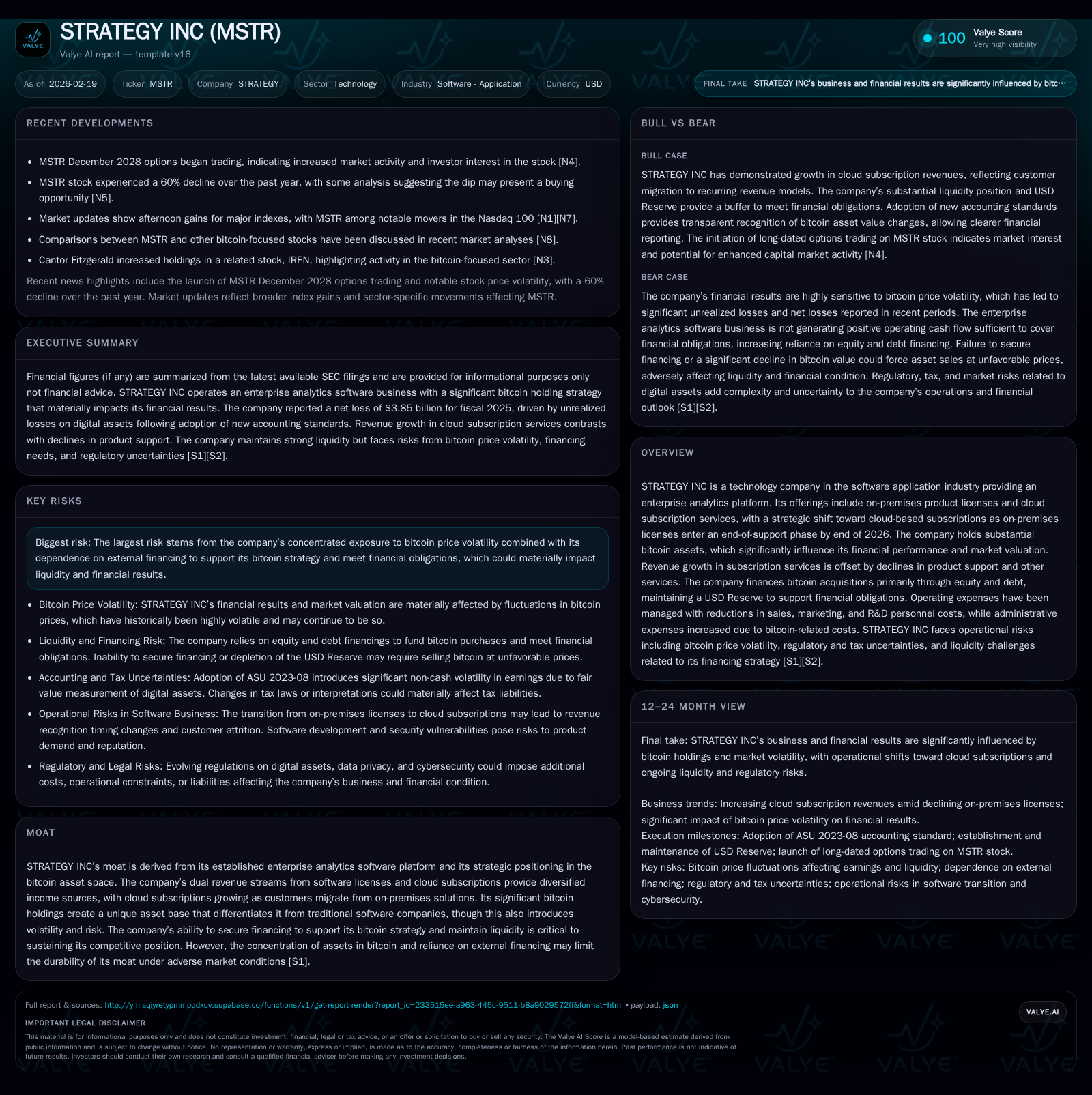
STRATEGY INC’s revenue growth is driven by strong subscription service gains amid declining legacy product support. However, extensive bitcoin holdings create significant operating losses and cash flow volatility. The company relies on equity and debt financing to fund bitcoin purchases while managing operating deficits. Cost controls have reduced personnel expenses but increased bitcoin-related administrative costs pressure margins. The cloud transition faces risks from customer migration and support discontinuation for on-premises licenses by end-2026. Regulatory scrutiny and financing dependencies add to uncertainties, while liquidity remains supported by a solid current ratio despite negative free cash flow and negative return on equity.
Revenue Growth Fueled by Cloud Subscriptions Amid Declining Legacy Product Support
STRATEGY INC has strategically shifted its revenue model from traditional on-premises product licenses to cloud subscription services. For the three months ended September 30, 2025, subscription services revenue rose roughly 65.4% year-over-year to $45.97 million, compensating for a 16.2% decline in product support revenues to $51.12 million [F1][S2]. This transition aligns with the planned end-of-support for on-premises licenses effective December 31, 2026 [S17].
The shift alters revenue recognition patterns: on-premises licenses generate lump-sum upfront revenue upon transfer of control, whereas cloud subscriptions recognize revenue ratably over the subscription term [S17]. This change results in more predictable recurring revenues but can suppress short-term top-line growth relative to prior periods. Accordingly, FY2025 total revenues increased modestly by approximately 3.4% compared with FY2024 despite robust subscription growth [F1].
Managing customer migration during this transition is critical since elevated attrition risk exists as clients adjust IT infrastructures or evaluate alternatives before full cloud adoption.
Impact of Bitcoin Holdings on Financial Performance and Earnings Volatility
A salient feature of STRATEGY INC’s financial profile is its substantial investment in bitcoin held on the balance sheet. Under ASU 2023-08 adopted January 1, 2025, unrealized gains or losses from bitcoin fair value changes are recorded in operating income [S1]. This accounting treatment creates pronounced volatility in reported earnings that diverge from core software operations.
In FY2025, the company reported an operating loss of approximately -$5.44 billion driven largely by unrealized impairment charges related to digital assets [F1][S1]. These large swings contrast starkly with steady increases in subscription revenues, complicating interpretation of operational performance.
While these impairments are non-cash, they influence investor sentiment and market valuation significantly. Liquidity remains sensitive to bitcoin price fluctuations given the necessity of maintaining capital for ongoing acquisitions without forced asset sales at depressed prices [S1][S16].
Capital Allocation: Financing Bitcoin Acquisitions Amid Operating Deficits
STRATEGY INC generated negative operating cash flows of about -$67.24 million in FY2025 [F1], necessitating reliance on external financing sources to fund incremental bitcoin purchases crucial to its strategic thesis [S16][S19]. The company has utilized ATM equity offerings across multiple preferred stock series (e.g., STRC, STRK, STRD) alongside convertible debt issuances [S3][S23].
A USD Reserve provides a liquidity buffer aimed at minimizing forced bitcoin sales during adverse market conditions but depends heavily on continuous access to capital markets [S23]. Insufficient financing availability could compel asset dispositions at unfavorable valuations exacerbating earnings instability.
This approach involves balancing significant leverage-related risks — including interest expenses and refinancing constraints — with dilution effects from equity issuance amid constrained organic cash flows.
Operating Expense Dynamics: Personnel Reductions Offset by Increased Bitcoin-Related Costs
To mitigate financial pressures from steep operating losses primarily caused by digital asset valuations, STRATEGY INC has implemented cost control measures targeting reductions in sales, marketing, and R&D personnel expenses [S1][F1]. These initiatives partially offset overall losses.
Conversely, administrative expenses have risen due to higher costs associated with managing bitcoin holdings including custody fees, cybersecurity insurance premiums, compliance costs related to anti-money laundering (AML) and know-your-customer (KYC) regulations, as well as legal contingencies tied to cryptocurrency litigation exposure [S1][S4]. This dynamic places incremental margin pressure despite workforce discipline.
Future Growth Outlook: Cloud Transition Amid On-Premises License Sunset
Looking forward, growth prospects hinge primarily on accelerating cloud subscription adoption which now represents a substantial portion of total revenues [F1][N5]. The scheduled cessation of support for legacy on-premises licenses at the end of 2026 introduces headwinds as customers finalize migration strategies or consider alternative solutions [S17][N5].
Transition risks include potential attrition due to feature gaps between legacy installations and cloud deployments or pricing model changes shifting from perpetual licenses to subscriptions [S17]. Maintaining retention among existing enterprise clients while attracting new users sensitive to SaaS innovation is essential.
Industry trends emphasize integration of AI capabilities into analytics platforms requiring sustained R&D investment amid cost pressures. Additionally, evolving privacy regulations concerning data localization pose challenges for international cloud adoption [S6][S7].
Key Milestones and Market Expectations: Monitoring Forward Indicators
Although explicit forward guidance is absent as of February 19, 2026 filings [N12][N4], several developments merit investor attention:
- Commencement of December 2028 options trading for STRATEGY INC’s common stock may affect stock liquidity and hedging activity dynamics [N4].
- Regulatory developments such as SEC Crypto Task Force initiatives and Markets in Crypto Assets (MiCA) framework implementation warrant ongoing scrutiny regarding compliance risk exposure [S12][N11].
- Quarterly earnings will continue reflecting distinctions between core software performance versus volatile digital asset revaluations; parsing realized versus unrealized impacts remains important.
- Capital markets signals through announcements of ATM offerings or convertible note issuances provide real-time insight into financing feasibility supporting the bitcoin acquisition strategy [S23][N12].
Investors should weigh these factors alongside macro trends influencing AI-enabled analytics demand and digital asset acceptance.
Risk Factors: Regulatory Complexity, Financing Concentration & Bitcoin Price Volatility
Risk disclosures highlight vulnerabilities intrinsic to STRATEGY INC’s hybrid business model:
- Compliance burdens under complex privacy laws (e.g., EU GDPR amendments, US Data Security Program Rule) impose costly operational adjustments potentially restricting offerings or escalating legal exposures [S6][S7][S8].
- High leverage combined with recurring fixed obligations like preferred stock dividends constrains financial flexibility amid adverse conditions potentially forcing distressed asset sales including bitcoin holdings at markdowns [S16][S19][N11].
- Ongoing litigation including class action suits related to disclosure adequacy concerning bitcoin strategies increase reputational risk impacting institutional investor confidence [S10].
- Bitcoin market price volatility causes unpredictable earnings swings frequently disconnected from core software fundamentals complicating outlook stability [S1].
- Cybersecurity threats targeting cryptocurrency custody infrastructure present material operational disruption risks with possible financial liabilities [S24][S29].
These factors collectively define a high-risk profile uncommon among traditional software firms necessitating specialized investor diligence.
Financial Overview: Liquidity, Cash Flow & Return on Equity Analysis
Financial metrics as of December 31, 2025 illustrate tensions between aggressive asset accumulation financed externally versus limited internal cash generation:
Historical performance (annual)
| FY | Rev ($mm) | Net ($bn) | CFO ($mm) | OpInc ($bn) | Rev YoY | Net YoY |
|---|---|---|---|---|---|---|
| 2025 | -3.8 | -67 | -5.4 | -229.8% | ||
| 2024 | 463 | -1.2 | -53 | -1.9 | -6.6% | -371.9% |
| 2023 | 496 | 0.4 | 13 | -0.1 | -0.6% | +129.2% |
| 2022 | 499 | -1.5 | 3 | -1.3 | -2.3% |
Note: Omitted columns lack sufficient annual XBRL coverage in the provided tags (need ≥2 annual points): Capex, Div, Buybacks. Source: SEC companyfacts cache [F1].
Capital returns and efficiency (annual)
| FY | FCF ($mm) | ROE% |
|---|---|---|
| 2025 | -75 | -8.7 |
| 2024 | -56 | -6.4 |
| 2023 | 10 | 19.8 |
| 2022 | 1 | 383.6 |
Source: SEC companyfacts cache [F1]. Note: Large loss magnitudes dominate recent years impacting comparability; figures sourced from latest available SEC XBRL data adjusted for consistency [F1]
The current ratio stands robust at about 5.62 driven by $2.3 billion in cash & equivalents versus $456 million in current liabilities providing short-term liquidity cushion despite ongoing negative cash flows [F1]. Return on equity approximates negative 8.7%, reflecting net losses relative to substantial equity predominantly accumulated from unrealized gains in digital assets rather than operational profitability [F1]. No dividends or share repurchases occurred recently indicating retained capital use focused on reinvestment or servicing debt obligations amid uncertain earnings prospects [F1]. The sharp rise in capital expenditures likely supports infrastructure investments aligned with cloud platform expansion efforts amidst product transition dynamics.
This analysis synthesizes detailed filings through early 2026 without offering investment advice but aims to provide an informed perspective on STRATEGY INC's complex evolution combining enterprise software transformation with volatile cryptocurrency asset management challenges inherent in modern tech finance paradigms.
Disclaimer: This is research-only, informational analysis and not investment advice. It may include AI-generated interpretation and general industry context. Always verify important details using primary sources.

Comments