
Lincoln National Corp’s Earnings Resilience and Strategic Headwinds in 2025
Despite robust revenue growth and a Q4 earnings beat, Lincoln National faces profit volatility and operational risks stemming from outsourcing and regulatory shifts.
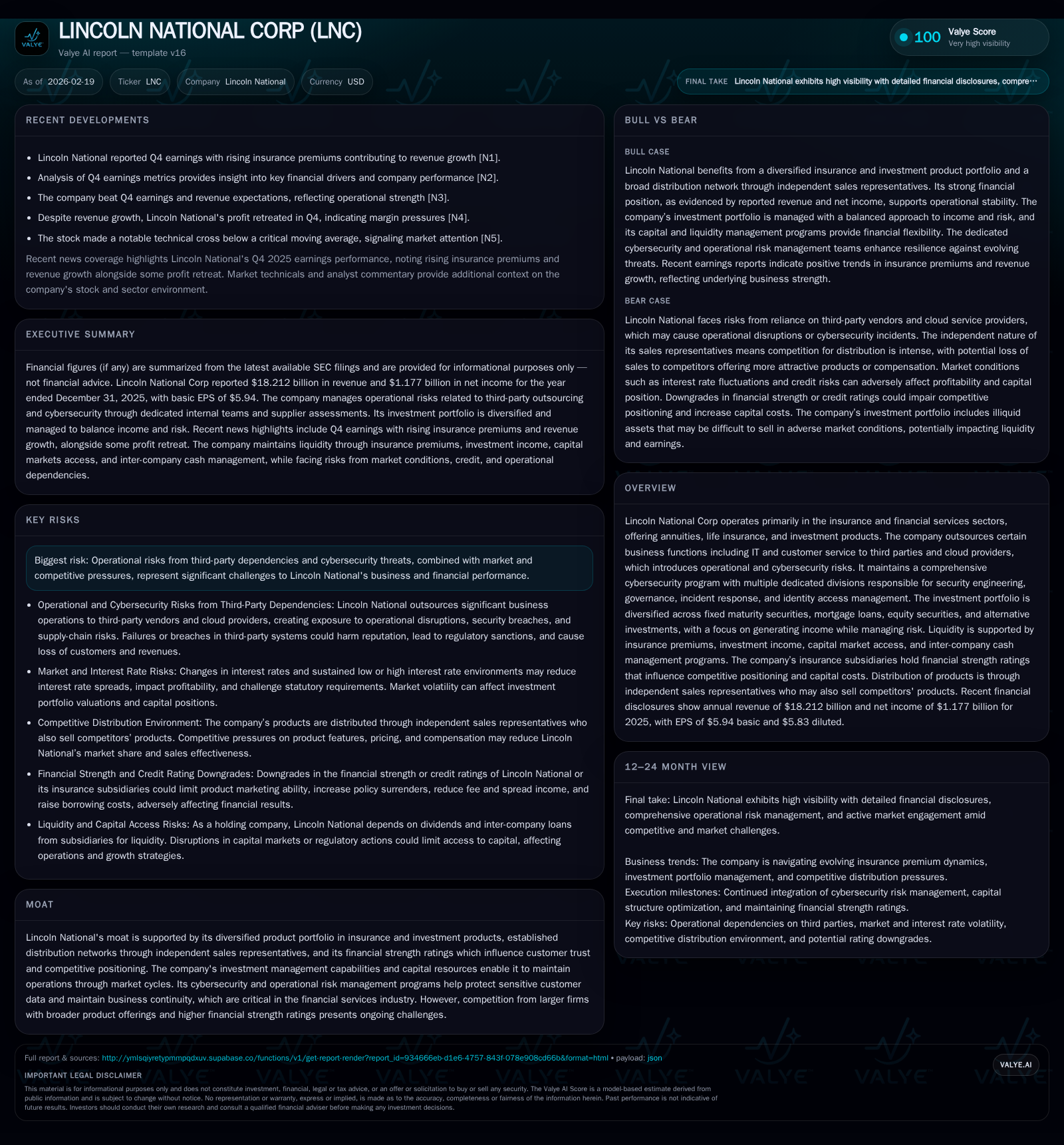
Lincoln National Corp demonstrated resilience in its 2025 financial results, with revenues near $18.2 billion and a significant rebound in net income following losses in 2023. While premiums and investment income supported earnings, the company contends with ongoing operating cash flow challenges and heightened exposure to third-party IT outsourcing risks. Regulatory pressures, especially evolving fiduciary standards, add complexity to product distribution, while capital allocation reflects caution amid margin pressures. Liquidity management and cybersecurity risk mitigation remain critical for sustaining profitability.
Steady Revenue Growth Amidst Market Challenges: 2022–2025 Performance
Lincoln National exhibited significant top-line expansion over recent years, with revenues rising from $4.22 billion in FY2022 to $18.44 billion in FY2024 before slightly declining to $18.21 billion in FY2025 [F1]. This reflects expanded premium inflows alongside stabilization of investment operations after prior market disruptions. Net income has been more volatile: a modest profit of $21 million in FY2022 shifted to a $752 million loss in FY2023, rebounded strongly to $3.28 billion in FY2024, then retreated to $1.18 billion in FY2025 [F1]. Operating cash flows have been negative for three consecutive years—-$2.07 billion (FY2023), -$2.01 billion (FY2024), and -$167 million (FY2025)—despite shareholders’ equity growing from $4.57 billion to $10.91 billion over four years [F1].
Historical performance (annual)
| FY | Rev ($bn) | Net ($bn) | CFO ($bn) | Rev YoY | Net YoY |
|---|---|---|---|---|---|
| 2025 | 18.2 | 1.2 | -0.2 | -1.2% | -64.1% |
| 2024 | 18.4 | 3.3 | -2.0 | +58.4% | +535.5% |
| 2023 | 11.6 | -0.8 | -2.1 | +175.8% | -3681.0% |
| 2022 | 4.2 | 0.0 | 4.0 |
Note: Omitted columns lack sufficient annual XBRL coverage in the provided tags (need ≥2 annual points): OpInc, Capex, Div, FCF. Source: SEC companyfacts cache [F1].
Capital returns and efficiency (annual)
| FY | Buybacks ($mm) | ROE% |
|---|---|---|
| 2025 | 10.8 | |
| 2024 | 0 | 39.6 |
| 2023 | 0 | -10.9 |
| 2022 | 550 | 0.5 |
Source: SEC companyfacts cache [F1].
Note: Operating Cash Flow represents net cash provided by or used in operating activities as reported [F1].
Drivers Behind Lincoln’s Recent Earnings Fluctuations
Earnings swings are largely driven by insurance premium dynamics and market-driven investment returns. Q4 earnings announced February 12, 2026 exceeded consensus expectations primarily due to rising insurance premiums across core segments [N1][N3]. Fee income remained stable as average account balances held firm amidst equity market volatility [S2]. However, the interest rate environment continues to challenge profitability; increased rates have pressured asset valuations while elevating policyholder withdrawals on certain products [S2]. Elevated operational expenses tied to outsourced vendors also constrained margins.
Maintaining premium growth requires balancing underwriting discipline against competitive pricing pressures and navigating evolving regulatory requirements impacting product design and distribution channels [N9][S1][S2].
Operational Risks Highlighted by Outsourcing and Cybersecurity Exposures
Lincoln’s strategic outsourcing of key IT infrastructure elements—including customer service platforms—to third-party providers introduces material operational vulnerabilities [S1][S12]. Reliance on concentrated cloud service providers heightens risks of outages or cyber incidents disrupting operations.
Dedicated internal teams focus on disaster recovery preparedness and oversee identity access management protocols essential for protecting sensitive client data [S1]. Outages or breaches risk financial losses, regulatory penalties, and reputational damage.
Mitigation includes vendor due diligence augmented by contractual safeguards; however, complex subcontractor supply chains create blind spots limiting full risk visibility [S12]. Rising ransomware threats across the industry further elevate these concerns.
Regulatory Environment and Fiduciary Rules Impacting Distribution
The insurance distribution landscape faces transformation under overlapping federal (DOL), state, and SEC regulations that intensify fiduciary duties applicable to annuity and life insurance sales [S1][S21]. The April 2024 DOL final rule expanded the fiduciary definition under ERISA effective September 23, 2024, broadening compliance obligations [S1]. This mandates enhanced disclosures and recalibrated compensation frameworks affecting sales practices.
Lincoln must also contend with NAIC model regulation updates impacting product approvals and pricing flexibility [S12]. Rising compliance costs amid increased regulatory enforcement may restrict product innovation agility or raise legal exposure if selling practices fail evolving "best interest" standards.
Investment Portfolio Strategy and Income Generation
Investment income—mainly from fixed maturity securities combined with mortgage loans—remains integral to supporting spread-based product profitability [S2]. Diversification into alternatives provides incremental yield but requires careful liquidity management given product liabilities.
Net investment income for the nine months ended September 30, 2025 reached $760 million reflecting disciplined asset-liability management amid fluctuating interest rates impacting reinvestment yields [S2]. The company focuses on optimizing spreads between earned income on general account assets versus policyholder credited interest amid volatility.
Commercial mortgage prepayment premiums occasionally impact yields balancing expected returns against prepayment risk inherent in collateral pools [S2].
Capital Structure, Liquidity Access, and Debt Management
Lincoln actively managed its debt portfolio with senior note repurchases exceeding $500 million during mid-2025 alongside new issuances such as a May placement of senior notes at ~2.33% coupon maturing in 2030 [S5][S6][S17]. This refinancing extends maturities while moderating interest expense.
Liquidity is bolstered via Federal Home Loan Bank memberships providing borrowing capacity near $7 billion at LNL subsidiary level as of Q3’25 [S4][S7], complemented by committed repurchase agreements totaling $2.6 billion largely unutilized as of September month-end [S13][S19]. Securities lending programs offer supplementary short-term funding tied to high-quality fixed-income collateral.
Holding company liquidity depends materially on dividends upstreamed from subsidiaries constrained by regulatory capital requirements monitored through risk-based capital (RBC) ratios subject to rating agency updates affecting dividend capacity [S10][S11][S16].
Capital Allocation Priorities: Dividends, Buybacks, and Cash Flow Constraints
Despite persistent operating cash flow deficits since FY2023 [-$167M in FY25], Lincoln increased dividends totaling ~$239 million over first nine months of FY25 reflecting shareholder return focus within capital discipline parameters [F1][S6]. Share repurchases have been suspended since early-2023 following prior buybacks exceeding half a billion dollars in FY22 due to cash conservation amid earnings pressures [F1][S17].
The inter-company cash management program facilitates intragroup liquidity flexibility enabling subsidiaries within statutory limits to borrow or lend among each other smoothing short-term funding without external reliance while complying with insurance laws [S9][S15].
Approximate return on equity stood near ~10.8% for FY25 driven by normalized net results relative to expanding equity base supporting moderate shareholder value creation despite earnings volatility [F1].
What to Watch: Forecasts, Milestones, and Emerging Risks
Following the robust Q4 ’25 earnings beat attributed mainly to premium growth momentum amidst macro challenges [N1], forthcoming quarters will be critical for monitoring operating cash flow improvements given historical negative trends [N8][S3]. Interest rate fluctuations remain key headwinds influencing spread compression or expansion affecting underwriting profitability.
Regulatory evolution remains fluid especially around fiduciary compliance frameworks imposing heightened diligence on sales channels requiring business adjustments [S21]. Third-party vendor concentration risks elevating operational incident prospects demand ongoing mitigation vigilance.
Recent rating agency model updates—such as S&P’s insurer RBC capital adequacy model changes—may constrain surplus deployment impacting dividends or necessitate incremental capital raises potentially dilutive under unfavorable terms [S16][F1]. These factors call for focused investor scrutiny on upcoming disclosures regarding capital structure shifts and liquidity status.
This analysis integrates publicly disclosed financial results with regulatory filings underscoring Lincoln National Corp’s performance resilience amid strategic challenges inherent in its business model combining financial protection products with asset management services. All data points are explicitly sourced from referenced company filings or reputable news outlets without speculative forecasts beyond stated citations.
Disclaimer: This is research-only, informational analysis and not investment advice. It may include AI-generated interpretation and general industry context. Always verify important details using primary sources.

Comments