
OPENLANE, Inc.: Assessing the Impact of Digital Transformation on Automotive Remarketing Profits
Examining how OPENLANE’s digital transformation investments drive revenue growth yet compress operating margins in a competitive used vehicle wholesale market.
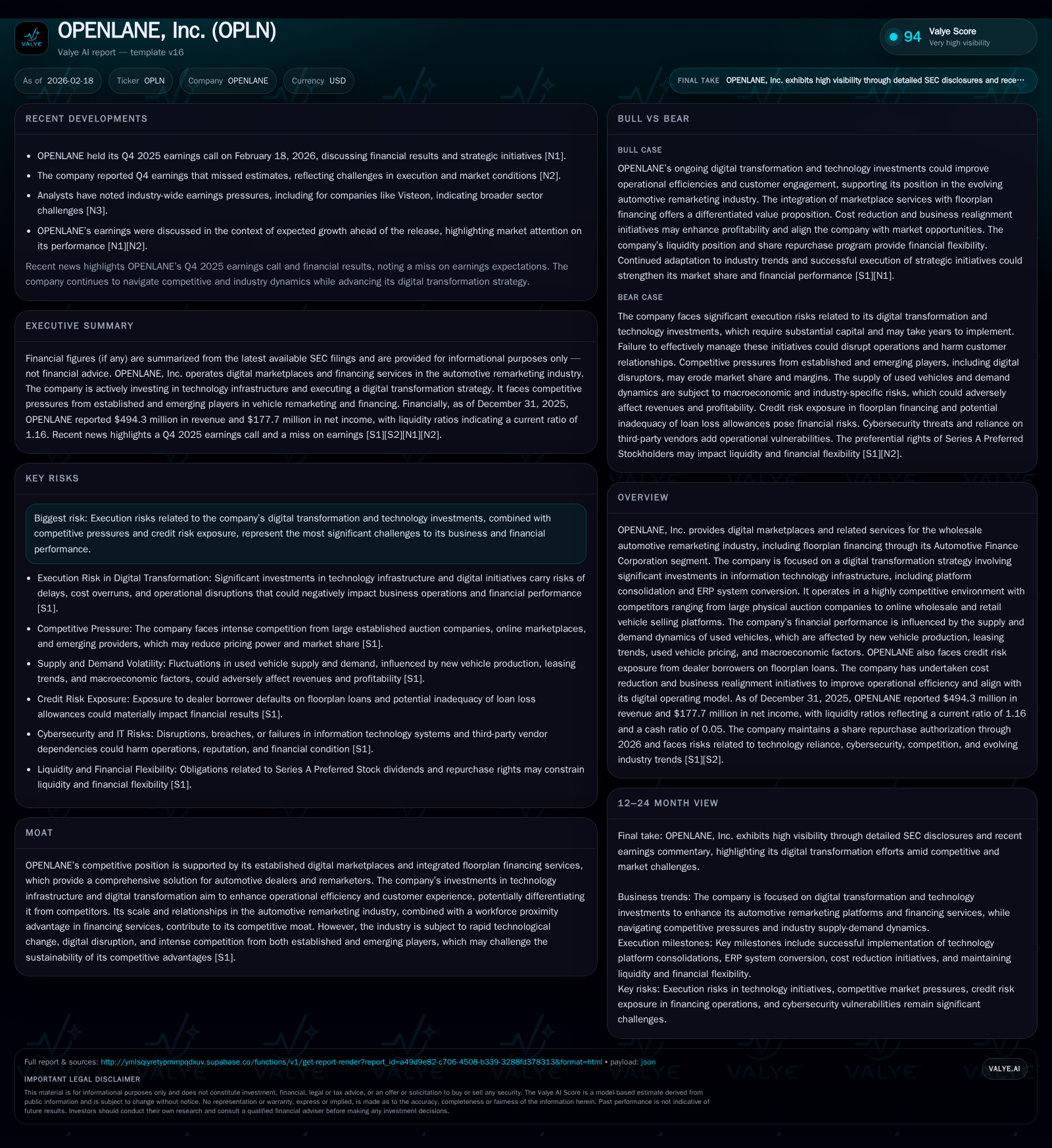
In 2025, OPENLANE delivered robust top-line growth with revenues rising 8.6% year-over-year to $494.3 million while operating income declined sharply by 46.2% to $42.5 million, reflecting significant technology-related investments. The company’s digital transformation—highlighted by platform consolidation and ERP system overhaul—is fundamental but introduces execution risks that have strained near-term profitability. Meanwhile, external pressures such as volatile used vehicle supply-demand dynamics and credit exposure from dealer floorplan financing complicate operational stability. OPENLANE’s capital allocation favored $45.6 million in share repurchases with no dividends, underpinned by strong free cash flow of approximately $694 million, indicating solid liquidity amidst strategic spending. Looking ahead, the company faces challenges from intense competition and technological disruption but aims to sustain its integrated marketplace and financing moat through ongoing technology upgrades.
Financial Trajectory: Revenue Growth Meets Earnings Pressure
OPENLANE’s recent financial performance showcases a stark contrast between accelerating revenue growth and contracting operating profitability. For fiscal year 2025, total revenues increased by a notable 8.6% year-over-year, reaching $494.3 million compared to $455 million in 2024 [F1]. This growth momentum reflects an expanded footprint in vehicle remarketing volumes as well as floorplan financing services under its Automotive Finance Corporation segment.
Yet the operating income trajectory tells a different story. Operating income dropped sharply by 46.2% from $79 million in 2024 down to just $42.5 million last year [F1]. The steep decline underscores mounting cost pressures tied primarily to intensified investments into enterprise technology platforms aimed at long-term digital enablement [S1]. Despite this, net income reversed prior volatility, soaring by 61.7% to $177.7 million after previously recording negative results in 2023—a pattern likely influenced by non-operating gains or tax adjustments rather than core profit trends [F1][N2].
This divergence signals increasing complexity within OPENLANE’s margins where topline gains are dampened by large upfront expenses related to digital upgrades alongside operational adjustments required for evolving market conditions.
Digital Transformation Efforts: Investments, Risks, and Execution Challenges
Underpinning the financial shifts are OPENLANE's significant technology initiatives centered on transforming its digital auction platform and back-office systems. Key projects include consolidating multiple tech platforms into an integrated infrastructure and executing a comprehensive ERP (Enterprise Resource Planning) system conversion spanning several years [S1].
While essential for future competitiveness—especially considering new entrants leveraging sophisticated AI-driven remarketing tools—the transition carries substantial execution risk that could disrupt workflows or customer service during migration phases [S1][N1]. Management acknowledges these risks openly, noting that failure to execute timely or cost-effectively could lead to operational downtime, loss of customers, or revenue shortfalls.
Moreover, given the rapid evolution of automotive remarketing technologies and increasing AI adoption by competitors, there is considerable pressure on OPENLANE not only to modernize legacy systems but also rapidly respond with enhancements that meet dealer expectations without excessive costs [S13]. Cybersecurity measures amid expanding AI usage add another layer of complexity given the rising sophistication of cyber-attacks targeting sensitive transaction data and proprietary algorithms [S11][S16].
External Market Forces: Used Vehicle Supply-Demand and Credit Risks
The wholesale automotive remarketing industry is intrinsically linked to the wider new vehicle production cycles and leasing trends which dictate used vehicle availability and pricing dynamics. OPENLANE’s business model depends substantially on these supply-demand factors that influence transaction volumes across its marketplaces [S1].
During periods of new vehicle production slowdowns or changes in lease return rates, used vehicle inventories tighten or expand erratically impacting dealer sourcing needs—directly affecting volumes processed via OPENLANE’s digital auction system.
Additionally, the credit risk associated with dealer floorplan financing remains a pivotal challenge. OPENLANE extends short-term financing to dealers for inventory acquisition through its AFC segment; however, economic headwinds such as rising interest rates or recessive pressures can increase loan delinquencies or defaults thereby impairing profitability [S7][S18].
Management maintains provisions against loan losses based on forward-looking assumptions but concedes that adverse macroeconomic shifts could exceed expectations leading to accelerated credit losses damaging overall returns.
Capital Allocation Overview: Share Repurchases, Dividends and Cash Flow Strength
OPENLANE's capital deployment strategy emphasizes share repurchases over dividends, aligning with management’s view of reinvestment priority amid transformational spending needs. In 2025 alone, the company expended approximately $45.6 million on repurchasing its common stock under an approved $250 million buyback authorization extended through December 2026 [F1][S6].
No dividends have been declared historically nor are they currently anticipated according to regulatory filings—a reflection of ongoing capital demands for IT infrastructure upgrade projects rather than shareholder income distribution focus [S5][S14].
Liquidity metrics underpin this approach with operating cash flow robustly growing nearly 27% year-over-year (historical CFO not fully provided for recent years) while capital expenditures climbed moderately by about 4.5% totaling roughly $55.4 million in investment spending last fiscal year [F1][S12]. The resulting implied free cash flow (CFO minus capex) exceeds $690 million annually—a strong cushion supporting debt servicing obligations including a substantial $550 million incremental term loan facility raised during 2025 earmarked partly for share repurchases [F1][S4][S25].
At year-end 2025, cash equivalents stood at $141.5 million with current ratio healthy at approximately 1.16x despite sizable current liabilities totaling over $2.6 billion—but largely offset by equally large current assets near $3 billion—indicating sound short-term liquidity management [F1].
Future Outlook: Navigating Competitive Pressures and Technology Adoption
Looking forward, OPENLANE faces a delicate balancing act to harness benefits from ongoing digital transformation while managing near-term operational disruptions inherent in system upgrades.
Market commentary highlights continuing competition from entrenched physical auction players as well as newer fully online wholesale/retail vehicle selling platforms disrupting traditional dealer-to-dealer transactions [N1][N4][S13]. Achieving seamless platform consolidation complemented by accelerated ERP rollout will be crucial milestones dictating future margin recovery trajectories.
Uncertainties remain high regarding exact timing when full efficiencies will normalize post-transition given inherent complexities documented by management coupled with intensifying technological innovation cycles necessitating continual reinvestment.
A successful completion should strengthen OPENLANE's integrated marketplace-financing moat that combines scale advantages with tailored dealer financing solutions enhancing customer retention versus competitive encroachment.
Key Financial Metrics Table: 2022-2025 Performance Snapshot
Historical performance (annual)
| FY | Rev ($mm) | Net ($mm) | OpInc ($mm) | Capex ($mm) | Rev YoY | Net YoY |
|---|---|---|---|---|---|---|
| 2025 | 494 | 178 | 43 | 55 | +8.6% | +61.7% |
| 2024 | 455 | 110 | 79 | 53 | +16.3% | +171.3% |
| 2023 | 391 | -154 | 57 | 52 | +5.0% | -163.9% |
| 2022 | 373 | 241 | 88 | 61 |
Note: Omitted columns lack sufficient annual XBRL coverage in the provided tags (need ≥2 annual points): CFO, Div, FCF. Source: SEC companyfacts cache [F1].
Capital returns and efficiency (annual)
| FY | Buybacks ($mm) | ROE% |
|---|---|---|
| 2025 | 46 | 14.3 |
| 2024 | 30 | 8.2 |
| 2023 | 22 | -11.6 |
| 2022 | 182 | 15.9 |
Source: SEC companyfacts cache [F1]. Note: Operating cash flow (CFO) data for recent years not available from provided tags; dividends paid were zero historically.
Risks Spotlight: Execution Challenges, Competitive Pressures, and Credit Exposure
Execution risk remains paramount given the multi-year scope of digital transformation initiatives including ERP system migration and platform consolidation that carry potential for disruption causing operational downtime or customer attrition if not managed effectively [S1].
Competition intensifies from both traditional physical auction operators and emerging online wholesale marketplaces deploying advanced AI-driven remarketing solutions which threaten market share if OPENLANE delays technology adoption or fails to innovate competitively [S13].
Credit risk associated with dealer floorplan financing is material amid macroeconomic uncertainties; rising delinquencies or defaults could impair overall profitability if economic conditions deteriorate beyond current provisioning assumptions [S7][S18].
Additionally, expanding use of AI technologies increases cybersecurity risks including data breaches or intellectual property infringements potentially leading to regulatory penalties or reputational harm beyond immediate financial effects [S11][S16].
In summary, while positioned for long-term value creation through integrated marketplace-financing capabilities enhanced by technology investment, OPENLANE must carefully navigate near-term execution risks and external market uncertainties.
This analysis is based solely on publicly available disclosures including SEC filings and recent earnings commentary as cited; it does not constitute investment advice or recommendations.
Disclaimer: This is research-only, informational analysis and not investment advice. It may include AI-generated interpretation and general industry context. Always verify important details using primary sources.

Comments