
Cavitation Technologies: Struggles and Strategies Behind Nano Reactor® Innovation
The company’s proprietary Nano Reactor® technology offers disruptive fluid processing potential, yet financial and execution challenges constrain growth.
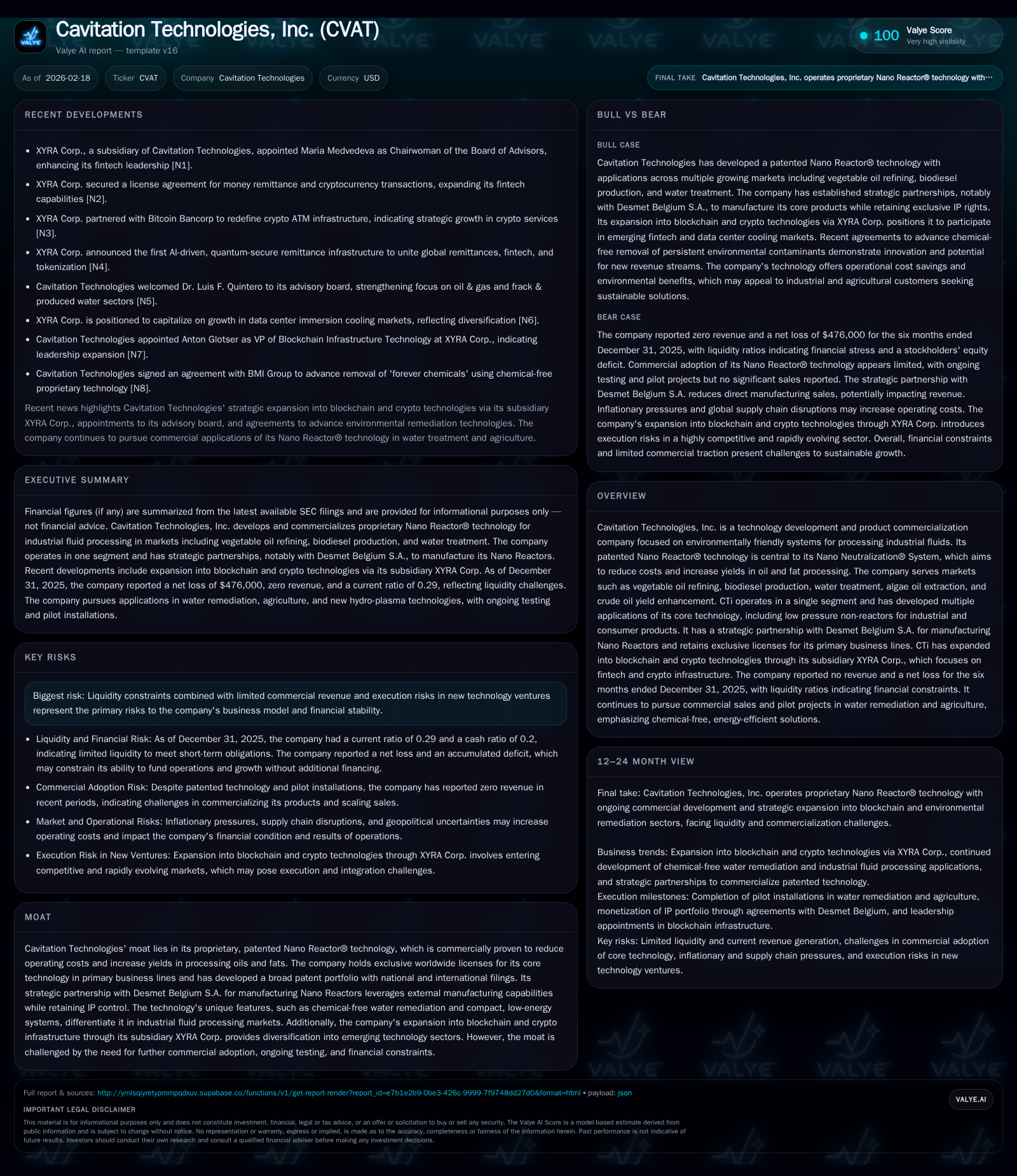
Cavitation Technologies is built around its patented Nano Reactor® platform aimed at revolutionizing industrial fluid processing with chemical-free, energy-efficient solutions for oil refining, biodiesel, and water treatment. Despite the technological moat and strategic manufacturing partnerships, the company has experienced a severe decline in revenues alongside mounting operating losses and liquidity pressures. These financial constraints challenge scaling commercialization while management pursues diversification into blockchain infrastructure through subsidiary XYRA Corp. The near-term outlook hinges on the completion of pilot tests and securing commercial contracts to validate Nano Neutralization’s market viability.
Proprietary Technology Powering Industrial Fluid Solutions
Cavitation Technologies, Inc. (CTi) centers its business on the proprietary Nano Reactor® technology—a hydrodynamic cavitational reactor designed to optimize industrial fluid processes without relying on chemicals. This patented platform harnesses controlled cavitation and fluid shear dynamics to significantly improve yield efficiencies in sectors such as vegetable oil refining, biodiesel production, algae oil extraction, crude oil enhancement, and notably chemical-free water remediation [N1][S1][F1]. The Nano Neutralization® System leverages this technology to reduce operational costs through lower energy consumption and compact system design.
Manufacturing is strategically outsourced under an exclusive arrangement with Desmet Belgium S.A., allowing CTi to maintain IP control while accelerating scale-up capabilities [S1]. The partnership injects critical manufacturing expertise into delivering the patented reactors integral for broad market application. Unique attributes such as easy integration (within 24 hours) and compact footprint allow deployment without disrupting existing operations—features highly valued within oil & gas water treatment where retrofitting challenges are common [S20].
Historical Financial Trajectory and Key Drivers Behind Revenue Volatility
CTi's financials illustrate volatile commercial progress marked by sharp revenue erosion and oscillating profitability. Revenue peaked at approximately $1.36 million in FY2024 but plunged by about 85% to roughly $203,000 in FY2025 (year ended June 30) [F1]. This precipitous decline aligns with patent licensing reassignments to Desmet that curtailed direct U.S. sales [S14]. Operating income reflected this disruption swinging from a positive $438K in FY2024 to a loss nearing $987K in FY2025—a 325% negative shift highlighting operational challenges in monetizing core technologies [F1]. Net income mirrored these patterns with significant losses eroding equity.
This trajectory traces the transition from legacy direct sales toward a licensing and usage fee revenue model tied closely to the manufacturing partner’s commercial success [S19]. The erosion also reflects increased general & administrative expenses driven by stock compensation, legal fees related to patent filings in Europe, and expanded payroll for product development talent infiltration [S14][S15].
Historical performance (annual)
| FY | Rev ($) | Net ($mm) | CFO ($) | OpInc ($) | Rev YoY | Net YoY |
|---|---|---|---|---|---|---|
| 2025 | 203000 | 0 | -806000 | -987000 | -85.1% | -125.7% |
| 2024 | 1363000 | 0 | 172000 | 438000 | +121.5% | |
| 2023 | -2 | -423000 | -886000 | -229.6% | ||
| 2022 | -1 | -484000 | -299000 |
Note: Omitted columns lack sufficient annual XBRL coverage in the provided tags (need ≥2 annual points): Capex, Div, Buybacks, FCF. Source: SEC companyfacts cache [F1].
Capital returns and efficiency (annual)
| FY | ROE% |
|---|---|
| 2025 | -163.8 |
| 2024 | -91.5 |
| 2023 | 222.0 |
| 2022 | -59.7 |
Source: SEC companyfacts cache [F1].
Note: Capital expenditure data is not available for recent years from provided tags.
Liquidity Crunch and Execution Risks: Capital Structure Deep Dive
Liquidity metrics starkly underline CTi’s financial fragility entering fiscal 2026. As of December 31, 2025, cash on hand was approximately $31K against current liabilities around $153K—a current ratio of only ~0.29 points to acute short-term stress [F1][S9]. The company relies on an EIDL loan bearing approximately 3.75% interest payable over three decades which constituted principal debt underpinning operations alongside convertible notes issued for capital raises [S3][S8].
Frequent mention in filings underscores reliance on limited vendor relationships with two suppliers accounting for over 60% of accounts payable balances—heightening supply chain concentration risk that could imperil production if disrupted [S3][S26]. Management acknowledges cash will likely be sufficient only through end-2025 absent further financing initiatives [S8]. Failure to raise additional equity or debt could force operational curtailments given persistent cash burn exceeding six-figure monthly rates [S8].
Current State of Commercialization and Market Penetration Efforts
Commercial revenues currently hinge on modest sales of Nano Reactors primarily linked to usage fees and equity method investments rather than direct product sales post-license assignment [N1][S11]. The transition away from direct control over patents complicates acceleration of topline growth despite ongoing installations such as an extended water remediation trial at a major Texas firm within the Permian Basin—which remains pilot stage requiring further testing before scale-up [S20].
Although Desmet Belgium S.A.’s manufacturing partnership is crucial for broader global distribution of Nano Reactors across key target markets like vegetable oils and biodiesel refining, demonstrated scalability into sustained volume contracts remains unproven at present [N1][S1]. The company signals ambitions for first half fiscal 2026 sales increases contingent on trial completions but lacks definitive visibility into contract timing or sizes [N1]. Limited pipeline disclosure leaves commercial momentum hard to gauge beyond hopeful R&D milestones.
Blockchain Expansion via XYRA Corp.: Diversification or Distraction?
CTi’s subsidiary XYRA Corp.'s launch into blockchain infrastructure represents a strategic pivot aiming to diversify revenue streams amid core market uncertainties [N2][S1]. Appointing fintech luminary Maria Medvedeva as chairwoman signals seriousness about building institutional credibility within the nascent crypto infrastructure ecosystem.
However, this expansion introduces tension between capital demands for deep tech commercialization versus emerging blockchain ventures that might dilute resource focus—especially given constrained liquidity highlighted throughout filings [N2][S8]. The move could be read as opportunistic exploration driving potential long-term upside but raises questions about management bandwidth allocation when fundamental industrial commercialization remains challenged.
Capital Allocation, Returns, and the Quest for Financial Stability
CTi displays no record of dividend payments or share repurchases historically or recently—a pattern consistent with early-stage loss-making technology developers focused on preserving cash for R&D and operations [F1][S26]. Operating cash flows persistently negative reaching approximately -$806K in FY2025 while capital expenditures appear minimal or unreported recently—underscoring burn rather than investment-mode cash dynamics [F1]. Approximated return metrics indicate negative ROE exceeding -160%, reflecting substantial equity erosion amid recurring net losses.
Stock-based compensation forms a growing portion of operating expenses adding non-cash outflows which while dilutive preserve liquidity but elevate shareholder dilution risk over time [S14][S15]. Overall capital stewardship focuses principally on survival with hope pinned on future commercialization inflections rather than generating investor returns presently.
2026 Outlook: Business Review Highlights and Strategic Milestones to Watch
Management commentary frames calendar year 2026 as critical focusing on validation trials completion across fluid processing segments including water remediation and oil/fat yield enhancements—central milestones enabling possible revenue revival should results prove positive [N1]. Close attention should be paid to announcements around contract awards or demonstrated efficacy gains since these will materially impact top-line trajectories.
Capital expenditure plans remain restrained reflecting cautious operational expansion aligned with uncertain funding environment; progress thus hinges as much on external financing success as internal technical validation [N1][S6]. Investors should monitor trial outcomes at strategic customer sites like Hacienda Farms’ agricultural water treatment project illustrating alternative use cases beyond petrochemical-focused applications driving innovation pathways [S20].
Risks and Long-term Sustainability Amid Technology Acceptance Challenges
Key risks revolve around CTi’s limited liquidity coupled with high execution risk inherent in pioneering industrial fluid technologies heavily dependent on third-party partners like Desmet for manufacturing scale-up without direct control over patents in some lines—a dual dependency exposing vulnerabilities if strategic relations sour or orders delay [S4].
Vendor concentration imposes supply chain fragility risking operational discontinuity if major suppliers encounter issues or shift terms unfavorably [S3][S26]. Market acceptance hurdles remain high given entrenched incumbent techno-economics despite unique advantages such as chemical-free process benefits [N1][S20]. Regulatory shifts or geopolitical inflationary pressures could adversely affect cost structures in targeted industrial segments complicating pricing power sustainability alongside shifting global trade environment impacts documented extensively in filings [S25].
In summary, Cavitation Technologies carves out a technically differentiated space within industrial fluids processing markets through its patented Nano Reactor® platform providing promising efficiency gains yet simultaneously confronts stark financial headwinds casting doubt on ability to transition from pilot-stage innovation breakthrough to scaled commercial success absent material capital infusion.
Disclaimer: This analysis is based solely on publicly available information as of February 18, 2026. It is provided for informational purposes only without any recommendation regarding investment decisions.
Disclaimer: This is research-only, informational analysis and not investment advice. It may include AI-generated interpretation and general industry context. Always verify important details using primary sources.

Comments