
Graco Inc. Pivots Through Industrial Cycles with Strategic Acquisitions and Innovation
Segment diversity, targeted acquisitions, and operational discipline sustain Graco’s growth amid cyclical headwinds.
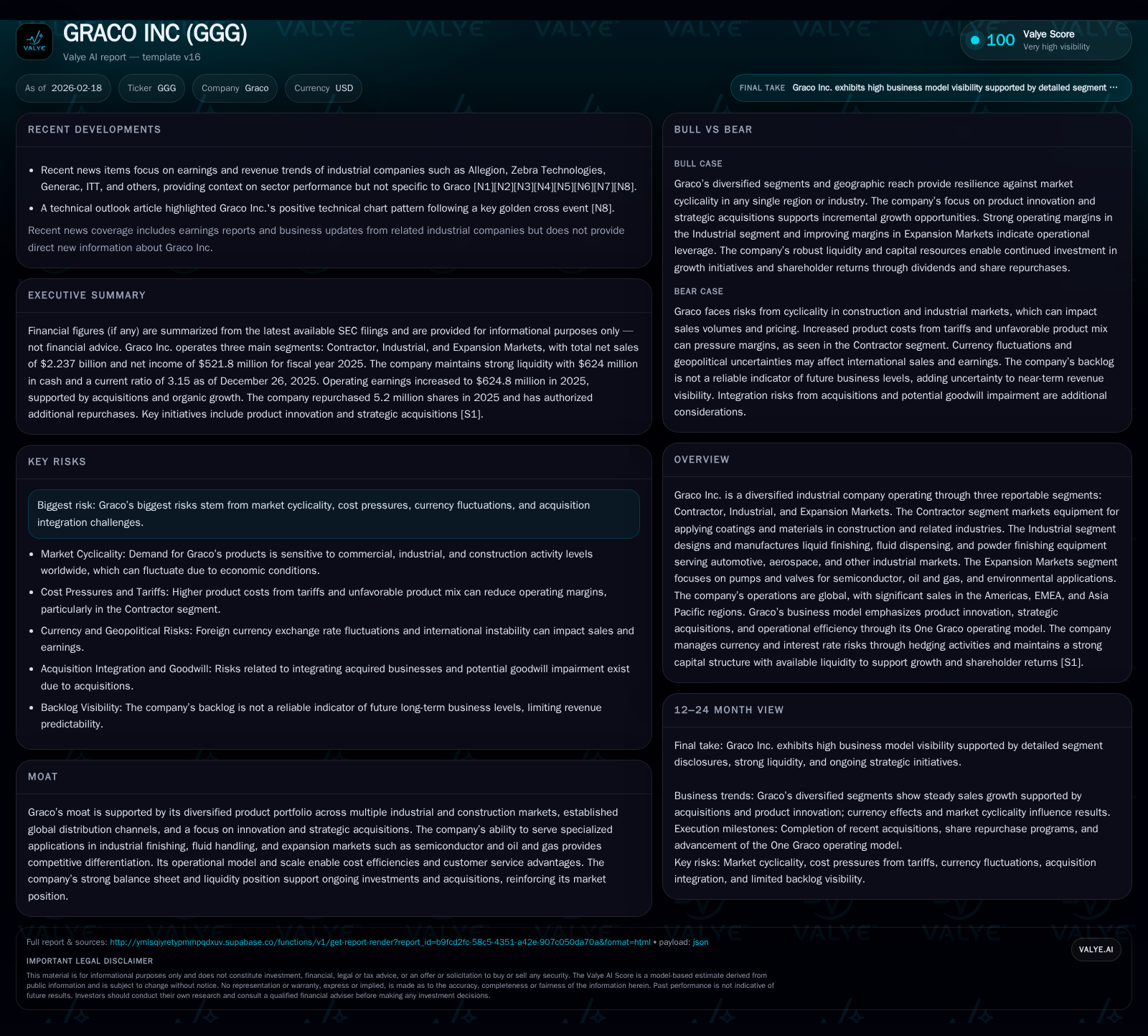
Graco Inc. delivered steady revenue and operating income growth in fiscal 2025 despite challenges from inflationary cost pressures, tariffs, and construction market softness. The company’s diversified portfolio across Contractor, Industrial, and Expansion Markets segments, combined with a consistent acquisition strategy and a unified One Graco operating model, underpins its resilience through industrial cycles. Strong cash flow generation supports aggressive capital return programs alongside strategic investments that position the company for mid-single-digit growth in 2026. Monitoring backlog trends, input cost dynamics, and acquisition integration will be crucial to understanding future operating leverage.
Evolution of Graco’s Segment Growth and Profit Drivers
In fiscal year 2025, Graco Inc.'s consolidated revenue reached $2.24 billion, marking a 5.8% increase year-over-year from $2.11 billion in 2024 [F1]. This growth was chiefly propelled by acquisitions contributing roughly $100 million in the Contractor segment alone [S1]. Notably, organic volume and price realization displayed mixed outcomes across segments due to cyclical pressures.
The Contractor segment saw net sales expand to $1.07 billion (an 8% increase over prior year), largely driven by a 10% lift attributable to acquired businesses offsetting a modest decline (-2%) in volume and price [S1]. Despite top-line progress, the operating margin for this segment contracted two percentage points to approximately 25%, pressured by elevated tariffs that increased product costs as well as integration costs diluting margins from lower-margin acquisitions [S1][S7]. It is important to underscore that residual pricing power could not fully counterbalance these headwinds or recoup the nonrecurring litigation costs observed in the prior year.
Conversely, the Industrial segment posted a more resilient performance with net sales edging up 4% to nearly $997 million. The driver included incremental sales from acquisitions (about +1%) and favorable currency translation (+1%), while organic volumes registered modest gains particularly in liquid finishing and advanced fluid dispensing equipment serving automotive and aerospace markets [S4][S7]. Operating earnings improved by approximately 7% year-over-year to $335 million, expanding margins roughly one percentage point as disciplined price realization combined with cost containment initiatives offset certain higher input costs related to tariffs [S7]. This margin expansion underscored strong expense leverage despite some product mix shifts towards lower-margin finishing systems.
The nascent Expansion Markets segment demonstrated stable but slower growth with revenues increasing just 1% to $168 million. Growth was lifted by semiconductor pump products and electric motor licensing revenues while environmental valve products declined slightly [S14]. Operating margin increased significantly by six percentage points to approximately 25%, primarily reflecting upfront license fees recognized within electric motor-related applications which are less capital intensive but carry attractive margin profiles [S14]. This niche exposure provides differentiation for Graco as it addresses complex high-pressure oil & gas valves and semiconductor fluid handling needs.
Overall, Graco managed to elevate consolidated operating profit by nearly 10% year-over-year to $625 million in 2025 despite persistent inflationary input cost pressures particularly in the Contractor range where volume softness continued globally amid subdued residential construction activity [F1][S1]. The ability of each segment’s management teams to flex price realization against elevated tariffs alongside acquisition-driven scale was critical.
Geographic Expansion and Its Influence on Sales Dynamics
Geographically, the Americas remain the single most important region representing just over half of total sales ($1.17 billion) though Europe/Middle East/Africa (EMEA) and Asia Pacific regions gained meaningful traction owing chiefly to recent acquisitions broadening reach beyond traditional North American dominance [S4][S7].
Within the Contractor segment specifically, EMEA revenues surged nearly one-quarter (24%) fueled by both acquisitions (+22%) and positive currency effects (+4%), while Asia Pacific grew equally impressively (+24%) following a similar pattern with acquisition accounting for +26% offset somewhat by slight volume erosion (-1%). In contrast, Americas Contractor sales exhibited slight contraction (-2%), partially mitigated by a robust +5% lift from acquired entities expanding regional footprint beyond legacy operations [S7]. Such geographic diversification counters overreliance risk on constricting North American construction end markets but also brings complexity around currency translation exposure which management actively hedges through forward contracts.[S23]
For the Industrial division, gains were evident across all three major regions: Americas (+2%), EMEA (+4%), Asia Pacific (~flat). This balanced geographic contribution reflects well on management's emphasis on international capital investment cycles particularly auto production trends influencing liquid finishing demand [S7]. Favorable currency translation added about one percentage point overall for Industrial sales. Likewise, Expansion Markets drew continued strength from Asia Pacific (+20%) partially offsetting declines in Americas (-6%) linked to oil & gas market volatility [S14]. Importantly, pricing dynamics between continents vary materially given competitive landscape nuances; thus 'price realization versus input inflation' scrutiny remains prudent when comparing across geographies.
Innovation, Acquisitions, and the One Graco Operating Model
Central to Graco’s enduring competitive edge is its consistent application of the One Graco operating model integrating product innovation initiative with streamlined manufacturing processes across its three reportable segments. This approach fosters shared purchasing leverage while enabling focused product development tailored per specialized market verticals—particularly notable in semiconductor pump technologies where rapid technological cycles demand nimble design-to-market speed.[S8]
Recent landmark acquisitions such as Corob S.p.A., completed late 2024 for approximately €230 million (~$250 million), expanded Graco's presence significantly in EMEA contractor spray equipment markets alongside fresh product capabilities underscoring inorganic growth potential.[S16] In totality, acquisitions contributed about $200 million of goodwill additions across Contractor and Industrial segments during recent years highlighting strategic intent to deepen penetration within niche industrial fluid handling arenas.[S28]
Operationally, integrated design/manufacturing efficiencies have improved cost structures evidenced through improving gross profit percentages despite tariff impact—manifesting as operating leverage benefits especially within Industrial division where scale-enabled expense absorption supported a rising operating margin profile.[F1][S25] Moreover, disciplined R&D spending balances advancing new product introductions with cost containment obligations—with capex notably reduced sharply (down ~57% YoY) indicating confidence in existing capacity utilization amid innovation-led product refresh cadence.[F1]
2025 Financial Milestones and What They Signal for the Future
Below is a summary of Graco’s key fiscal year financial metrics illustrating steady advancement:
Historical performance (annual)
| FY | Rev ($bn) | Net ($mm) | CFO ($mm) | OpInc ($mm) | Rev YoY | Net YoY |
|---|---|---|---|---|---|---|
| 2025 | 2.2 | 522 | 684 | 625 | +5.8% | +7.4% |
| 2024 | 2.1 | 486 | 622 | 570 | -3.7% | -4.0% |
| 2023 | 2.2 | 507 | 651 | 647 | +2.4% | +10.0% |
| 2022 | 2.1 | 461 | 377 | 573 |
Note: Omitted columns lack sufficient annual XBRL coverage in the provided tags (need ≥2 annual points): Capex, ROE%. Source: SEC companyfacts cache [F1].
Capital returns and efficiency (annual)
| FY | Div ($mm) | Buybacks ($mm) | FCF ($mm) |
|---|---|---|---|
| 2025 | 183 | 423 | 638 |
| 2024 | 172 | 31 | 515 |
| 2023 | 158 | 102 | 466 |
| 2022 | 142 | 233 | 176 |
Source: SEC companyfacts cache [F1].
Despite some volatility in capital expenditures aligned with acquisition investments falling off from recent peaks, operating cash flow maintained robust growth (+10%) reaching $684 million reflecting strong core earnings quality coupled with working capital improvements.[F1]
Management highlighted expectations for low single-digit organic sales growth at constant currency for fiscal 2026 supplemented by mid-single-digit sales growth including acquisitions.[S21] However explicit backlog figures were not robustly disclosed due to their limited forward predictive value; accordingly close attention should be paid to quarterly bookings trends or customer advance receivables disclosures moving forward.
Capital Deployment: Dividends, Share Repurchases, and Liquidity Management
Graco adopts an active capital allocation philosophy balancing shareholder returns with reinvestment appetite for scalable acquisition opportunities.[S6][S13] Fiscal 2025 saw dividends rise by approximately 7%, totaling about $183 million paid out compared to $172 million prior year; concurrently share repurchases accelerated sharply reaching $423 million — nearly fourteenfold higher than $31 million spent repurchasing shares in fiscal 2024.[F1] This buyback activity resulted in retiring roughly 5.2 million shares compared with less than half a million shares repurchased prior year.[S13]
Free cash flow (operating cash flow less capex) approximated $638 million — a sizeable cushion supporting discretionary repurchase programs alongside planned acquisitions.[F1] Available liquidity remained strong at roughly $624 million cash plus an unused committed credit line totaling $777 million offering ample flexibility for near-term M&A or opportunistic stock purchases.[S9]
The company reported an approximate return on equity around 19.7%, signaling effective capital usage combining earnings growth leverage with prudent balance sheet stewardship.[F1] Maintaining this balance between ongoing R&D/innovation funding versus distributions will remain central as technology evolution drives new product cycles.
Navigating Market Headwinds: Tariffs, Cost Pressures, and Currency Fluctuations
Persistent inflationary cost pressures impacted gross margins substantially across segments during fiscal 2025 — notably raising manufacture input costs surrounding metals and logistics expenses tied partly to tariffs imposed globally.[S16][S1] Within the Contractor business unit, the inability fully to pass through escalating expenses pressure compressed operating margin despite incremental pricing efforts — emblematic of 'price realization versus input inflation' tension intrinsic in sectors exposed heavily to construction cyclicality.
Currency translation effects were mixed but generally favorable overall (~+1 percentage point impact), particularly benefiting Industrial sales pockets in EMEA owing to euro strength against the U.S dollar.[S23] To mitigate foreign exchange risk volatility that could erode profits unpredictably, management uses hedging programs involving derivatives designated as normal purchases or sales reducing net monetary exposures.[S23]
Additional risks include channel mix shifts toward lower-margin acquired businesses diluting consolidated profitability temporarily alongside broader macroeconomic uncertainties affecting capital investment rates worldwide — both highlighted prominently as key risk factors in company disclosures.[S16][S2]
What to Monitor Next: Backlog, Bookings, and Operational Leverage
While explicit forward guidance remains subdued absent granular backlog visibility—owing partly to contract structures deeming order books poor predictors of long-term business levels—key operational data points can provide directional insight.
Market watchers should prioritize analyzing quarterly booking flows if disclosed alongside commentary regarding tariff normalization expected post-2025 which could restore some lost margin headroom. Furthermore, monitoring capital expenditure trends following the significant downward adjustment last fiscal year (~57% reduction) should yield signals about confidence levels regarding reinvestment pace fitting capacity needs versus organic growth projections.[F1]
Working capital efficiency metrics such as inventory turns—improving from prior year levels—and stable accounts receivable days (constant ~62 days) will indicate sustained discipline supporting cash flows vital for debt-free funding of acquisitions or shareholder returns.[F1][S15]
Lastly, evolution of innovation cadence especially within semiconductor-related pumps embedded in high-growth electric vehicles or advanced industrial process markets will test agility underpinning sustainable operational leverage enhancing long-run profitability beyond cyclical troughs.
This analysis is based solely on historically reported figures from Graco Inc.’s SEC filings up through fiscal year-end December 26, 2025 ([F1],[S#]) complemented by publicly available news sources ([N#]). It does not provide investment advice or recommendations.
Disclaimer: This is research-only, informational analysis and not investment advice. It may include AI-generated interpretation and general industry context. Always verify important details using primary sources.

Comments