
Clean Harbors’ Expanding Network Fuels Steady Environmental Services Growth
Clean Harbors leverages its unique asset footprint and disciplined capital approach to sustain growth amid regulatory and commodity price challenges.
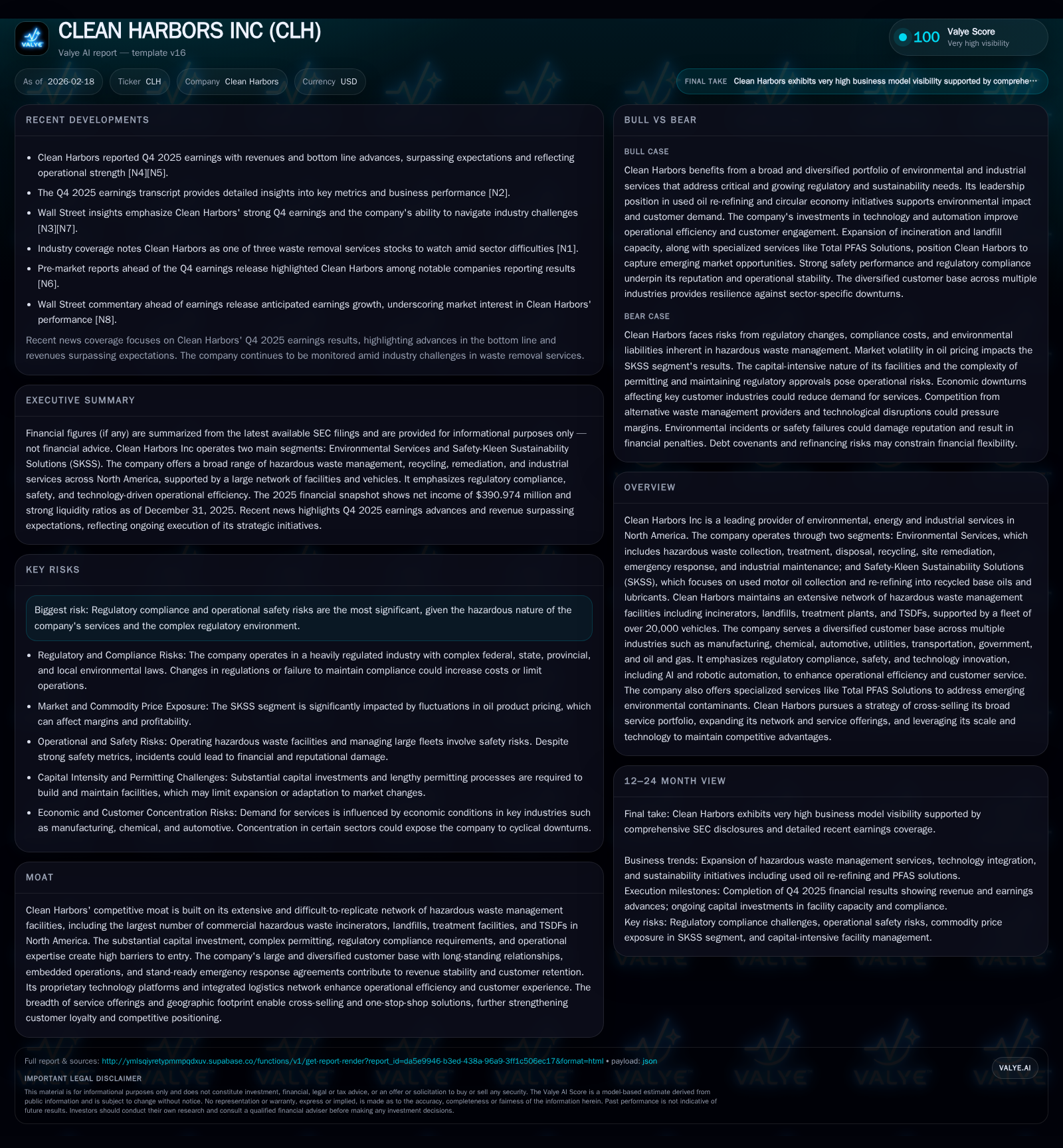
Clean Harbors Inc (CLH) is a North American leader in hazardous waste management and industrial services, supported by the largest network of hazmat disposal facilities including incinerators and landfills. From fiscal years 2022 through 2025, Clean Harbors posted steady revenue growth averaging about 8%, driven by volume increases and price management, while operating income remained largely stable despite inflationary pressures. The company’s capital allocation balances ongoing investments in facility expansion, technology, and regulatory compliance with increasingly sizable share repurchases. Future growth opportunities center on expanding PFAS solutions, broadening service lines, and leveraging technology platforms, though margin pressures from SKSS commodity exposure persist. Strong cash flow generation and a robust balance sheet underpin Clean Harbors’ ability to navigate complex regulatory demands and market volatility.
Resilient Growth: Historical Performance and Revenue Drivers
Clean Harbors has demonstrated consistent revenue expansion over the past several fiscal years, achieving approximate annual growth of 8% from FY2024 to FY2025, increasing revenues from $6.23 billion to roughly $6.73 billion [F1]. This growth was driven primarily by higher volumes of hazardous waste collection and treatment across diversified industrial customers — notably in manufacturing, chemical processing, automotive sectors, and utilities which collectively represent about 67% of revenues combined [S6]. The company’s broad service catalog coupled with embedded operations at customer sites fosters recurring revenue streams that are relatively insulated against cyclicality.
Operating income has exhibited narrow improvement (+0.5% YoY) despite inflationary pressures impacting input costs such as fuel, labor, and regulatory compliance expenses [F1],[N1]. This stability reflects effective cost management programs employing procurement synergies and logistics optimization leveraging their integrated asset base [S4]. However, net income declined slightly (-2.8% YoY), partly attributable to increased depreciation from recent capital investments alongside commodity price volatility affecting margins in the Safety-Kleen Sustainability Solutions (SKSS) segment [F1],[N3]. Nonetheless, operating cash flow strengthened to $867 million (+11.4% YoY) facilitating robust free cash flow after capex [$442 million] allocations [F1].
Historical performance (annual)
| FY | Net ($mm) | CFO ($mm) | OpInc ($mm) | Capex ($mm) | Net YoY |
|---|---|---|---|---|---|
| 2025 | 391 | 867 | 673 | 425 | -2.8% |
| 2024 | 402 | 778 | 670 | 432 | +6.5% |
| 2023 | 378 | 735 | 612 | 422 | -8.2% |
| 2022 | 412 | 626 | 635 | 345 |
Note: Omitted columns lack sufficient annual XBRL coverage in the provided tags (need ≥2 annual points): Rev, Div. Source: SEC companyfacts cache [F1].
Capital returns and efficiency (annual)
| FY | Buybacks ($mm) | FCF ($mm) | ROE% |
|---|---|---|---|
| 2025 | 250 | 442 | 14.2 |
| 2024 | 55 | 346 | 15.6 |
| 2023 | 51 | 312 | 16.8 |
| 2022 | 50 | 281 | 21.4 |
Source: SEC companyfacts cache [F1].
Note: Complete historical revenue data prior to FY2024 was inconsistent; dividends data unavailable.
Expanding Asset Network: Unique Competitive Moat Explained
Clean Harbors’ moat rests on its expansive infrastructure comprising the largest concentration of environmental disposal facilities in North America: ten commercial hazardous waste incinerators—including a recently commissioned second incinerator at the Kimball, Nebraska site launched in late-2024 expected to reach full capacity by end-2026—as well as seven landfills (six handling hazardous wastes), multiple treatment storage and disposal facilities (TSDFs), wastewater treatment plants, solvent recycling centers, complemented by a fleet exceeding 20,000 vehicles [S7],. The high capital intensity for establishing these licensed facilities combined with extensive federal and state permitting hurdles creates formidable barriers for new entrants.
Moreover, Clean Harbors sustains substantial operational know-how accumulated over decades that underpins safety protocols essential for handling toxic materials safely . The geographic breadth allows for internalized waste transportation routing efficiencies reducing costs while enhancing reliability—a critical factor given customer’s liability concerns under environmental laws which also limit vendor switching [S6],[S20]. This integrated network supports cross-selling across environmental services and SKSS segments enabling one-stop-shop offerings that deepen client relationships.
Navigating Regulatory Complexities: Compliance as Strategic Investment
Given the hazardous nature of its operations, Clean Harbors prioritizes regulatory compliance through continuous capital expenditure specifically earmarked for upgrading permits and facility capabilities in accordance with evolving federal and state regulations [S5],[S10]. An independent compliance group oversees licensing adherence with frequent internal audits augmenting external inspections [S20],[S27]. Such efforts help mitigate legal risks linked to environmental violations or contamination liabilities.
The company acknowledges the increasing capital intensity imposed by regulatory standards may deter some customers from self-managing waste disposal; consequently Clean Harbors gains competitive advantage as a preferred external vendor providing turnkey compliance solutions [S5],. This proactive posture seeks not only risk reduction but also preservation of operational continuity amidst tightening environmental legislation.
Future Growth Outlook: Industry Tailwinds and Internal Initiatives
Looking forward, Clean Harbors intends to leverage its underlying strengths to capture several growth vectors: expansion of its Total PFAS Solutions addressing emerging contaminant disposal needs; continued enhancement of technology platforms incorporating AI-driven logistics optimizations; broadening scope into additional waste streams benefiting from permit expansions or acquisitions; plus deepening penetration into response services for natural disaster remediation [N1],[N2],[S9],[S14].
That said, SKSS margin performance remains partially constrained by commodity pricing swings inherent in re-refined oil products markets which pressure re-refinery spreads despite active dynamic pricing strategies mitigating some exposure [S4],[N5]. Overall industry trends toward heightened sustainability mandates bode well for Clean Harbors given its circular economy contributions.
Analyzing Earnings and Operational Margins Trends
Despite revenue gains circa +8%, operating income edged up only marginally (+0.5%), reflecting inflationary cost pressures from labor, fuel surcharges, and increased regulatory overheads [F1],[N3]. Maintained discipline on procurement synergy programs alongside support function leverage helped contain margin erosion.
The SKSS business segment's fluctuating commodity prices contribute variability to margins but are counterbalanced by this unit’s scale enabling hedging through customer pricing adjustments [S4]. Overall operational margin resilience indicates effective orchestrated cost controls amid challenging macroeconomic backdrops.
Cash Flow Generation and Capital Allocation Priorities
Clean Harbors consistently generates strong operating cash flows—reaching $867 million in FY2025 (+11.4%)—which after capex ($425 million) results in meaningful free cash flow (~$442 million) capable of supporting both reinvestment needs and shareholder returns [F1]. Capital expenditures reflect ongoing investments in facility capacity increases (e.g., Kimball incinerator completion), permit modifications broadening facility capabilities without full-scale new builds, and technology upgrades enhancing efficiency [S9].
The company has returned cash steadily via share repurchases that accelerated substantially to $250 million in FY2025 compared with ~$52 million two years prior—indicating a focus on improving per-share metrics alongside organic growth funding [F1],[S19]. Dividend data were not explicitly available; investors should monitor for disclosure updates going forward.
ROE is estimated at around 14.2%, underscoring efficient deployment of equity capital balancing growth investment with returns generation [F1].
Balance Sheet Health: Debt Structure and Liquidity Position
Financial flexibility is well maintained through a prudent balance sheet with current assets nearly double current liabilities yielding a healthy current ratio (~2.3x), underscoring short-term liquidity strength [F1],[S8]. Clean Harbors carries a mix of secured term loans totaling approximately $1.26 billion due between 2032-2033 alongside senior unsecured notes maturing through late decade [S16],[S17],[S22]. Recent credit agreements include customary covenants limiting excessive leverage while allowing prepayments without premium after April-2026 conditions expire [S16].
This robust debt profile supports ongoing capex programs while enabling opportunistic share buybacks as operational cash flows permit.
Environmental Sustainability Efforts Integrated into Business Model
The firm's leading role in circular economy practices is exemplified by its Safety-Kleen segment collecting over 243 million gallons of used motor oil annually for re-refining into recycled base oils—thereby helping avoid approximately 2.2 million metric tons of greenhouse gases annually (,[S4]). This impact equates roughly to emissions from nearly six billion passenger vehicle miles or carbon sequestered by millions of trees grown over a decade.
Such sustainable initiatives provide both reputational benefits fueling customer loyalty as well as measurable contributions aligned with tightening global ESG frameworks influencing industrial customers’ vendor preferences.
Key Risks: Regulatory, Operational Safety, and Market Volatility
Primary risks stem from rigorous regulatory oversight demanding continual capital investment to maintain compliance amid evolving federal/state policies—failure here could result in fines or operational disruptions ,[S10],[S12]. Hazardous waste handling entails intrinsic safety risks requiring disciplined workforce training programs vividly reflected in industry-leading low total recordable incident rates (TRIR of ~0.49)—a key competitive differentiator—but safety incidents remain plausibly impactful if materialized [S27].
Additionally, commodity price volatility poses earnings uncertainty within the SKSS re-refinery business segment even though pricing strategies mitigate downside exposure somewhat [N8]. The company's experienced management is equipped to navigate these factors but investors should monitor developments closely.
This report synthesizes Clean Harbors’ publicly available filings ([F1],[S#]) and recent earnings commentary ([N#]) without offering investment advice or price guidance. It aims solely to provide detailed insight into corporate operations, financial performance trends, strategic positioning, risks, and capital deployment priorities relevant to professional readers with interest in environmental services sector dynamics.
Disclaimer: This is research-only, informational analysis and not investment advice. It may include AI-generated interpretation and general industry context. Always verify important details using primary sources.

Comments