
Otter Tail Corp’s Earnings Contraction Masks Strategic Capital Deployment
Otter Tail balances regulated utility stability with manufacturing and plastics pressures amid focused renewables investments.
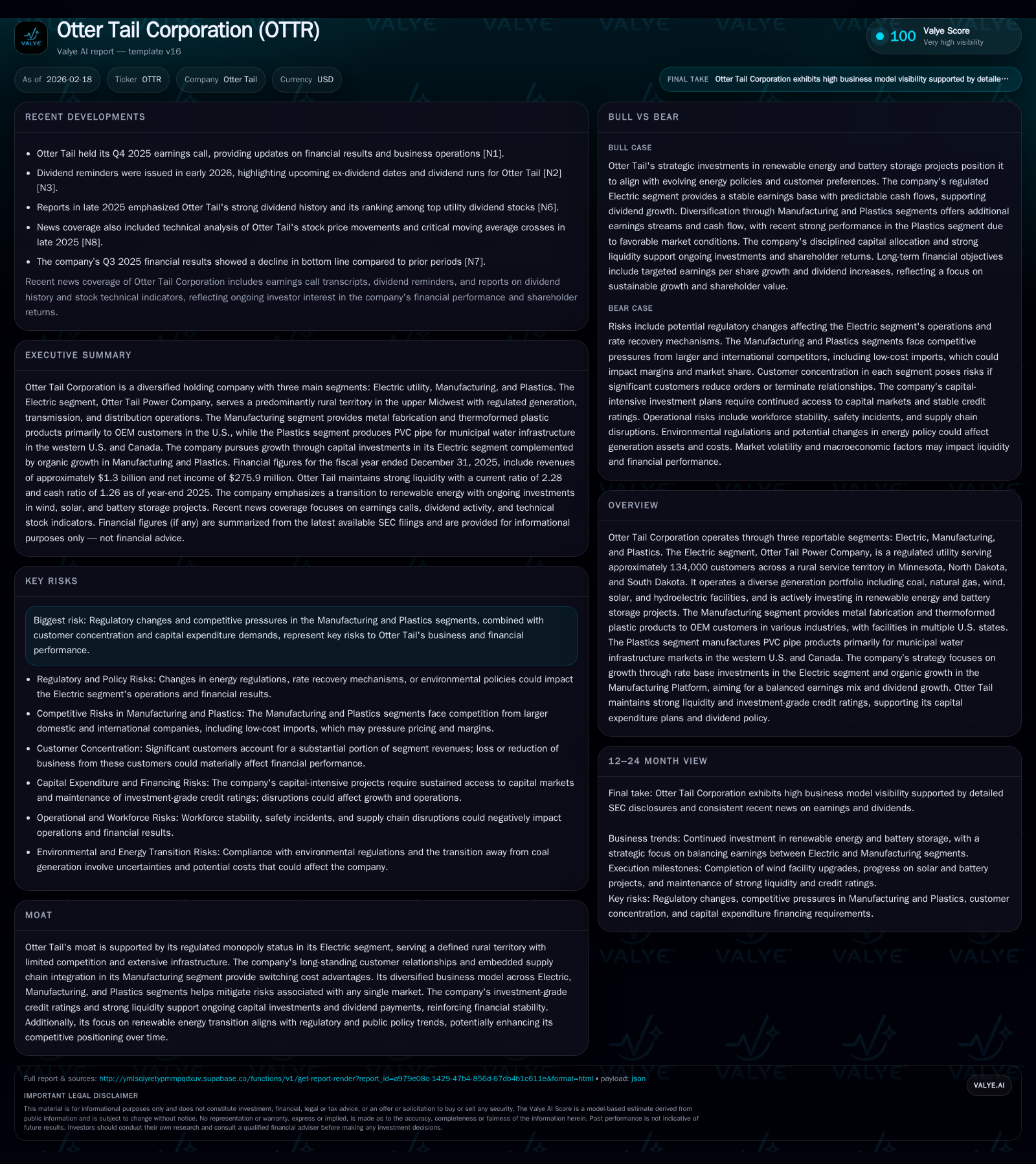
Otter Tail Corporation posted a 2025 fiscal year decline in revenue and earnings driven by pressures in its Manufacturing and Plastics segments, even as its Electric utility segment underpinned stable cash generation. The company continues disciplined capital deployment focused on renewable energy and grid investments within its regulated Electric segment, targeting a long-term compound annual EPS growth rate of 7-9%. Risks include regulatory uncertainties, tariff-driven cost inflation, customer concentration, and ongoing antitrust litigation concerning its Plastics business. Otter Tail’s investment-grade credit profiles and steady dividend policy underpin financial resilience despite operating challenges.
Historical Financial Performance and Revenue Dynamics
Otter Tail Corporation recorded revenues of approximately $1.30 billion in fiscal year (FY) 2025, marking a decline of about -2.3% compared to FY2024's $1.33 billion [F1]. Operating income exhibited a steeper contraction at -9.1%, falling from roughly $380 million in FY2024 to $346 million in FY2025, highlighting margin compression likely attributable to cost inflation as well as segment-specific pressures [F1][S2]. Net income similarly declined by -8.5% to about $276 million.
Operating cash flow was adversely affected by timing mismatches in cost recoveries typical within regulated utilities alongside reduced earnings, decreasing by approximately -14.7% year-over-year to $386 million [F1]. Meanwhile, capital expenditures decreased by nearly 20% to $288 million reflecting shifts in the timing of strategic investments rather than a truncation of growth plans.
Historical performance (annual)
| FY | Rev ($mm) | Net ($mm) | CFO ($mm) | OpInc ($mm) | Rev YoY | Net YoY |
|---|---|---|---|---|---|---|
| 2025 | 1300 | 276 | 386 | 346 | -2.3% | -8.5% |
| 2024 | 1330 | 302 | 453 | 380 | -1.7% | +2.5% |
| 2023 | 1353 | 294 | 404 | 378 | -7.9% | +3.5% |
| 2022 | 1469 | 284 | 389 | 390 |
Note: Omitted columns lack sufficient annual XBRL coverage in the provided tags (need ≥2 annual points): Capex, Buybacks. Source: SEC companyfacts cache [F1].
Capital returns and efficiency (annual)
| FY | Div ($mm) | FCF ($mm) | ROE% |
|---|---|---|---|
| 2025 | 88 | 98 | 14.8 |
| 2024 | 78 | 94 | 18.1 |
| 2023 | 73 | 117 | 20.4 |
| 2022 | 69 | 218 | 23.3 |
Source: SEC companyfacts cache [F1].
Note: Metrics omitted – Buybacks not available post-FY2020.
Overall, Otter Tail's financial results portray an entity navigating incremental earnings pressure while maintaining robust cash generation capacity anchored by its Electric segment.
Segment-Level Growth Drivers and Operational Challenges
The Electric segment—comprising Otter Tail Power Company (OTP)—remains the cornerstone business, operating as a vertically integrated, regulated utility serving approximately 134,000 customers spread across rural Minnesota, North Dakota, and South Dakota [S1][S10]. This regulated monopoly status offers a durable moat supported by well-established infrastructure with limited direct competition and benefits from rate base investment-driven revenue models.
This segment's generation portfolio is diversified across coal, natural gas, wind, solar, and hydroelectric power sources with ongoing capital deployments aimed at expanding renewable energy capacity and battery storage systems aligned with decarbonization trends . Seasonal demand variation tied to harsh winter and summer peaks adds revenue cyclicality though is partially offset by stable regulation.
The Manufacturing segment centers on metal fabrication coupled with thermoformed plastic production catering primarily to OEM customers in the Midwest and Southeastern U.S., including prominent players such as Caterpillar and Deere & Company [S15]. This segment faces operational headwinds from increased domestic steel prices due to tariffs imposed on steel imports [S2], raising input costs which the company has largely passed through but faces risk where end-customer demand or pricing power may wane.
There are also emerging competitive risks related to customer in-sourcing strategies that could diminish volumes in this segment amid broader macroeconomic tightening.
The Plastics segment produces PVC pipes primarily used for municipal water infrastructure across western U.S and Canada via plants located strategically in North Dakota and Arizona [S20]. Access to PVC resin feedstock is vulnerable due to concentration of chemical production facilities along the hurricane-prone Gulf Coast—interruptions there cause supply volatility impacting output costs.
This segment is embroiled in significant antitrust litigation alleging conspiratorial price-fixing practices alongside other market participants since as early as 2017/2020 depending on the class action [S4][S20]. Resolution outcomes bear material financial uncertainties.
Capital Investment Strategy and Regulatory Considerations
Otter Tail approaches capital allocation with a primacy focus on rate base growth investments within the Electric segment targeting modernization of generation assets towards renewables and enhancing transmission/distribution infrastructure reliability amid evolving regulatory frameworks [S25]. It maintains an active multi-year capex plan projecting substantial outlays even as it prudently moderated spending by almost one-fifth in FY2025 relative to prior year reflecting project phasing rather than strategic pullbacks.
Regulatory approval remains a critical gating factor for cost recovery associated with these investments; delayed or deferred approvals pose tangible execution risks that could weigh on earnings due to under-recovery or squeezed margins [S1]. Additionally, public policy shifts regarding environmental controls on existing fossil assets create uncertainty around compliance costs, especially for large coal-fired units like Coyote Station subject to EPA regulatory actions [S24].
Within transmission development under Midcontinent Independent System Operator (MISO) jurisdiction, Otter Tail has elected self-funding options for transmission upgrades linked to new generation interconnections—a position under regulatory scrutiny that may alter cost recovery dynamics if ruled otherwise by FERC [S6].
Future Growth Outlook and Risk Factors
The company’s forward guidance articulated during the Q4 2025 earnings call underscores a commitment to delivering compounded annual EPS growth between 7-9%, leveraging steady cash flow from its utility base complemented by organic expansion initiatives within Manufacturing Platforms [N1]. Investors should monitor regulatory decisions on key renewable energy projects' cost recovery mechanisms which can materially affect near-term margin profiles.
Tariff fluctuations remain a wildcard especially impacting raw material inputs for both manufacturing metals and plastics resins amid ongoing geopolitical trade tensions [S2]. Operational demand volatility tied to weather patterns—both acute seasonal mildness reducing electricity sales volumes and extreme events disrupting supply chains—is another source of unpredictability inherent in Otter Tail’s businesses [S1].
The outcome of pending multi-jurisdictional antitrust litigations has critical financial implications estimated beyond currently disclosed provisions given treble damages potential posed by U.S Magnuson-Moss Act claims as well as Canadian Competition Act allegations involving Northern Pipe Products and Vinyltech subsidiaries [S4][S20]. The timing and financial magnitude remain uncertain elevating risk premiums incorporated into valuation metrics.
Financial Health, Capital Allocation, and Shareholder Returns
Otter Tail’s balance sheet reflects substantial equity growth reaching approximately $1.86 billion at end-FY2025 supporting an approximate ROE of about 14.8%, denoting effective equity utilization despite revenue headwinds [F1]. The current ratio stands healthy near 2.28 indicating strong near-term liquidity coverage with ample cash ($386 million) complemented by undrawn revolving credit facilities totaling nearly $380 million enhancing financial flexibility against unexpected contingencies or investment opportunities [F1][S12][S18].
The company maintains an unwavering dividend policy evidenced by a steady increase in annual dividend payments reaching nearly $88 million paid out in FY2025 representing a sustainable payout ratio given free cash flow generation around $98 million after capital expenditures are considered [F1][N2][N3]. Notably share repurchases have been minimal or absent recently signaling prioritization of investment for regulated assets and balance sheet fortification over aggressive buybacks.
Long-term debt issuances within the OTP subsidiary—with fixed coupon rates between ~3-6% spanning maturities through mid-century—and absence of short-term borrowings underscore deliberate capital structure management aligned with regulatory expectations preserving investment grade credit ratings from Moody's (Baa2), Fitch (BBB), and S&P (BBB) all with stable outlooks ensuring continued capital access at favorable rates [S9][S11].
Antitrust Litigation and Its Potential Impact
Since mid-2024 onward multiple coordinated nationwide class action lawsuits have targeted Otter Tail’s Plastics entities alongside competitors alleging concerted efforts to fix prices of various PVC pipe products violating U.S federal/state antitrust statutes plus Canadian Competition laws through confidential data exchanges facilitated by Oil Price Information Service (OPIS) [S4][S6]. Similar allegations extend into Canada complicating legal exposure across jurisdictions.
The DOJ investigation adding grand jury subpoena weight further escalates regulatory scrutiny bearing material downside risks including treble damage liabilities potentially amounting to tens of millions or more if adverse judgments prevail while settlements remain unresolved at this stage.
While Otter Tail contests these allegations vigorously citing factual/legal defenses it acknowledges significant uncertainties surrounding timing/resolution magnitude requiring disclosures cautioning investors accordingly within MD&A sections underscoring elevated risk embedded in valuation consensus reflecting litigation-related contingencies [S13][S20].
Key Milestones to Monitor in 2026
Key upcoming catalysts for observers will include final adjudication or settlement activity timelines relating to antitrust proceedings impacting the Plastics segment profitability outlooks; critical regulatory determinations affecting recoverability of recent renewable energy investments under state utility commissions shaping margin profile trajectories; quarterly operational results revealing margin resilience or further pressure across segments; updates on tariff developments influencing raw material input costs; and any material shifts in customer demand influenced by macroeconomic or climatic fluctuations given underlying rural agricultural exposure inherent in the Electric service territory customer base exposing seasonality risks requiring continuous operational agility [N1][N3][S25].
Synthesis:
Otter Tail demonstrates a careful balancing act managing its historically grounded Electric utility operation that benefits from stable rate base investments while concurrently addressing manufacturing supply chain challenges exacerbated by tariffs and pursuing longer term transition through renewables capex amidst regulatory circumspection. Meanwhile, its Plastics arm faces considerable external legal overhang warranting monitoring given inherent complexities crossing U.S.-Canada jurisdictions impinging cash flows. Despite pressured top-line metrics evident across consolidated results, prudent capital management preserving liquidity combined with sustained shareholder dividends express disciplined stewardship maintaining resilience against evolving industry headwinds.
Disclaimer: This is research-only, informational analysis and not investment advice. It may include AI-generated interpretation and general industry context. Always verify important details using primary sources.

Comments