
Global Innovative Platforms' Early-Stage Breath Analysis Faces Financing and Commercialization Challenges
GIPL pursues animal health diagnostics with proprietary gas chromatography and AI but struggles with capital, operating losses, and unproven revenue.
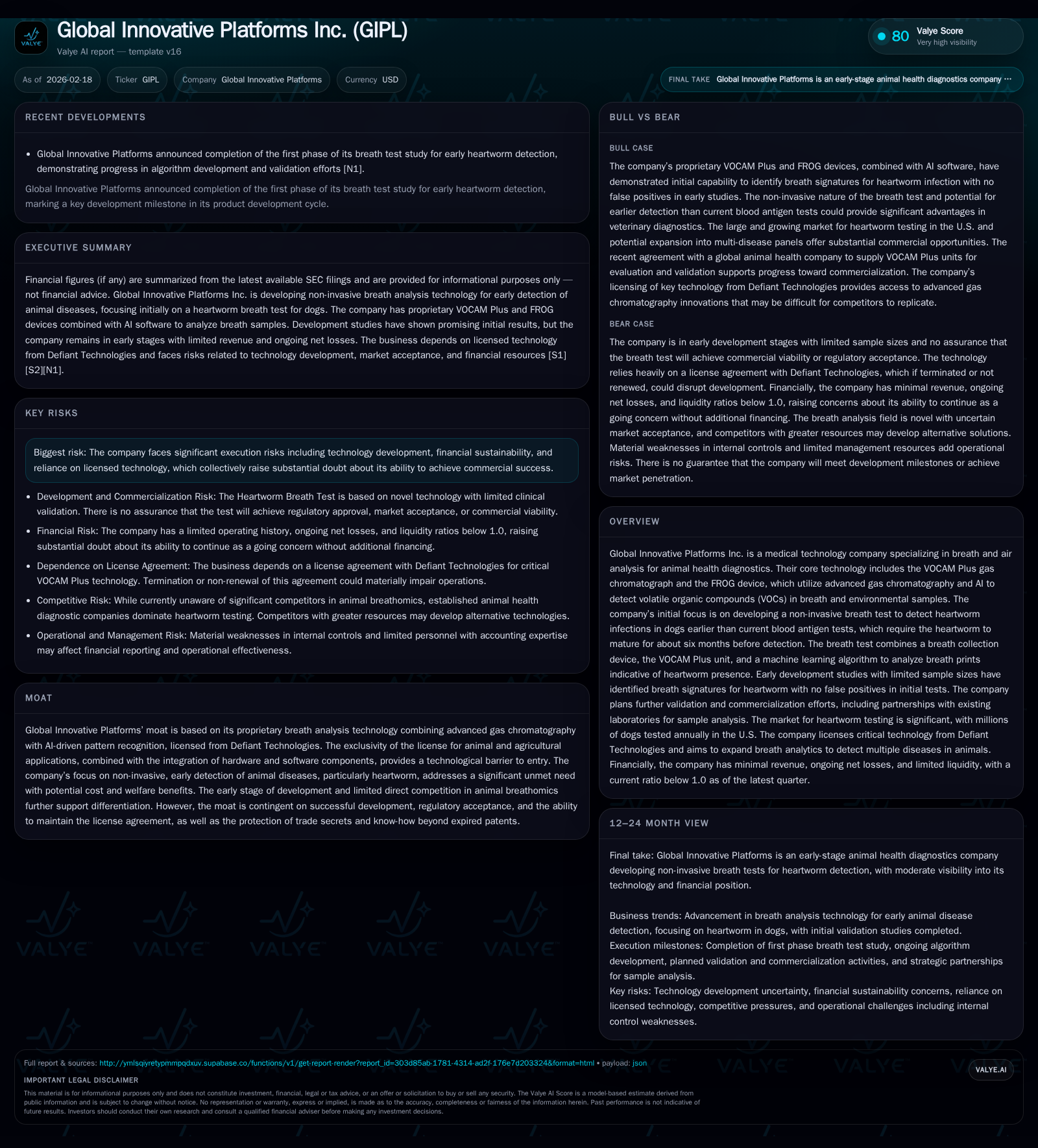
Global Innovative Platforms Inc. (GIPL) is a medical technology startup focused on non-invasive breath analysis diagnostics for animal health, notably early detection of canine heartworm using VOCAM Plus gas chromatography combined with AI pattern recognition. Despite promising preliminary findings, GIPL remains pre-revenue, incurring growing operating losses and liquidity constraints that raise substantial doubts about its ability to continue as a going concern. The company relies heavily on a licensed technology agreement with Defiant Technologies, faces competitive pressure from well-capitalized incumbents in veterinary testing, and must secure further financing to develop and commercialize its products. Monitoring milestones around regulatory acceptance, larger validation studies, and successful capital raises will be key indicators of its future viability.
Company Overview and Technology Focus
Global Innovative Platforms Inc. (GIPL) operates within the nascent field of animal health diagnostics leveraging breath analysis technology. The company specializes in detecting volatile organic compounds (VOCs) from animals’ breath using proprietary devices—the VOCAM Plus gas chromatograph paired with the FROG system—that employ AI-driven algorithms to parse diagnostic patterns indicative of diseases like heartworm infection.
While breath analysis has seen broader interest in human medicine for non-invasive diagnostics, GIPL targets animal health where methods are less developed. Its early-stage efforts concentrate on canine heartworm detection aiming to circumvent limitations of the leading blood antigen tests which require worms to mature over approximately six months before yielding positive results. By capturing distinctive 'breath prints,' GIPL hopes to facilitate earlier diagnosis and improve treatment outcomes.
Historical Performance and Financial Trends
Since inception through fiscal year ending September 30, 2025, GIPL has remained in the research and development stage without recording significant revenues. The company reported zero revenues across FY2022 to FY2025 despite progress in technology advancement and preliminary clinical studies [F1][S7]. Operating income has declined steeply from a loss of approximately $54K in FY2022 to over $718K by FY2025, reflecting escalating expenditures primarily tied to R&D, testing protocols refinement, personnel costs, and administrative overhead [F1]. Correspondingly, net losses mirror this trend.
Operating cash flows have become increasingly negative—from about -$53K in FY2022 accelerating sharply to nearly -$561K by FY2025—highlighting cash burn amid an absence of commercial sales or licensing revenue [F1]. This ongoing cash outflow stresses liquidity given limited cash reserves (e.g., $18.5K as of mid-2021) and working capital challenges shown by a current ratio below 1 at recent reporting periods [F1].
Shareholders’ equity improved from negative territory (-$363K as of FY2023) into modest positive territory (~$188K by FY2025), indicative of capital infusions through equity issuances rather than operational profitability [F1]. Notably, the company engaged in share repurchases totaling $60K across consecutive years prior to 2025 amid thin trading volumes but continues lacking sustainable earnings or dividends [F1][S17][S22].
Financial Summary Table
Historical performance (annual)
| FY | Rev | Net ($) | CFO ($) | OpInc ($) | Net YoY |
|---|---|---|---|---|---|
| 2025 | 0 | -718251 | -560740 | -718251 | -427.4% |
| 2024 | 0 | -136197 | -87378 | -136197 | +51.8% |
| 2023 | 0 | -282786 | -234793 | -282786 | |
| 2022 | 0 | -53620 | -53816 |
Note: Omitted columns lack sufficient annual XBRL coverage in the provided tags (need ≥2 annual points): Capex, Div, FCF. Source: SEC companyfacts cache [F1].
Capital returns and efficiency (annual)
| FY | Buybacks ($) | ROE% |
|---|---|---|
| 2025 | 60000 | -382.7 |
| 2024 | 60000 | 411.0 |
| 2023 | 77.7 | |
| 2022 |
Source: SEC companyfacts cache [F1].
Note: Current ratio only available for FY2025 due to data limitations.
Growth Prospects and Development Milestones
GIPL’s growth outlook depends critically on advancing its breath test toward regulatory clearance and market readiness. While initial clinical studies showed promising accuracy for early heartworm detection without false positives [N# not available], no specific timelines or detailed milestones have been disclosed publicly for subsequent larger-scale validations or regulatory submissions [S24].
The company envisions expanding applications beyond heartworm diagnosis into broader animal health conditions and environmental toxin detection leveraging its AI-driven breathomics platform [S24][S28]. Cost competitiveness is a stated goal aiming at consumables costing less than existing blood antigen tests priced around $5 per use [S23].
However, concrete milestones such as completion dates for pivotal studies or commercial launch windows are not provided in SEC filings or other disclosures. Thus investors should monitor announcements related to:
- Expanded validation trials confirming sensitivity/specificity metrics
- Regulatory feedback or approvals even though FDA premarket clearance is not mandated for animal devices [S23]
- Partnerships or distribution agreements facilitating market entry
- Successful capital raises enabling scale-up activities
Capital Allocation and Financial Position
The company does not pay dividends given ongoing losses and developmental focus; historical share repurchases (~$60K annually before FY2025) appear aimed at modest price support amid thin trading volumes rather than shareholder return programs [F1][S17].
Negative return on equity is evident due to sustained net losses relative to modest positive equity at fiscal year-end 2025—approximating an annual ROE near -383%—reflecting lack of profitability at this stage [F1]. Capital expenditures data is not available from provided tags.
Liquidity remains constrained with current liabilities exceeding current assets recently leading to a current ratio below one; management indicates reliance on additional debt or equity financings for continued operations including potential mergers or strategic transactions [S3][S9][S10].
Key Risks and Competitive Landscape
Significant risks include:
- Dependence on Defiant Technologies’ license covering core VOCAM Plus technology involving upfront payments plus royalties; some underlying patents have expired though replaced by trade secrets which may limit IP exclusivity protections increasing exposure to competition or disputes [S12][S16][S21].
- Competitive pressure from established veterinary diagnostic companies offering blood antigen tests such as Idexx Laboratories; no direct competitors identified in animal breath analytics niche but entrenched incumbency poses barriers [S28].
- Financial sustainability concerns given lack of revenue generation amid growing cash burn necessitating urgent capital raising; auditors express substantial doubt about going concern status [F1][S1][S9].
- Limited management depth and specialized scientific staff heighten operational risks including retention challenges cited by management disclosures [S10].
- Regulatory environment is less stringent than human diagnostics but evolving standards could impact commercialization timing or costs; FDA oversight is minimal but manufacturers bear responsibility for safety/effectiveness claims [S23].
- Thin public market liquidity combined with penny stock trading restrictions may impede shareholder exit options even if technical progress materializes [S11][S20][S22].
Industry Context Analysis
Breath-based diagnostics represent an innovative frontier primarily explored within human healthcare; translation into veterinary medicine faces unique challenges including species variability and sample collection logistics. GIPL’s combination of microfabricated gas chromatography with AI pattern recognition aligns with emerging trends in portable rapid diagnostics.
Dominance of large-cap veterinary diagnostics firms offering centralized lab services or point-of-care antigen/antibody tests underscores competitive hurdles. However non-invasive earlier detection capabilities could create differentiation if validated successfully.
Conclusion
Global Innovative Platforms remains an early-stage venture balancing promising proprietary breath analysis technology against substantial execution risks inherent in startup biotech enterprises. The absence of definitive milestones or timelines limits visibility into near-term growth trajectories. Continued clinical validation progress alongside successful capital raises will be critical determinants of whether GIPL can evolve into a viable commercial enterprise within the animal diagnostic sector.
This analysis synthesizes publicly disclosed SEC filing information up through early 2026 alongside extracted financial data without speculative projections or investment recommendations.
Disclaimer: This is research-only, informational analysis and not investment advice. It may include AI-generated interpretation and general industry context. Always verify important details using primary sources.

Comments