
Bunge Global SA's Operating Momentum Accelerates on Viterra Acquisition and Processing Growth
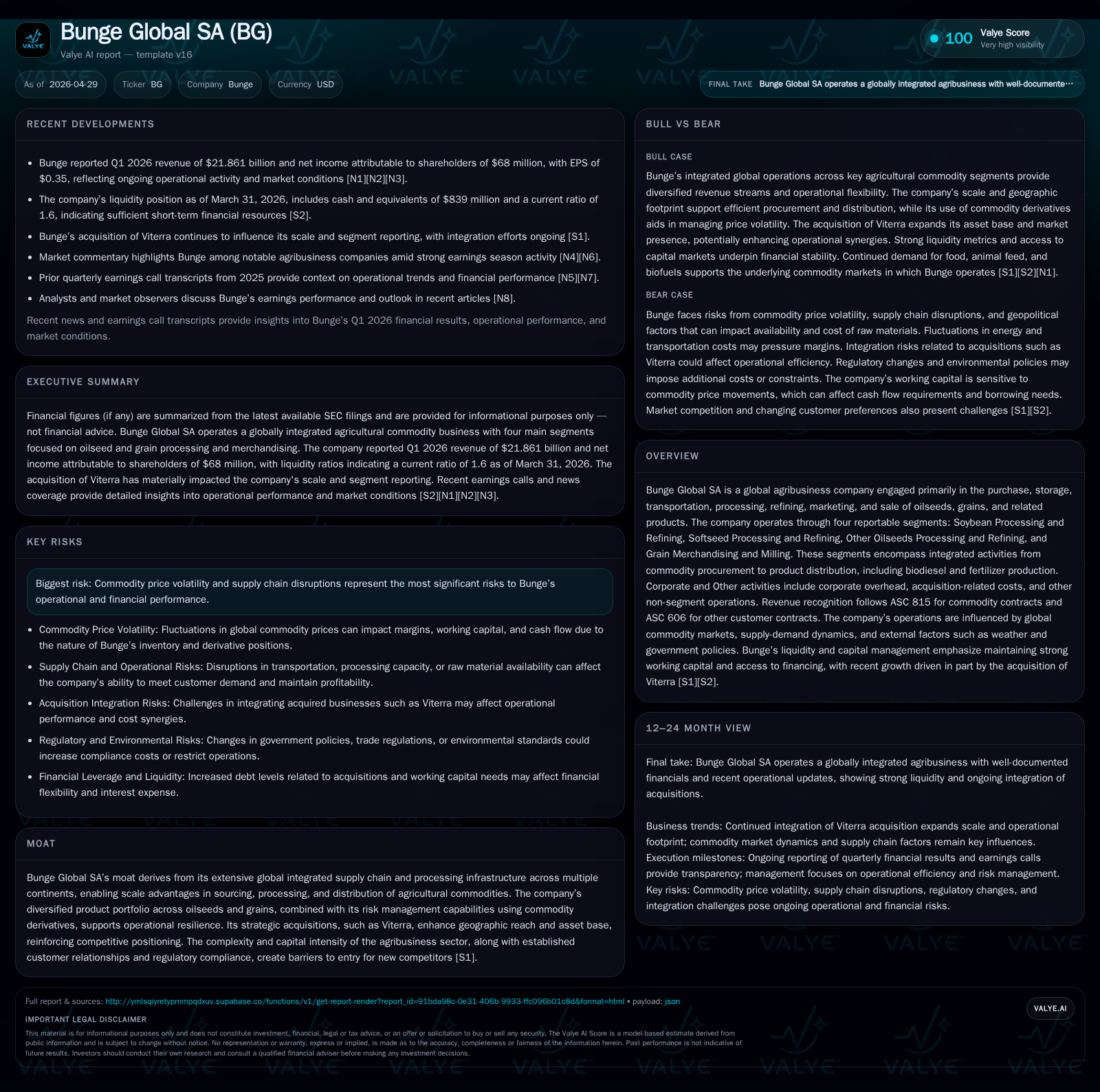
Bunge’s Q1 2026 results showcase expanded raw material inventories, increased derivative gains, and integration progress following the Viterra acquisition, reinforcing its global agribusiness scale.
In the first quarter of 2026, Bunge Global SA reported significant growth in raw material inventories driven by its Soybean Processing and Refining segment, reflecting inventory buildup post-Viterra acquisition. The company’s risk management via commodity derivatives intensified, as evidenced by rising unrealized gains. Its integrated supply chain and diversified processing platforms across oilseeds and grains create high barriers to entry and operational resilience. Going forward, growth hinges on synergies from Viterra assets, margin enhancement through refined product penetration, and expansion in emerging markets. However, commodity price volatility and acquisition measurement uncertainties pose noteworthy risks. Key milestones include final acquisition accounting adjustments and tracking operational performance against synergy targets.
Latest Quarterly Operating Update Highlights
Bunge Global SA’s Q1 2026 financial disclosures reveal meaningful shifts in operational posture following its July 2025 acquisition of Viterra Limited. Raw Material Inventories (RMI) surged to $13.4 billion at the quarter-end from $11.4 billion at the end of 2025 despite seasonal effects [S2]. The increase was largely concentrated in the Soybean Processing and Refining segment (from $4.8 billion to $6.9 billion), underscoring Bunge’s strategy of inventory buildup to leverage scale efficiencies and supply positioning across integrated processing assets acquired from Viterra [S2]. The Softseed Processing segment also registered modest RMI growth.
Simultaneously, Bunge intensified its use of commodity derivatives for exposure management: unrealized gains on these instruments rose by over $600 million sequentially to $2.18 billion [S2]. This heightened risk management activity reflects responsiveness to ongoing macroeconomic volatility affecting agricultural commodities.
The accounting treatment for Viterra acquisition remains preliminary due to customary measurement period adjustments allowed under ASC 805 rules [S2]. Current goodwill associated with the deal stands at approximately $2.8 billion allocated primarily to Softseed ($1.1 billion), Soybean ($0.9 billion), and Grain Merchandising ($0.8 billion) [S22]. The full asset valuation is expected within one year from the deal close date.
Integrated Business Model and Product Quality Framework
Bunge operates a globally integrated agribusiness spanning four reportable segments: Soybean Processing and Refining; Softseed Processing and Refining; Other Oilseeds Processing (including Tropical Oils and Specialty Ingredients); and Grain Merchandising and Milling [S1]. These businesses collectively cover procurement from farmers or suppliers through storage, transportation logistics (including port terminals), processing plants that refine oilseeds and grains into consumable oils or food ingredients, down through distribution.
For instance, the company owns over 35 oilseed processing plants servicing soybeans alone with substantial refining, packaging facilities (22 refining units globally in soybeans), along with nearly 100 grain-related storage sites worldwide [S1]. Such strategic localization close to supply sources reduces costs while supporting high-quality product standards required by downstream customers.
Additionally, Bunge produces value-added products like biodiesel fuels through dedicated fertilizer plants and recently expanded lecithin/soy protein concentrate acquisitions targeting specialty food ingredient markets [S1], broadening its product portfolio relevance amid evolving consumer trends.
Competitive Advantages Within a Capital-Intensive Agricultural Supply Chain
Bunge’s moat is grounded in extensive capital-intensive infrastructure complemented by sophisticated risk management capabilities [S1]. Its physical footprint—comprising upward of 300 processing plants and storage facilities distributed across North America, South America, Europe, and Asia-Pacific—sanctions large daily capacities (soybean: ~193k MT/day; softseed: ~69k MT/day) which few competitors can rival due to high fixed-cost burdens [S1].
This scale drives competitive sourcing advantages enabling procurement discipline over vast crop cycles across hemispheres.
Moreover, Bunge’s usage of commodity derivatives—encompassing futures contracts for price risk mitigation—and its employment of ASC 815 compliant accounting standards reinforce an active risk control culture protecting margins during volatile periods [S2]. Long-term customer contracts secured by established relationships enhance retention with major food producers while compliance with complex regulatory regimes across jurisdictions adds structural barriers discouraging new entrants in these fragmented markets.
Growth Drivers Fueling Revenue and Margin Expansion
Growth beyond core processing stems chiefly from leveraging the recently integrated Viterra asset base expanding geographic reach notably in grain merchandising operations plus incremental capacity in tropical oils/specialty products [N1][S2]. The 'Softseed' category notably benefits from targeted investments enhancing refined edible oils which command premium pricing.
Derivative trading gains expanding alongside physical volume growth signal mature margin optimization efforts where active contract positioning mitigates raw material cost fluctuations supporting steadier earnings streams [S2][N1]. Emerging market expansions via localized production hubs feed increasing demand for protein-rich ingredients responding structurally to global protein consumption trends.
Capital expenditures continue focusing on modernization projects boosting throughput efficiencies as well as environmental compliance upgrades particularly for cleaner biodiesel manufacturing aligned with sustainability goals S1.
Risks Related to Commodity Volatility and Acquisition Integration
Commodity price volatility remains Bunge’s primary exposure impacting both inventory carrying costs and downstream sales realizations causing earnings fluctuations despite hedging efforts [S1]. Unexpected adverse moves could erode margins if hedges fail to offset immediate price shocks comprehensively.
Integration risks related to Viterra center on potential final purchase price adjustments or asset impairments stemming from ongoing measurement period reviews under GAAP which could shift goodwill valuations or introduce charges affecting reported equity or income statements [S2][S22].
Additionally, elevated leverage due to acquisition financing—with net debt approximating $10.5 billion as of quarter-end—increases sensitivity to interest expense variability should credit environments tighten [F1][S2]. Supply chain disruptions linked to geopolitical tensions or adverse weather patterns also remain latent constraints given global sourcing dependencies.
Key Upcoming Milestones and Performance Watchpoints
Market participants should focus on Bunge’s formalization of purchase price allocations for the Viterra business expected within twelve months following closing; such adjustments will clarify goodwill or intangible asset balances influencing future amortization or impairment considerations [S2][S22].
Subsequent quarterly filings will provide insight into synergy capture evidenced through margin improvements or working capital efficiencies amidst growing raw material inventories.
Tracking sustained unrealized derivative gains offers a window into risk management effectiveness amid continuing commodity market turbulence [N1][S3]. Moreover regulatory changes impacting fertilizer or biodiesel production—such as emissions standards—may alter cost structures necessitating adaptive capital allocation decisions.
Latest Financial Snapshot and Capital Structure Overview
Latest financial snapshot
| Metric | Value | Period |
|---|---|---|
| Cash & equivalents | $839mm | |
| 2026-03-31 | ||
| Total debt | $11.3bn | |
| 2026-03-31 | ||
| Net debt | $10.5bn | |
| 2026-03-31 | ||
| Current assets | $27.1bn | |
| 2026-03-31 | ||
| Current liabilities | $16.9bn | |
| 2026-03-31 | ||
| Current ratio | 1.6x | |
| 2026-03-31 |
Source: SEC companyfacts cache [F1].
| Metric | Amount (USD Millions) |
|---|---|
| Cash & Equivalents | 839 |
| Total Debt | 11,308 |
| Net Debt | 10,469 |
| Current Assets | 27,094 |
| Current Liabilities | 16,940 |
| Current Ratio | 1.6 |
As of March 31, 2026, Bunge maintained cash equivalents totaling $839 million juxtaposed with total debt exceeding $11.3 billion reflecting financing drawn principally for the Viterra acquisition along with working capital support [F1][S2]. The current ratio near 1.6 indicates ample short-term liquidity relative to obligations despite elevated borrowings [F1].
This analysis synthesizes public filings as of April 29, 2026 without offering investment recommendations or market forecasts. It reflects currently available data regarding operations impacted materially by strategic acquisitions within a complex agricultural commodity environment characterized by cyclical pricing dynamics and capital intensive infrastructure requirements.
Disclaimer: This is research-only, informational analysis and not investment advice. It may include AI-generated interpretation and general industry context. Always verify important details using primary sources.

Comments