
Sabesp Advances Infrastructure Expansion Post-Privatization with Strategic Capital Raises and Regulatory Navigation
Recent quarterly disclosures highlight Sabesp's accelerated infrastructure investments and corporate actions underpinning growth in São Paulo's sanitation sector.
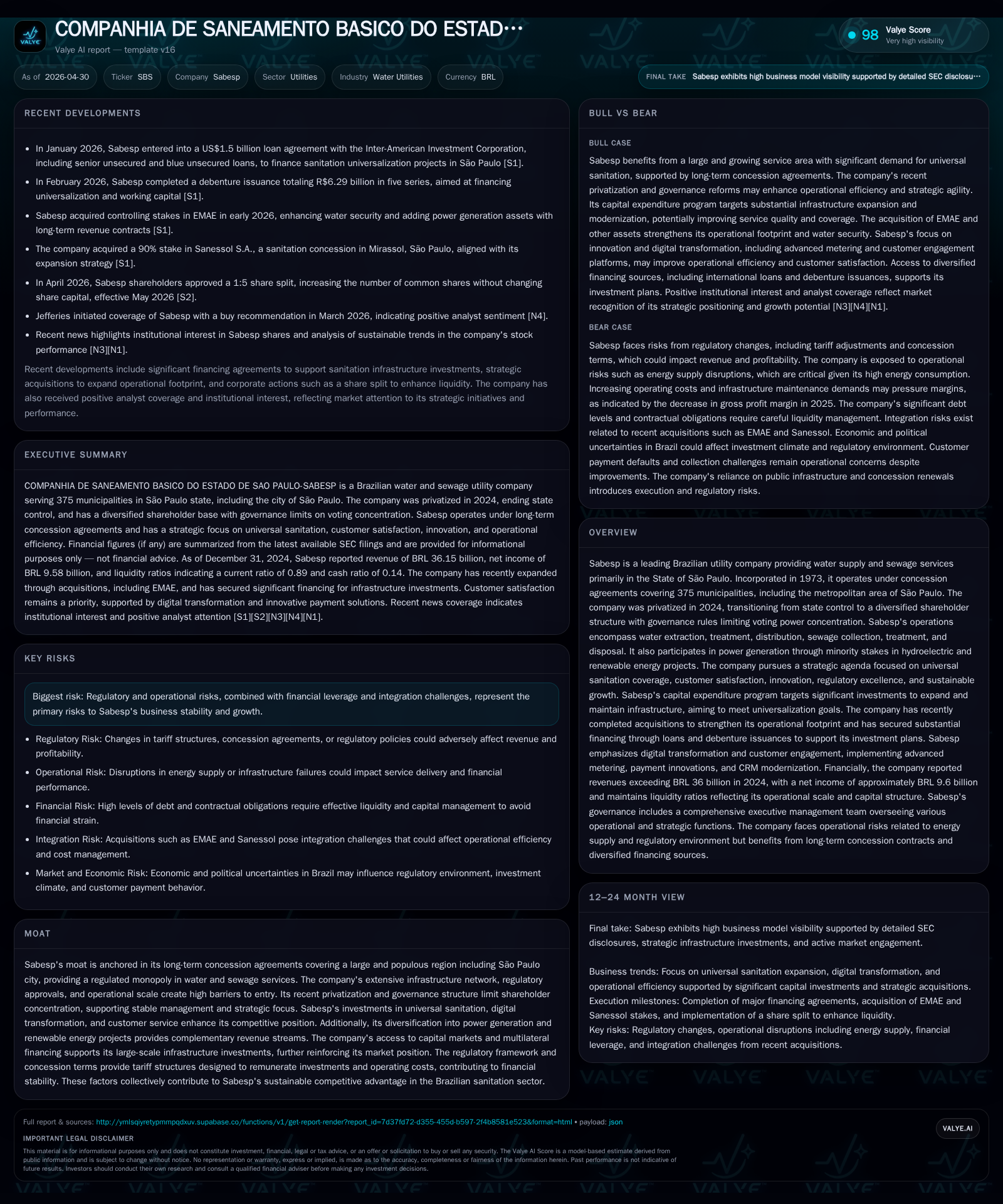
Companhia de Saneamento Básico do Estado de São Paulo (Sabesp) reported Q1 2026 updates confirming approval of a 1:5 stock split, ongoing organic expansion, and strategic acquisitions aligned with its mission to universalize sanitation services in the populous State of São Paulo. After its 2024 privatization, Sabesp is leveraging diversified financing instruments including significant loan agreements and a Blue Bond issuance to fund R$70 billion CAPEX plans through 2029. The company maintains a regulated monopoly under long-term concession agreements covering 375 municipalities, reinforcing its wide moat supported by operational scale, regulatory approvals, and innovation leadership. Risks remain concentrated in regulatory pressures, extreme climate events impacting water supply security, and high financial leverage.
Recent Operating Update
Sabesp filed its latest quarterly interim report on April 29, 2026 ([S2], [S3]) announcing key corporate actions materially impacting shareholder structure and liquidity. Foremost among these was shareholder approval for a five-for-one split of all common shares, effective May 4, 2026, increasing the number of common shares to over 3.5 billion without changing total capital. This move aims to improve tradability and broaden investor participation.
Additional recent operational developments include Sabesp’s acquisition agreement for Sanessol S.A., holding the sanitation concession in Mirassol municipality (~65k inhabitants), signaling ongoing expansion beyond the core metropolitan area for consolidating market position ([S19]).
The reports reinforced ongoing substantial investments aimed at expanding water supply and sewage networks across São Paulo State municipalities. This aligns with efforts to meet growing demand driven by urban expansion and regulatory mandates for universal sanitation coverage under Brazil’s New Legal Framework.
Business Model Overview
Sabesp operates as an integrated water utility providing water extraction, treatment, distribution, sewage collection, treatment, and disposal services primarily under concession agreements covering 375 municipalities in São Paulo state ([S1], [S19]). It holds regulated monopoly status supported by long-term contracts—concessions mostly running through 2060—anchoring its competitive moat.
Revenue stems largely from tariffs charged to residential, commercial, industrial customers, and public entities based on consumption volumes. Rates are subject to regulation balancing cost recovery with service quality obligations enforced by ARSESP and federal bodies ([S1], [S7]).
The company also pursues complementary revenue streams including minority stakes in hydroelectric plants and renewable energy ventures such as photovoltaic projects through affiliates ([S25]). This diversification supports operational leverage by integrating power generation critical for pumping and treatment processes.
Following its July 2024 privatization, Sabesp transitioned from state control to a broad shareholder base capped by bylaws limiting voting power concentration to under 30%, fostering governance stability ([S1]).
Innovative payment platforms pioneered by Sabesp—including installment payments via WhatsApp using PIX (Brazil's instant payment system) and automated recurring PIX payments—enhance customer experience while reducing default rates ([S1]). These technological advancements reflect strategic priorities focused on digital transformation and operational efficiency.
Industry Structure and Competitive Position
Within Brazil’s highly regulated sanitation sector, Sabesp stands out as the largest player due to its extensive scaled infrastructure footprint serving São Paulo’s metropolitan region plus surrounding municipalities ([S1]). Its size yields operating economies and bargaining power with suppliers.
High barriers to entry arise from capital intensity requirements for building treatment plants and distribution networks alongside prolonged concession awards enforced by public authorities. Sabesp's longstanding regulatory approvals act as strong moats protecting market share.
The recent acquisition of smaller local operators like Sanessol illustrates consolidation trends within the industry focused on expanding integrated service delivery under a unified framework ([S19]).
Operationally, Sabesp invests heavily in mitigating supply risks inherent in Brazil’s climate variability—for example expanding capacity in the Integrated Metropolitan System (SIM), an interconnected water supply network that provides redundancy options mitigating drought impacts ([S1]). Such investments underpin resilience against increasingly frequent extreme weather events.
Growth Drivers
Universal Sanitation Coverage Pursuit: Mandated expansions under government policy targeting full sanitation access drive substantial infrastructure investments totaling roughly R$70 billion over six years ([S18]).
Population Growth & Urbanization: São Paulo state's demographic trends continue fueling steady increases in water demand and sewage services demand across urbanizing municipalities.
Technological Innovation: Rollout of new payment technologies reduces defaults; digital tools also enhance operational efficiencies and customer satisfaction ([S1]).
Strategic Acquisitions & Consolidation: Acquisitions like Sanessol augment geographical reach facilitating economies of scale.
Renewable Energy Integration: Investments in hydropower and solar generation lower operating costs while supporting environmental targets ([S25]).
Regulatory Tariff Frameworks: Established allowed returns on invested capital incentivize ongoing CAPEX deployment while protecting cash flow margins within a balanced tariff review process.
Water Security Investments: Expansion projects enhancing SIM capacity strengthen system reliability amidst climate stressors reducing supply volatility risk ([S1], [S8]).
Risks / Watchpoints / Growth Constraints
Regulatory Risks: Tariff setting mechanisms may pressure profitability if political or economic pressures require rate freezes or caps not aligned with cost inflation ([S1], [S18]). Regulatory changes could also alter concession terms unfavorably.
Financial Leverage: Total borrowings surged by nearly 60% year-over-year reaching over R$40 billion nominal debt at end-2025 with substantial foreign currency exposure increasing currency risk ([S12], [S26]). While covenants are met currently, refinancing risks exist should credit conditions deteriorate.
Climate Impact & Operational Disruptions: Extreme weather such as torrential storms threaten physical assets including treatment facilities; drought episodes stress reservoir levels impacting supply continuity ([S1] Risk Factors).
Customer Payment Risk: Despite innovations in payment methods, defaults by large debtor segments remain a factor affecting cash flow timing ([S1]).
Integration Challenges: Consolidating recently acquired operations like Sanessol requires successful transition management to avoid execution slippage ([S19]).
Currency Fluctuation Exposure: Foreign-denominated debt exposes Sabesp to real depreciation risks that can inflate debt-servicing costs when converted into local currency ([S10], [S12], [S26]).
What to Watch Next
- Implementation progress of significant infrastructure projects outlined in the R$70 billion investment plan through incremental backlog reporting or regulatory filings.
- Financial covenant compliance updates amid rising indebtedness levels disclosed in subsequent quarters.
- Results of integration efforts post-Sanessol acquisition measuring contribution to revenue base expansion.
- Regulatory agency decisions impacting tariff structures or concession renewals.
- Resilience indicators tied to water source reservoir levels during dry seasons or extreme weather events affecting operational continuity.
- Adoption rates and impact analysis of payment innovations including automated PIX on accounts receivable performance metrics.
- Additional corporate actions such as further share issuances or refinancing activity reflecting capital structure optimization strategies.
Financial Profile Snapshot (Supporting Context)
While detailed historical financials are excluded per policy constraints, it is notable that Sabesp generated R$36.15 billion revenue for fiscal year ended December 2024 with net income approximately R$9.58 billion ([F1]), evidencing significant scale profitability prior to recent aggressive reinvestment phases noted through increased CAPEX spending (R$15.2 billion in 2025) funded largely via expanded borrowings including US-dollar denominated blue bonds issued early 2026 ([S11], [S17], [S25]). Cash generated from operations has grown steadily (+12.9% YoY) supporting these investments without compromising liquidity despite current ratio under unity (0.89) partly due to working capital dynamics typical in utilities sectors ([F1],[S11],[S16]). The company continues meeting all financial covenants under loans from development banks like CEF, BNDES, IDB Invest across multiple measurement bands reflective of prudent financial management even amid market uncertainties ([S4],[S6],[S13],[S18],[S26]).
This report synthesizes available public filings without offering investment advice or performance forecasts. Readers should consult primary sources cited herein for detailed disclosure nuances before forming any conclusions about Companhia de Saneamento Básico do Estado de São Paulo (Sabesp).
Disclaimer: This is research-only, informational analysis and not investment advice. It may include AI-generated interpretation and general industry context. Always verify important details using primary sources.

Comments