
Alkami Technology Advances SaaS Banking Platform with Strategic Acquisitions and Long-Term Contracts
Alkami's Q1 2026 update underscores accelerating revenue growth, integration of MANTL acquisition, and continued advance of its multi-tenant SaaS platform for community financial institutions.
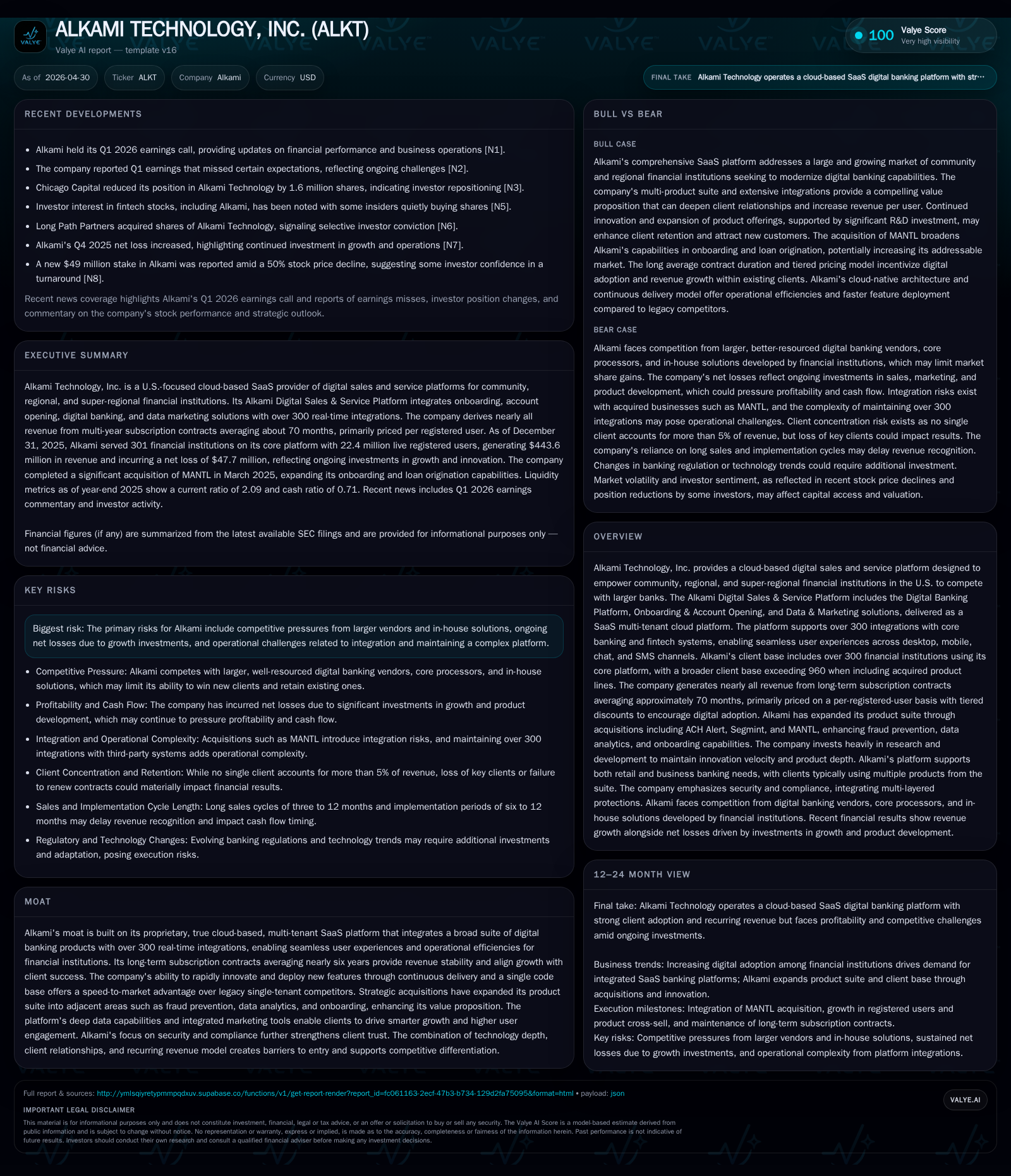
In its latest quarterly filing, Alkami Technology reported robust progress in expanding its digital banking SaaS footprint despite recent earnings misses. The company’s strategic acquisition of MANTL has broadened its product suite into onboarding and loan origination, enabling deeper client engagement and cross-selling opportunities. With over 300 financial institutions using its core platform and nearly seven-year average subscription contracts, Alkami’s cloud-native architecture and extensive fintech integrations create a defensible competitive position. Key growth drivers include registered user expansion, sustained contract renewals, and accelerated innovation velocity, while risks center on competitive pressures and integration complexities.
Latest Quarterly Operating Update Highlights
A recent event filing highlights that Alkami’s Board authorized a $100 million stock repurchase program as of April 23, indicating confidence in capital allocation flexibility despite near-term operating losses [S20]. This move arrives alongside ongoing efforts to leverage cross-selling between the base Alkami Digital Banking Platform and acquired product offerings such as those from MANTL.
Business Model and Product Suite Overview
Alkami operates a cloud-native digital sales & service platform designed specifically for community, regional, and super-regional financial institutions (FIs) in the United States seeking to compete against larger banks with superior technology. Its flagship solution—the Alkami Digital Sales & Service Platform—comprises three major components: the Digital Banking Platform itself; Onboarding & Account Opening functionalities (largely sourced from MANTL); and Data & Marketing tools (enhanced by Segmint).
This platform is deployed as a true multi-tenant SaaS solution emphasizing rapid innovation velocity through a single code base that supports seamless feature rollouts. Over 300 real-time integrations connect to core banking systems as well as adjacent fintech services including payments processing, mortgages, bill pay, document management, personal financial management, and more [S1][S24]. This integration breadth enables customizable yet scalable deployments that meet diverse FI needs.
The revenue model is driven primarily by long-term subscription contracts averaging around 70 months. Pricing typically follows a per-registered-user basis tied closely to active account holders or members within FI clients’ customer bases. Volume thresholds yield tiered discounts incentivizing client-led digital adoption campaigns that increase engagement — thus creating a feedback loop aligned with both Alkami’s growth and client success objectives [S1][S25].
Additionally, the company provides professional services for custom implementations or unique integrations requested by clients though these represent less than subscription revenue. Notably, the addition of MANTL expands product depth enabling Alkami to address not only retail but increasingly business banking segments — critical given FIs’ growing demand for commercial deposit account onboarding coupled with loan origination capabilities [S25].
Competitive Landscape and Industry Positioning
Alkami positions itself against legacy single-tenant providers—often large core processing vendors—and emerging fintech challengers attempting to disintermediate traditional banks. Its competitive moat stems from proprietary multi-tenant architecture delivering faster innovation cycles compared to fragmented legacy platforms requiring costly upgrades or multiple vendor patches.
The company's platform integration exceeds 300 connections which allows offering an end-to-end digital experience that few competitors currently replicate at scale among community banks. Furthermore, its typical customer segment excludes megabanks but focuses heavily on the top ~2,500 U.S. financial institutions where customization demands and cost sensitivity require robust yet flexible SaaS solutions [S24][S10].
Pricing power derives from several factors: long contract durations tying clients for an average of nearly six years provide recurring visibility; usage-based pricing rewards deeper user penetration; integrated cross-sell opportunities enhance switching costs; plus embedded security/compliance features minimize risk exposure — all acting as client retention anchors.
While competition includes vendors like nCino which recently outperformed estimates suggesting intensified competitive dynamics within CRM-based commercial banking solutions—for example—Alkami emphasizes a broader omnichannel approach blending data analytics (Segmint), fraud prevention (ACH Alert), and onboarding efficiencies (MANTL) into one ecosystem leveraging cloud scalability for speed-to-market advantage [N3][S10].
Growth Drivers Shaping Future Demand
Key measurable growth levers revolve around increasing registered users across existing clients’ customer bases as well as net new FI client acquisitions focusing on mid-tier regional players adopting digital transformations. The acquisition of MANTL notably adds upstream funnel functionality allowing clients not only to serve customers post-account opening but capture leads across commercial lending verticals.
Cross-selling across acquired product lines provides incremental upsell pathways elevating total contract value per client over time. For instance, deployment rates of onboarding/account opening modules have accelerated since integration into Alkami’s core SSAAS platform allowing for streamlined implementations without major API rework due to the unified code base architecture [S1][N1].
Additionally, deeper data insights powered by Segmint’s analytics drive smarter marketing campaigns delivering higher digital penetration levels—directly correlating with increased per-user pricing tiers. Product innovation velocity supported by cloud infrastructure enhances ability to rapidly offer new features responsive to evolving regulatory or end-user needs without disruptive upgrades.
Market-wise supply/demand trends favor digitization at smaller FIs striving to remain competitive versus mega banks’ superior apps enhancing Alkami’s runway within this niche segment poised for above-average tech spending growth relative to overall bank IT budgets.
Risk Factors and Operational Challenges
Primary risks identified remain consistent with earlier disclosures: heightened competition especially from entrenched vendors capable of bundling cloud offerings or internal development by large FIs threatens market share gains; continued net losses reflect ongoing investments in R&D plus expanded sales/implementation staffing constraining near-term profitability metrics [S18][S2].
Integration complexities stemming from multiple acquisitions impose operational burdens including harmonizing product roadmaps and unifying customer support systems amid rapid scale-up. Also pertinent are regulatory compliance demands around data privacy/security especially considering the synchronized transaction-level data stored across third-party systems—any breaches could materially damage reputation.
Sales cycles persistently long at three to twelve months combined with implementation durations up to one year introduce execution risk; deviations can delay expected revenue recognition affecting quarterly guidance credibility. Further dependencies on third-party hosting providers underline cybersecurity/systems availability risks intrinsic to SaaS models.
Key Milestones and What to Watch Next
Investors should track momentum within newly acquired onboarding/loan origination segments represented by MANTL integration milestones such as number of live production clients using those modules fully embedded within Alkami’s platform ecosystem. Equally important are reported renewal rates on long-duration subscription contracts which serve as bellwethers for client satisfaction amidst rising sector competition.
Attention should also be paid to management commentary during upcoming quarterly earnings calls or investor presentations particularly regarding any adjustments in churn assumptions or updates on incremental ARR booked via cross-selling efforts across ACH Alert/Semgint/MANTL products [N1][N3]. The effectiveness of the recently announced $100 million share repurchase program may offer insight into capital deployment priorities amid sustained investment spending [S20].
Wider fintech sector developments—for example competitor results like nCino surprising positively—offer contextual benchmarks informing Alkami’s competitive standing moving forward.
Current Financial Snapshot and Capital Position
Latest financial snapshot
| Metric | Value | Period |
|---|---|---|
| Cash & equivalents | $63mm | |
| 2025-12-31 | ||
| Current assets | $187mm | |
| 2025-12-31 | ||
| Current liabilities | $90mm | |
| 2025-12-31 | ||
| Current ratio | 2.09x | |
| 2025-12-31 |
Source: SEC companyfacts cache [F1].
| Metric | Value |
|---|---|
| Quarterly Revenue* | ~$115 million** |
| Cash & Equivalents | $63.5 million |
| Current Ratio | 2.09 |
| Net Income | $(47.7) million |
As of December 31, 2025, Alkami held $63.5 million in cash equivalents with no outstanding debt according to the most recent balance sheet metrics available [F1]. Current assets stood at $187 million versus current liabilities near $89.5 million yielding a strong short-term liquidity ratio above two times—a signifier of sound solvency supportive of ongoing investments.[F1]
Management appears positioned financially to sustain strategic skews toward innovation-led growth complemented by prudent capital structure origins—fungible equity-linked convertible notes issued in early 2025 facilitate balance sheet robustness without resorting presently to dilutive equity raises or onerous debt burdens.
Disclaimer: This analysis is based solely on publicly available filings through April 2026 combined with recent news transcripts. It does not constitute investment advice or recommendations.
Disclaimer: This is research-only, informational analysis and not investment advice. It may include AI-generated interpretation and general industry context. Always verify important details using primary sources.

Comments