
Banco de Chile Enhances Liquidity and Prepares for Loan Growth in 2026
Banco de Chile’s latest quarterly disclosures highlight strong liquidity metrics and a strategic balance sheet expansion focused on customer loans and securities.
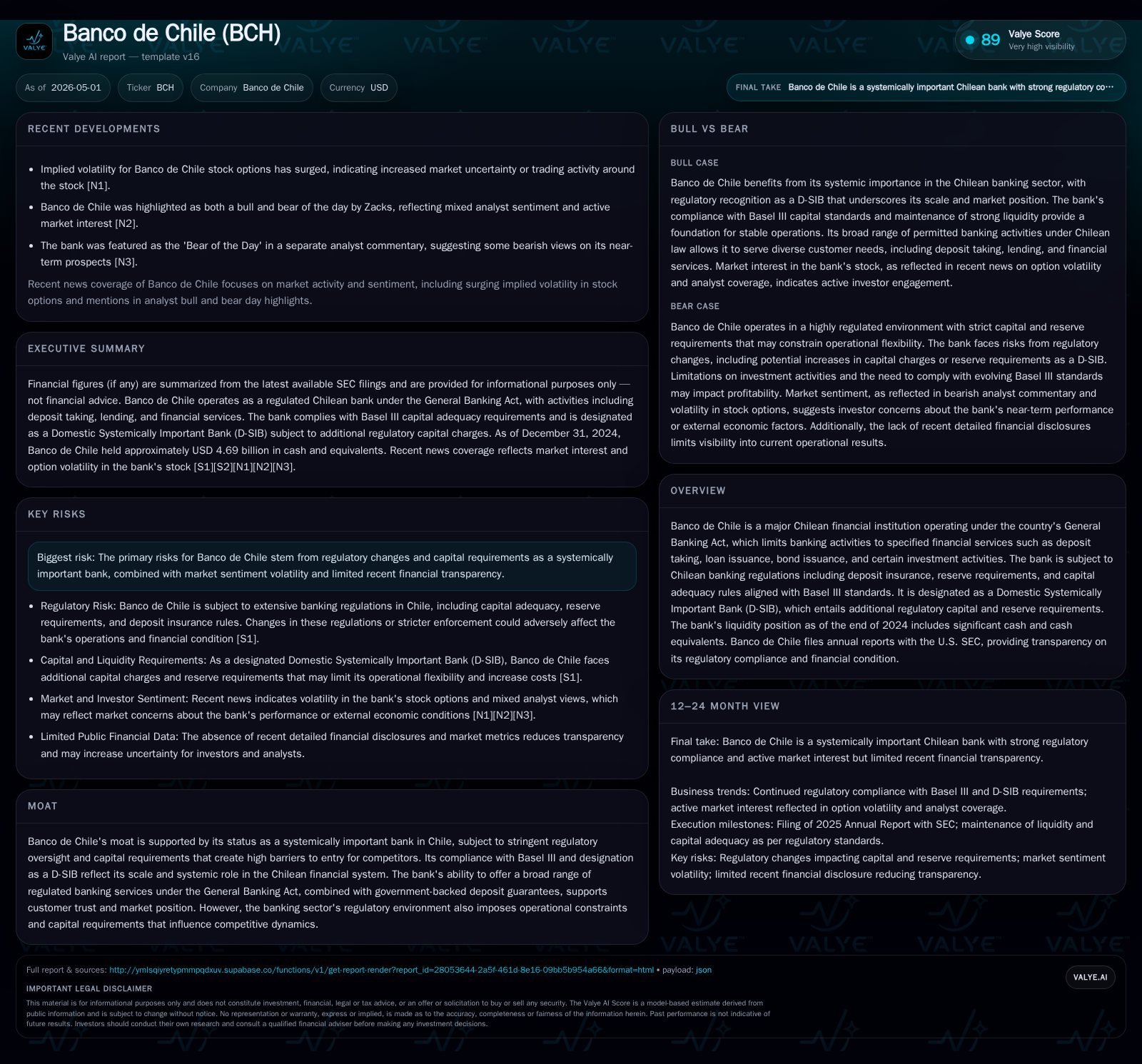
Banco de Chile’s April 2026 filings reveal a deliberate plan to grow its loan portfolio supported by robust liquidity coverage and stable funding ratios. The bank operates within a stringent regulatory framework as a designated Domestic Systemically Important Bank (D-SIB), enforcing high capital and reserve requirements. Its broad range of financial services under Chile's General Banking Act, combined with government-backed deposit guarantees, supports customer confidence and market position. Key growth drivers include prudent liquidity management and expanding credit demand amid regulatory compliance mandates.
Latest Quarterly Operating Highlights
Banco de Chile's recent quarter filings as of April 30, 2026 ([S2], [S3]) emphasize the bank’s strategic commitment to balance sheet growth over the next fiscal period. The expansion is predominantly linked to higher loans extended to customers alongside greater holdings in various securities categories—trading securities, amortized cost instruments, and securities carried at fair value through other comprehensive income. This multi-faceted asset growth aligns with internal policies aimed at maintaining strict adherence to both internal liquidity standards and Basel III regulatory mandates.
The bank’s liquidity metrics are notably robust; the Liquidity Coverage Ratio (LCR) stood at 198%, nearly double the phased-in minimum regulatory requirement that reached 100% in mid-2022. Similarly, the Net Stable Funding Ratio (NSFR) was measured at 118%, surpassing the required standard set to be fully effective by January 2026 ([S1], [S6]). These figures reflect disciplined funding strategies centered on stable retail deposits backed by reserve mandates configured under the Central Bank of Chile’s evolving framework.
Business Model and Service Offering
Operating strictly within the confines of Chile's General Banking Act ([S1]), Banco de Chile focuses on permitted financial activities including deposit acceptance, issuance of consumer and commercial loans (secured or unsecured), bond issuance, and select investment operations. Its product suite extends through subsidiaries into securities brokerage, mutual fund management, foreign capital funds management, financial advisory services, securitization, factoring, leasing, and derivatives trading.
Revenue generation is primarily interest-driven from its core commercial banking operations—loans to individuals and businesses constitute the principal earnings engine. Fee income derives from adjunct services like asset management and brokerage operations. The bank benefits strategically from governmental deposit guarantees which cover demand deposits fully and time deposits within defined limits (UF 200 per individual per bank). This backing bolsters client trust pivotal in a competitive retail banking environment.
Regulatory Environment and Competitive Advantages
Banco de Chile holds the status of a Domestic Systemically Important Bank (D-SIB), subjecting it to enhanced regulatory scrutiny imposed by the Financial Market Commission (CMF) and the Central Bank of Chile ([S1]).
Chile’s comprehensive adoption of Basel III standards further defines the bank’s operational parameters. The bank has complied fully with these thresholds—including Common Equity Tier 1 (CET1), Tier 1 Capital ratios, conservation buffers currently at 2.5%, plus a countercyclical buffer active since mid-2024 at 0.5%. Notably, technical reserve rules necessitate holding liquid assets proportional to certain deposit categories—a pivotal aspect for D-SIBs like Banco de Chile that influences how liabilities are structured ([S12], [S19]).
These rigorous regulations create formidable entry barriers for potential competitors but also impose operational constraints such as tighter credit underwriting standards and reserved capital initiatives limiting aggressive balance sheet expansion beyond regulatory tolerance.
Industry Structure and Market Positioning
The domestic banking landscape in Chile is highly concentrated with few major players exerting dominant influence over pricing power and client acquisition (, [S1]). Banco de Chile benefits from scale advantages inherent from its D-SIB status, enabling comprehensive product offerings across retail, corporate banking, treasury services, and investment products.
Central Bank policies materially impact loan growth dynamics through monetary tools including reserve requirements that can vary widely—from baseline reserves against demand deposits around 9% up to discretionary hikes reaching as high as 40% during tightening cycles ([S1]). These controls modulate credit availability tightly linked with macroeconomic conditions in Chile.
Government-backed deposit guarantees combined with longstanding market presence underpin strong client retention rates in both consumer segments and corporate sectors. However, growing regulatory burdens might temper margin expansion capabilities relative to peers less constrained by systemic risk designations.
Key Growth Drivers and Strategic Initiatives
Primary growth vectors center on anticipated reacceleration in loan demand following cyclical troughs; both consumer financing needs and commercial credit appetite are expected to support portfolio expansion ([S1], [S2]). Concurrently, strategic adjustments toward diversified securities portfolios—encompassing trading books plus held-to-maturity assets—serve dual purposes: meeting internal liquidity buffering targets while optimizing yield spread performance within regulatory confines.
Liqudity management plays an active role as well; maintaining LCR substantially above mandated floors affords flexibility to capture funding opportunities efficiently without undue cost escalation ([S6]). Moreover, expanding use of internal liquidity adequacy assessments (ILAAP) integrates stress testing frameworks ensuring preparedness for potential market shocks or sudden funding withdrawals ([S6]).
Further strategic initiatives include leveraging subsidiary capabilities in payments processing (through Banchile Pagos) and acquiring complementary financing services via absorption of collection units like Socofin—all enhancing fee-based revenue streams balanced against core lending risks ([S25]).
Risks and Operational Constraints
Key risks stem heavily from evolving regulatory landscapes. Incremental capital buffer increases or shifts in countercyclical policies could tighten capital allocation impacting profitability margins directly ([S13]). Additionally, restrictions limiting foreign currency exposures constrain international loan growth ambitions; specifically catalogued credit-rating floors govern permissible investments abroad introducing concentration risk considerations ([S15]).
Macroeconomic uncertainty including potential monetary policy contraction could elevate reserve requirements sharply—directly influencing available economic capital for lending activity. Furthermore, legal reforms enhancing consumer protections along with heightened data privacy regulations impose compliance costs potentially restraining product innovation speed or customer engagement processes ([S14], [S16]).
Market volatility poses underwriting challenges too with credit loss provisioning models recently standardized for consumer loans demanding adaptive risk management protocols based on multiple borrower attributes including historic arrears data ([S18], [S19]).
Upcoming Catalysts and Execution Priorities
Focus will be on sustained execution of planned loan growth aligned with stable net interest margin maintenance without incurring disproportionate credit risk escalation ([S2], [S3]). Monitoring quarterly earnings releases will provide visibility into profit trajectory reflecting operating leverage from portfolio scale alongside cost efficiency measures.
Regulatory updates concerning deposit insurance redesigns remain potential catalysts impacting liability structure optimization strategies ([S1]). Banks are also expected to demonstrate continued compliance with final Basel III NSFR enforcement as January 2026 benchmarks arrive.
Operationally, completion timelines around integration of newly acquired payment subsidiaries will influence fee income contribution profiles while technological investment progress in data protection frameworks remains critical given upcoming legal enforcement schedules beginning late 2026 ([S14]).
Financial Overview: Balance Sheet and Capital Adequacy
Banco de Chile maintains a solid liquidity profile anchored by substantial cash equivalents valued near USD $4.7 billion at end-2021 according to company facts data ([F1]). Recent filings confirm no material deviation indicating ongoing prudent asset-liability management maintaining excess buffers over minimum Basel III thresholds.
Capital adequacy is robust; full compliance has been achieved across all Tier 1 ratios including D-SIB mandated systemic charges totaling a cumulative CET1 plus conservation buffer exceeding required levels as of December 31, 2025 ([S8], [S10], [S20]).
Loan portfolio quality remains closely managed under updated provisioning rules incorporating standardized probability-of-default matrices ensuring forward-looking reserve calibrations reflect accurate sectoral risk profiles ([S18]). Such rigor supports sustainable earnings generation capacity vital in navigating tightening macroprudential conditions.
This analysis relies exclusively on SEC-filed disclosures through April 30, 2026 complemented by structural context drawn from Banco de Chile’s latest annual filing plus current market-focused operational commentary. No investment recommendations or price targets are offered herein. Readers should consult company releases directly for detailed data verification.
Disclaimer: This is research-only, informational analysis and not investment advice. It may include AI-generated interpretation and general industry context. Always verify important details using primary sources.

Comments