
Goldman Sachs Recalibrates Strategy with Q1 Shift to Transaction Banking
The firm’s first-quarter 2026 filing reveals a deliberate segment realignment emphasizing transaction banking within capital markets to sharpen strategic focus amid evolving market dynamics.
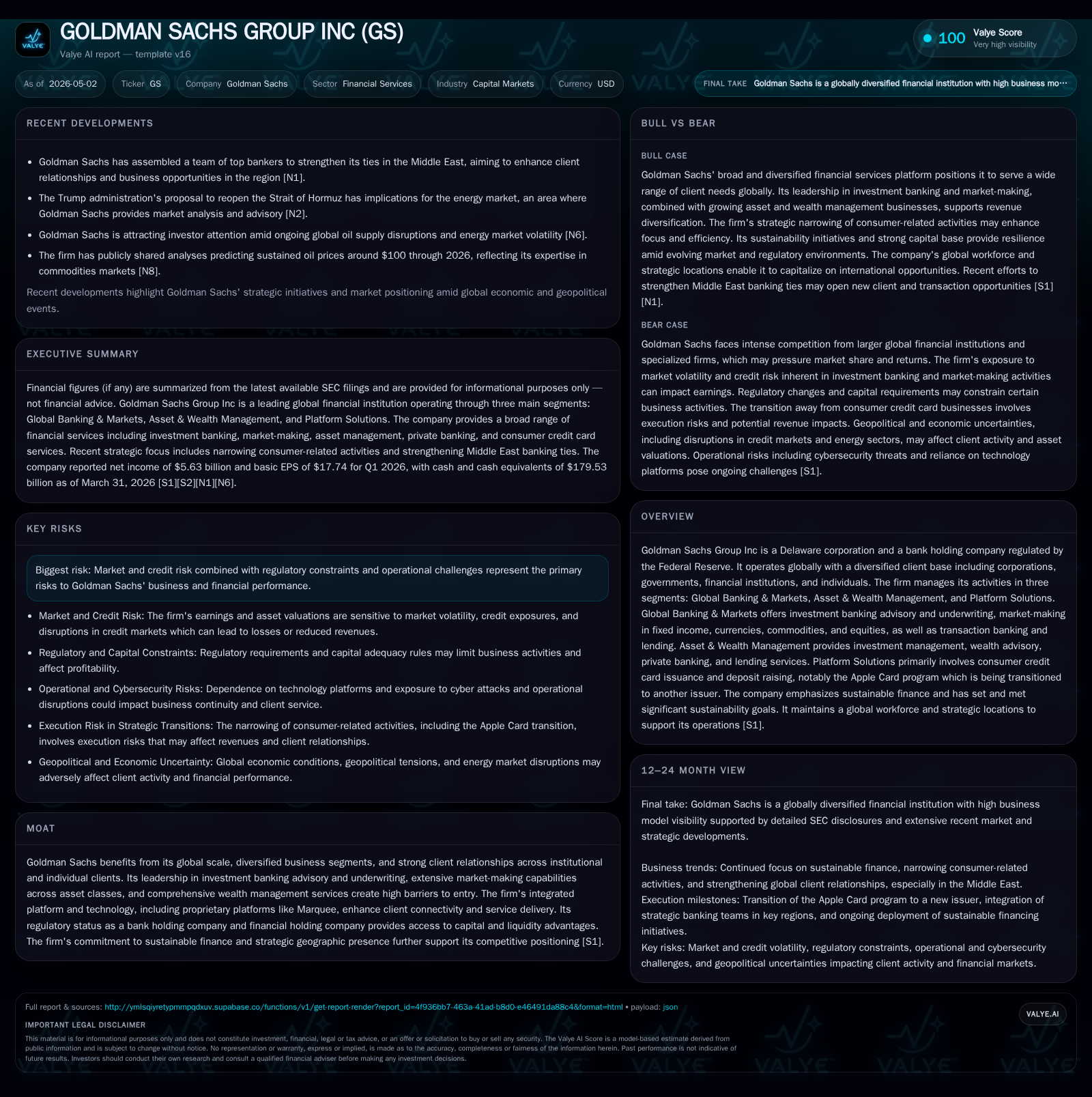
Goldman Sachs’ Q1 2026 10-Q filing confirms a strategic recalibration that moves transaction banking from Platform Solutions into Global Banking & Markets, signaling a shift toward core investment banking and market-making activities. This refocus narrows consumer finance exposure while bolstering institutional lending and syndication efforts under a refined segment structure. The firm leverages its global scale, diversified product set, and proprietary technology to maintain competitive advantages in an increasingly complex regulatory and market environment. Key growth levers include expansion in sustainable finance offerings, market-making innovation, and wealth management services, though risks remain embedded in credit volatility and regulatory pressures. Financially, Goldman Sachs maintains robust liquidity with $179.5 billion in cash and equivalents as of March 31, 2026 [F1][S2].
Q1 2026 Operating Update: Strategic and Segment Shifts
Goldman Sachs’ latest quarterly report filed May 1, 2026 [S2] reveals key strategic realignments affecting segment composition and reporting. Most notably, the transaction banking business—previously housed within Platform Solutions—is consolidated into the Global Banking & Markets (GB&M) segment. This reallocation underscores a deliberate corporate focus pivot away from broader consumer financial services towards strengthening core intermediated lending and market-making functions within GB&M.
In addition to absorbing transaction banking revenues (including interest income from deposits and payments solutions), GB&M now reports results for facilitating institutional primary loan syndications and structured letters of credit under its Fixed Income, Currency & Commodities (FICC) financing activities [S2]. These shifts reflect growing importance placed on relationship lending products catered to corporate clients within the GC&M landscape.
Concurrently, Platform Solutions is narrowing its profile chiefly to residual consumer credit card businesses following the transition of the flagship Apple Card program to third-party issuance [S3]. This signals a retrenchment strategy to de-emphasize capital-intensive consumer finance units in favor of institutional client coverage.
This segment remodeling not only realigns revenue recognition mechanics—moving fee-generating institutional lending closer to advisory underwriting—but also reflects Goldman’s intent to optimize client coverage models by clustering similar service lines under GB&M. The change positions the firm to better leverage synergies between underwriting, market-making spreads, transactional deposit gathering, and relationship lending.
Goldman Sachs’ Business Model: Diversified Revenue Streams and Client Segments
Goldman Sachs operates through three principal segments: Global Banking & Markets, Asset & Wealth Management (AWM), and Platform Solutions [S1][S2]. GB&M serves corporations, governments, institutional investors with advisory assignments (M&A advice), debt/equity underwriting fees, sales & trading intermediation revenues across multiple asset classes (fixed income, currencies, commodities, equities), alongside transaction banking deposits and lending integrated into the segment following recent restructuring [S2].
Revenue drivers for GB&M comprise a blend of fee-based income from advisory work plus net interest generated from financing products including prime brokerage margin loans and relationship lending facilities. Market-making profits stem from capturing bid-ask spreads and financing gains on positions held briefly during client facilitation.
AWM delivers management fees on assets under management (AUM), incentive fees tied to performance benchmarks, private banking wealth advisory earnings, alongside lending collateralized by client portfolios [S1]. The platform’s strength lies in client stickiness due to long-duration asset holdings and personalized advisory relationships.
Platform Solutions historically relied heavily on consumer-facing products such as the Apple Card credit card issuance program [S1]. With the Apple Card now transitioning out of Goldman’s issuance portfolio [S3], this segment’s revenue base contracts significantly. Remaining revenues stem from deposit raising tied to consumer balances and legacy businesses winding down.
The business model's strategic emphasis on fee income diversification over purely transactional profits aims to smooth earnings volatility inherent in capital markets activities. Furthermore, Goldman’s recent sustainable finance initiatives—structuring ESG-linked debt issuances and sustainability-focused advisory mandates—illustrate evolving product relevance that caters both to regulatory trends and expanding investor/client preferences for green financing [S1].
Industry Structure: Competitive Advantages and Regulatory Framework
Goldman Sachs operates within a highly consolidated but intensely competitive capital markets ecosystem featuring global banks with extensive geographic reach. Its bank holding company status confers regulatory benefits including more reliable access to liquidity facilities via the Federal Reserve while simultaneously imposing capital adequacy requirements [S1].
The firm’s moat hinges substantially on its scale—allowing it to participate meaningfully across all major markets worldwide—and on differentiated technological infrastructure exemplified by its proprietary Marquee platform. This system enhances trade execution efficiency and offers clients integrated analytics across asset classes, reinforcing sticky client engagement.
Regulatory challenges are notable; compliance costs remain elevated as global jurisdictions impose stringent governance regimes governing market conduct, anti-money laundering standards, capital buffers, stress testing rules, among others [S12][S15]. However, regulatory status also acts as barrier-to-entry deterring newer players without bank-holding entity licenses from accessing low-cost funding or offering full-service products seamlessly.
The industry is shaped by cyclical demand patterns fluctuating with economic cycles—investment banking deal volume commonly tapers during macro uncertainties but wealth management remains relatively sticky due to long-term savings behavior. Market-making profitability depends heavily on volatility levels; subdued volatility compresses bid-ask spreads reducing intermediation returns.
Growth Drivers: Market-Making Innovations, Sustainable Finance, and Wealth Management Expansion
Key growth vectors combine structural thematic bets with tactical repositioning. First is scaling the newly integrated transaction banking business within GB&M which provides steady net interest income largely insulated from deal cycle swings [S2][N6]. Institutional syndication volumes have seen incremental growth aligning with clients’ demand for syndicated loans facilitated through Goldman’s centralized platform.
Second is expanding sustainable finance offerings—Goldman has issued green bonds aligned with rigorous ESG frameworks while co-investing in energy transition ventures alongside clients [S1]. Increasingly sophisticated sustainability-linked financing solutions appeal especially to corporate clients facing tighter regulatory emissions targets.
Thirdly, AWM’s sustained penetration into high-net-worth wealth management with customized advisory services ensures recurring fee revenues backed by long-dated asset bases providing margin stability even amid broader capital markets turbulence.
Additionally, technology-led efficiencies improve cross-selling opportunities between lending products and investment advisory mandates enhancing wallet share per client relationship. Ongoing enhancements in electronic execution capabilities boost market access breadth driving increased trading volumes even during dampened volatility periods.
Key Risks and Constraints: Market Volatility, Credit Exposure, and Regulatory Challenges
Goldman Sachs faces substantial risk exposures rooted primarily in volatile financial markets affecting asset valuations critical for both trading inventory profitability and asset management fees linked to AUM performance [S12][S15]. Prolonged downturns can depress underwriting pipelines curbing fee generation.
Credit risk concentrates especially within leveraged financing activities involving syndicated loans where default spillover could trigger mark-to-market losses or impair liquidity if collateral values deteriorate sharply. Market-making desks also carry counterparty risk exacerbated by unsettled derivatives or delayed settlements increasing loss probabilities.
Operational risks stemming from cybersecurity threats or failure of AI-driven processes introduce potential disruptions or reputational harm. Legal/regulatory landscapes add complexity with increasing enforcement actions heightening compliance expenditure possibly constraining operational flexibility.
Macro headwinds like inflationary pressures raise cost bases while geopolitical tensions inject uncertainty influencing client confidence negatively impacting deal flow activity levels.
What to Watch Next: Milestones, Guidance, and Execution Signals
Investors will focus closely on Goldman’s next quarterly earnings release for clarity on margins within investment banking underwriting amid an ostensibly slow deal environment highlighted in recent sector commentary [N1][N2]. Monitoring transaction banking deposit growth trajectory will signal whether segment integration achieves forecasted steady-state profitability.
Further disclosures around Platform Solutions’ evolution post-Apple Card issuer handoff scheduled for implementation throughout 2026 will indicate progress in trimming non-core consumer exposures maintaining capital efficiency [S3].
Additionally, updates pertaining to sustainable finance AUM inflows or new ESG-linked product launches will serve as barometers for how effectively Goldman capitalizes on shifting client preferences aligned with environmental mandates.
Watch list also includes any commentary on operational risk mitigation enhancing cyber resilience or AI governance frameworks given their increasing prominence in firm disclosures [S12].
Financial Snapshot: Balance Sheet Strength and Capital Considerations
Goldman Sachs reported cash and equivalents of $179.5 billion as of March 31, 2026 [F1]. While no current quarter or event filing explicitly details total debt or net leverage, the firm’s liquidity position remains robust, supporting ongoing market-making activities and regulatory capital requirements [S2][S3].
This financial resilience combined with diversified revenue streams enables Goldman Sachs to weather episodic market volatility without pronounced solvency or funding distress thereby preserving its premium franchise status within global financial services.
Disclaimer: This analysis is based exclusively on publicly filed SEC documents as of May 2026 combined with sector-native commentary. It does not constitute investment advice or an offer of securities nor does it predict future financial performance outside the disclosed filings.
Disclaimer: This is research-only, informational analysis and not investment advice. It may include AI-generated interpretation and general industry context. Always verify important details using primary sources.

Comments