
Tevogen Bio Advances AI-Integrated Immunotherapy Amid Financial Challenges
Tevogen Bio is pushing forward with its proprietary immunotherapy pipeline and AI platform while confronting critical liquidity constraints.
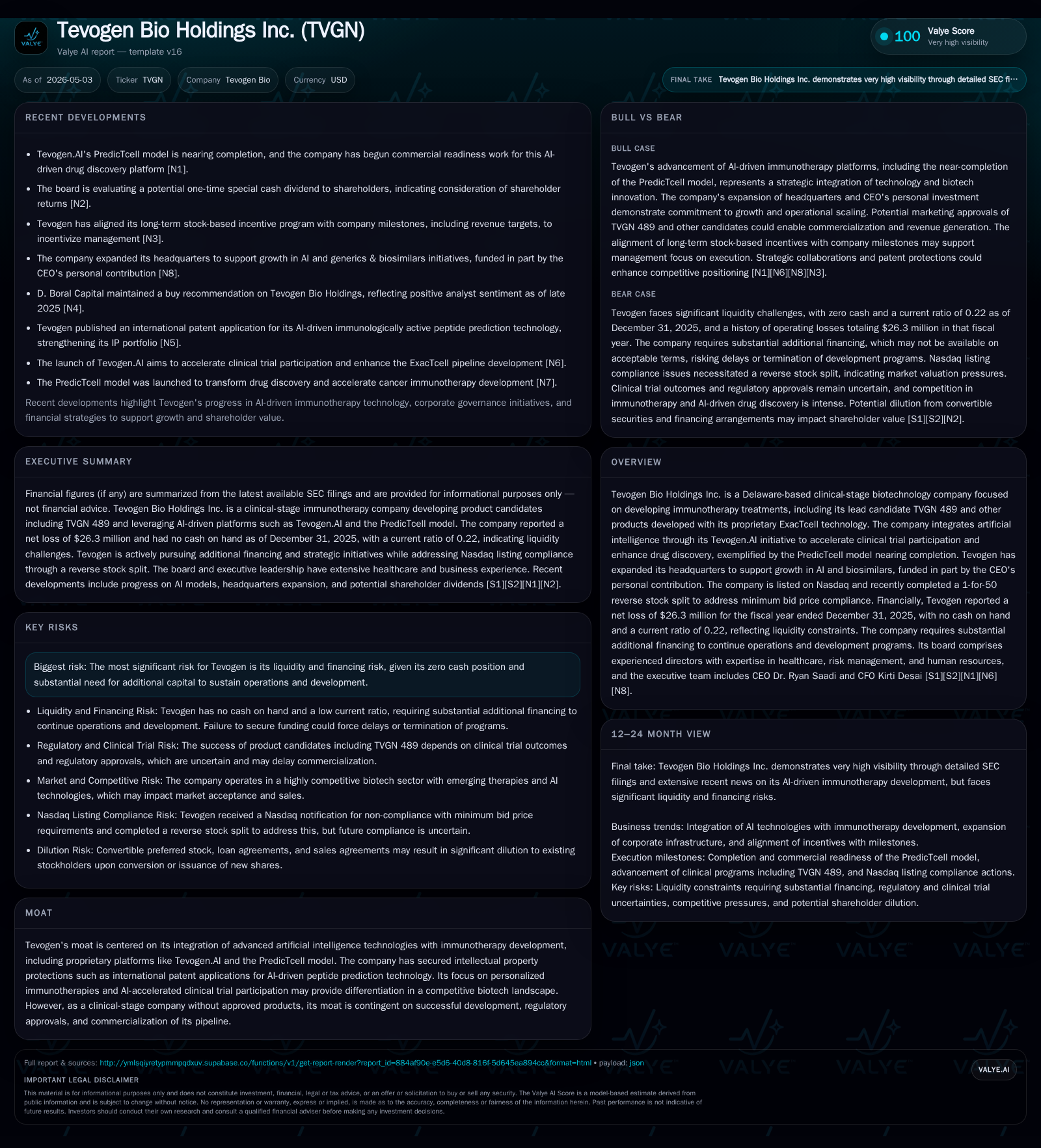
As of its November 2025 quarterly report, Tevogen Bio Holdings Inc. exhibits acute liquidity pressure with zero cash reserves and a current ratio of 0.22, placing operational continuity at risk without imminent financing. Despite this, the clinical-stage biotech is advancing its lead candidate TVGN 489 and nearing completion of its AI-driven PredicTcell model, reflecting dual strategic commitments to cellular immunotherapy and artificial intelligence innovation. The company’s business model revolves around personalized cell therapies augmented by proprietary AI technology to accelerate development timelines and improve patient targeting. However, substantial capital needs coupled with the typical uncertainties of clinical-stage development present significant risks. Near-term catalysts include potential capital raises, regulatory updates on TVGN 489, and commercial readiness deployments for PredicTcell.
Latest Operating Update Highlights Liquidity Strains and Pipeline Advances
Tevogen Bio's latest Form 10-Q filing dated November 14, 2025 ([S2]) starkly frames the company's financial fragility, with reported cash & equivalents at zero as of December 31, 2025 ([F1]). The current assets stand at approximately $1.54 million against current liabilities exceeding $7 million, yielding an especially weak current ratio of just 0.22 ([F1]). This ratio significantly underlines short-term liquidity constraints that could hamper routine operational funding absent immediate capital infusion.
Simultaneously, despite these fiscal headwinds, Tevogen continues to advance its pipeline. As per the April 22, 2026 8-K ([S3]) and corroborated by a Nasdaq news report from late April ([N1]), the PredicTcell AI model under the company’s Tevogen.AI initiative is nearing completion. This marks a meaningful operational milestone reflective of management’s commitment to integrating cutting-edge AI within drug discovery and clinical trial acceleration frameworks.
These filings collectively indicate a paradoxical situation where Tevogen trades acute financing pressures against tangible progression in its lead therapeutic programs—a scenario that demands close scrutiny as it shapes the company’s strategic runway going forward.
Business Model and Product Platform – ExacTcell Immunotherapies Plus AI Insights
Tevogen’s value proposition centers on its proprietary ExacTcell technology platform enabling personalized immunotherapy treatments. The company’s lead candidate, TVGN 489, represents an autologous cell therapy approach aimed at leveraging the patient’s own immune cells for targeted cancer treatment ([S1]). This product composition reflects a highly specialized niche in biopharmaceuticals where individualized treatment paradigms are becoming increasingly important.
Complementing the biologics arm is Tevogen.AI—a strategic initiative designed to harness artificial intelligence to streamline clinical R&D. Their PredicTcell model embodies this integration by enabling enhanced prediction of peptide candidates that facilitate robust T-cell responses ([N1]). This AI-powered augmentation targets improvements in trial speed, patient stratification accuracy, and overall probability of clinical success.
Revenues are projected to derive primarily from licensing deals, partnerships with clinical sites conducting trials, eventual product sales upon regulatory approvals, or royalties tied to the commercialization of successfully developed products. Volume and pricing dynamics will depend heavily on approved indications for TVGN 489 and succeeding pipeline candidates as well as the industry acceptance of AI-enhanced immunotherapy designs.
Competitive Dynamics – Emerging Niche in Personalized Cell Therapy with AI Integration
The biotech sector focusing on CAR-T and other immunotherapies is intensely competitive with multiple players pursuing similar cell therapy modalities. What sets Tevogen apart is its deliberate coupling of proprietary immunotherapy platforms with advanced machine learning technologies including patent-protected AI methodologies for peptide prediction ([S1][S2]).
This integrated approach can provide a defensible moat by reducing time-to-market through smarter trial design and more efficient patient recruitment—elements which commonly account for high failure rates or delays in this segment.
Nevertheless, as a clinical-stage entity without FDA-approved products yet, Tevogen faces considerable hurdles: manufacturing scale-up complexities inherent to autologous therapies, IP litigation risks over novel biologics or algorithms, pricing pressure from payers wary of high-cost therapies without proven long-term outcomes, plus steep regulatory requirements imposing long timelines before commercialization gains traction ([S2][N1]).
Growth Drivers – PredicTcell Model Completion and Commercial Preparations
Key growth levers visible in recent disclosures include:
- Near-term completion of the PredicTcell model signaling readiness to transition from pure R&D focus toward commercial applicability ([N1]).
- Progression in ongoing clinical trials for TVGN 489 alongside anticipated regulatory milestones tied to marketing approval pathways ([S3]).
- Expansion of headquarters facilities to support scaling work across both AI efforts and biosimilar development initiatives funded partially by CEO personal contributions ([N1]).
These drivers reinforce expectations that Tevogen is aiming not only for therapeutic breakthroughs but also building infrastructure to support commercialization.
Risks and Constraints – Funding Needs and Clinical Development Uncertainties
Heightened attention must be paid to liquidity risk that permeates every facet of Tevogen’s operations. With no cash on hand at year-end 2025 ([F1]) combined with a suboptimal current ratio (0.22) ([F1]), immediate capital sufficiency is questionable absent substantial fundraising or partnership transactions ([S2][S6]).
The company explicitly acknowledges these constraints in their risk disclosures: inability to raise capital could force curtailment or delay of developmental programs including TVGN 489 advancement or Tevogen.AI activities ([S2]). Moreover, cost unpredictability linked to late-stage clinical trial designs only compounds budgeting difficulties.
Complementing funding risks are typical execution uncertainties inherent in early-stage biotechs: variability in trial results, regulatory hurdles specific to novel cell-therapy approaches, competition pressures potentially limiting market share gains against alternative treatments eventually reaching approval ([S6]).
Thus while technical innovation offers promise, financial resilience emerges as the critical bottleneck determining near-term viability.
What to Monitor Next – Capital Raise, Regulatory Milestones, and AI Platform Deployment
Investors should closely watch three categories of forthcoming developments:
- Public announcements regarding financing transactions like equity offerings or strategic collaborations which would alleviate existing liquidity pressures and extend operational runway ([S3]).
- Updates on regulatory progress concerning TVGN 489's clinical trial phases that could clarify timing toward potential marketing authorization or pivotal trial outcomes ([N1],[S3]).
- Deployment milestones related to PredicTcell moving beyond internal R&D use into commercial trial support or licensing arrangements signaling tangible revenue generation capabilities ([N1]).
Tracking these metrics provides leading indicators of both financial health restoration trajectories and execution fidelity vis-à-vis their dual innovation pillars.
Financial Snapshot – Balance Sheet Pressures Amid Operational Execution
Latest financial snapshot
| Metric | Value | Period |
|---|---|---|
| Cash & equivalents | 0 USD | |
| 2025-12-31 | ||
| Current assets | $1539783 | |
| 2025-12-31 | ||
| Current liabilities | $7mm | |
| 2025-12-31 | ||
| Current ratio | 0.22x | |
| 2025-12-31 |
Source: SEC companyfacts cache [F1].
| Metric | Value (USD) |
|---|---|
| Cash & Equivalents | 0 |
| Current Assets | 1,539,783 |
| Current Liabilities | 7,068,491 |
| Current Ratio | 0.22 |
Underlying operating loss stood at approximately $26.1 million for the fiscal year ended December 31, 2025 ([F1]), reflecting heavy investment into R&D activities without offsetting revenues to date. The absence of reported debt implies no external borrowing cushions liquidity gaps currently ([F1]).
Disclaimer: This analysis is provided solely for informational purposes based on publicly available filings and news sources as indicated; it does not constitute investment advice or recommendations.
Disclaimer: This is research-only, informational analysis and not investment advice. It may include AI-generated interpretation and general industry context. Always verify important details using primary sources.

Comments