
Tesla’s Q1 2026: Operational Advances Signal Expansion in AI-Driven Mobility
Tesla’s latest quarterly filing reveals critical strides in autonomous driving, Robotaxi rollout, and AI infrastructure development that pivot its growth beyond traditional auto manufacturing.
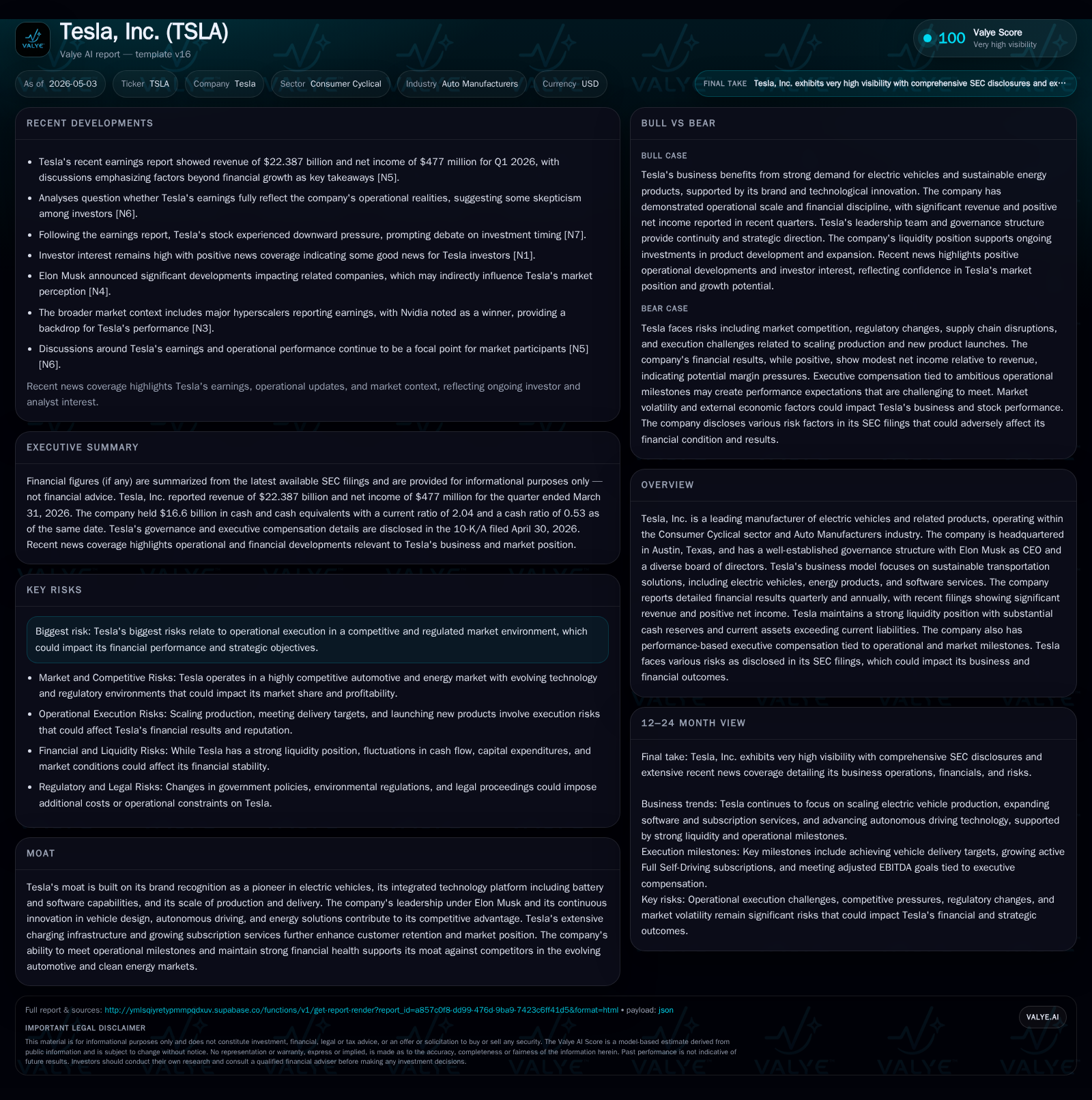
In Q1 2026, Tesla accelerated its transition from a conventional electric vehicle manufacturer to a physical AI and mobility services company, as detailed in its latest 10-Q. Key operational advancements include supervised FSD beta expansions, initial progress on Robotaxi services, and scaling of AI training infrastructure underpinning these innovations. Tesla’s integrated business model leverages hardware sales, software subscriptions, and energy products to sustain competitive advantage amid intensifying competition. Risks remain in regulatory scrutiny and litigations targeting Autopilot claims. Monitoring near-term production milestones and Robotaxi commercial metrics will be essential to evaluate Tesla's sustained execution on these strategic pivots.
Latest Quarterly Operating Highlights and Implications
Tesla’s Form 10-Q for the quarter ended March 31, 2026 [S2], supplemented by the subsequent 8-K update [S3], lays out a clear narrative of operational momentum pivoting toward a physical AI company model. The disclosures detail significant forward strides in the Full Self-Driving (FSD) supervised beta program — an advanced iteration of their autonomous driving software that increasingly relies on machine learning trained through human supervision rather than purely deterministic code. Tesla reports an expanded geographic deployment of supervised FSD beta testers, enhancing data acquisition and system robustness.
Of particular note is Tesla’s formal introduction of the Robotaxi service pilot phase, which represents a foundational shift from vehicle sales to a mobility-as-a-service revenue paradigm. Although still early-stage, this service rollout aligns closely with Tesla’s broader strategy articulated in the most recent annual filing [S1], emphasizing monetizing autonomous vehicle technology through scalable fleets rather than one-off hardware sales alone.
Moreover, Tesla has intensified investments in its internal AI training infrastructure — notably augmenting supercomputer capacity dedicated to neural network developments supporting both FSD enhancements and Optimus robotic initiatives described earlier [S1]. This infrastructure scale-up positions Tesla not just as an automaker but as an integrated technology platform provider fusing physical hardware with AI intelligence.
The management discussion underscores the transition away from a near-exclusive focus on producing electric vehicles toward embedding AI at the core of all proprietary products — amplifying operational leverage in future growth phases.
Tesla’s Integrated Business Model: Vehicles, Energy, and AI
Tesla’s revenue streams continue to reflect a hybridized model combining hardware sales (electric vehicles), energy product solutions (solar panels and Powerwall batteries), alongside an expanding base of software licenses and subscription offerings anchored by FSD capabilities [S1]. While EV unit sales remain Tesla’s dominant top-line component, margins from software features like FSD subscriptions contribute disproportionately to profitability due to low incremental costs.
The introduction of the Robotaxi service signals a material evolution—a shift toward recurring mobility service revenues that could mimic a SaaS-like economics profile if broadly scaled. This imbues customer relationships with higher switching costs given ongoing vehicle updates via over-the-air software patches combined with access to exclusive networked services such as supercharging and automated fleet usage.
Tesla leverages vertically integrated battery manufacturing capacity both to optimize cost structures and control supply chain exposures. Proprietary battery chemistry advancements improve range and performance, bolstering product differentiation against emerging EV competitors. Concurrently, Tesla's evolving ecosystem—incorporating vehicle-to-grid (V2G) programs via energy storage systems—illustrates deepening integration across transportation and renewable energy customer segments.
By monetizing software-enabled features independent of fixed hardware sales cycles, Tesla enhances revenue visibility and captures value across the full lifecycle of its products.
Industry Positioning and Competitive Moat
Tesla occupies a hybrid position blurring traditional automotive manufacturing with tech platform characteristics that few incumbents or pure-play EV startups replicate [S1]. The company sustains competitive advantages through an entrenched brand identity synonymous with innovation-led EV adoption.
Battery supply chain control underpins cost leadership while reducing exposure to global commodity fluctuations—a notable edge relative to newer entrants like Rivian or Lucid Motors [N2]. Further compounding this moat is Tesla's supercomputer investments that facilitate rapid iteration cycles on AI models powering FSD beta progressions.
Pricing power appears resilient owing to differentiated product quality coupled with sustained market demand for long-range electric vehicles paired with emerging autonomous features. However, the competitive landscape is evolving rapidly as legacy automakers accelerate electrification efforts backed by sizeable capital resources [N7]. Yet few match Tesla’s combination of vertical integration and full-stack software autonomy development intensity.
Growth Drivers Reinforced by AI and Product Innovation
Tesla’s growth trajectory hinges on several identifiable catalysts documented across annual [S1] and quarterly filings [S2]. Foremost among these is the scaling of Robotaxi services which promises transforming the company into a provider of transport-as-a-service leveraging physical AI capabilities embedded in its vehicles.
Continued geographical expansion of supervised FSD beta scales user-generated training datasets vital for refining autonomous driving algorithms —progressively unlocking market-ready functionality that can be transitioned into full self-driving commercialization with regulatory clearance.
Energy segment growth remains supported by macro tailwinds toward decarbonization policies globally while internal advancements boost product mix uplift via higher-margin storage solutions paired with solar offerings.
Recurring revenues from subscription-based software like FSD capability unlock steady margin-enhancing income streams insulated from cyclical automotive demand shocks. The increased cadence of feature rollouts coupled with OTA delivery further enhances customer engagement levels.
In combination, these factors support expectations for structural revenue expansion driven more by innovation-driven ecosystem lock-in than volume-only considerations.
Key Risks Impacting Execution and Market Dynamics
Significant risks persist primarily from operational execution challenges operating at the nexus of heavily regulated automotive safety standards intertwined with cutting-edge AI technology deployment [S17]. Regulatory investigations spearheaded by entities such as NHTSA continue probing incidents linked to Autopilot/FSD claims which could materially affect go-to-market strategies if stricter operating constraints are imposed [S4].
Relatedly, Tesla faces multiple consolidated class-action litigations asserting misrepresentations regarding driver assistance technologies' safety profile [S5][S8]. These legal battles introduce uncertainty around potential financial liabilities as well as reputational impacts concerning autonomous driving marketing claims.
Supply chain volatility particularly pertaining to specialized semiconductors and advanced battery materials poses ongoing production risk given current geopolitical complexities affecting critical raw material sources.
Margin pressure risks emerge as traditional OEMs increase EV production scale; heightened competition may drive aggressive pricing or increased marketing spend diluting Tesla's established premium positioning [N7].
Executive compensation tied closely to operational milestones highlights internal emphasis on hitting ambitious delivery targets but also concentrates outcome risk should execution falter [S1].
Upcoming Milestones and Market Signals to Monitor
Investors and analysts should monitor upcoming quarterly results for indications regarding production output trends relative to guidance —especially outputs linked directly to new Model Y lines supporting Robotaxi fleet supply [S2]. Regulatory developments impacting FSD commercialization pathways also warrant close attention as approvals or restrictions fundamentally influence scalability timelines.
Further insights are expected from detailed performance metrics tied to early-stage Robotaxi deployments such as vehicle dispatch rates, user adoption patterns, utilization efficiency ratios supplied during interim updates or corporate communications [S3]. Expansion timelines for additional supercomputer enhancements feeding into improved AI model capabilities constitute another leading indicator shaping future autonomous feature penetration rates.
Pricing strategy modifications reflecting competitive pressures or material cost pass-throughs may surface in subsequent earnings commentary providing early readouts on margin sustainability scenarios.
Finally, monitoring customer retention rates within new subscription offerings tied to autonomous functionality will offer clues about stickiness factors essential for realizing long-term revenue visibility beyond unit sales alone.
This analysis synthesizes information solely from publicly filed SEC reports including Tesla’s recent Q1 2026 10-Q and associated disclosures without speculative assumptions. It aims to provide an informed lens into Tesla’s evolving operational strategy centered on integrating AI-driven mobility solutions alongside its traditional vehicle manufacturing business model.
Disclaimer: This is research-only, informational analysis and not investment advice. It may include AI-generated interpretation and general industry context. Always verify important details using primary sources.

Comments