
Green Dot Corp Faces Strategic Transition with Partner Concentration and Regulatory Risks
Recent merger plans and ongoing partner dependencies shape Green Dot’s near-term operational dynamics.
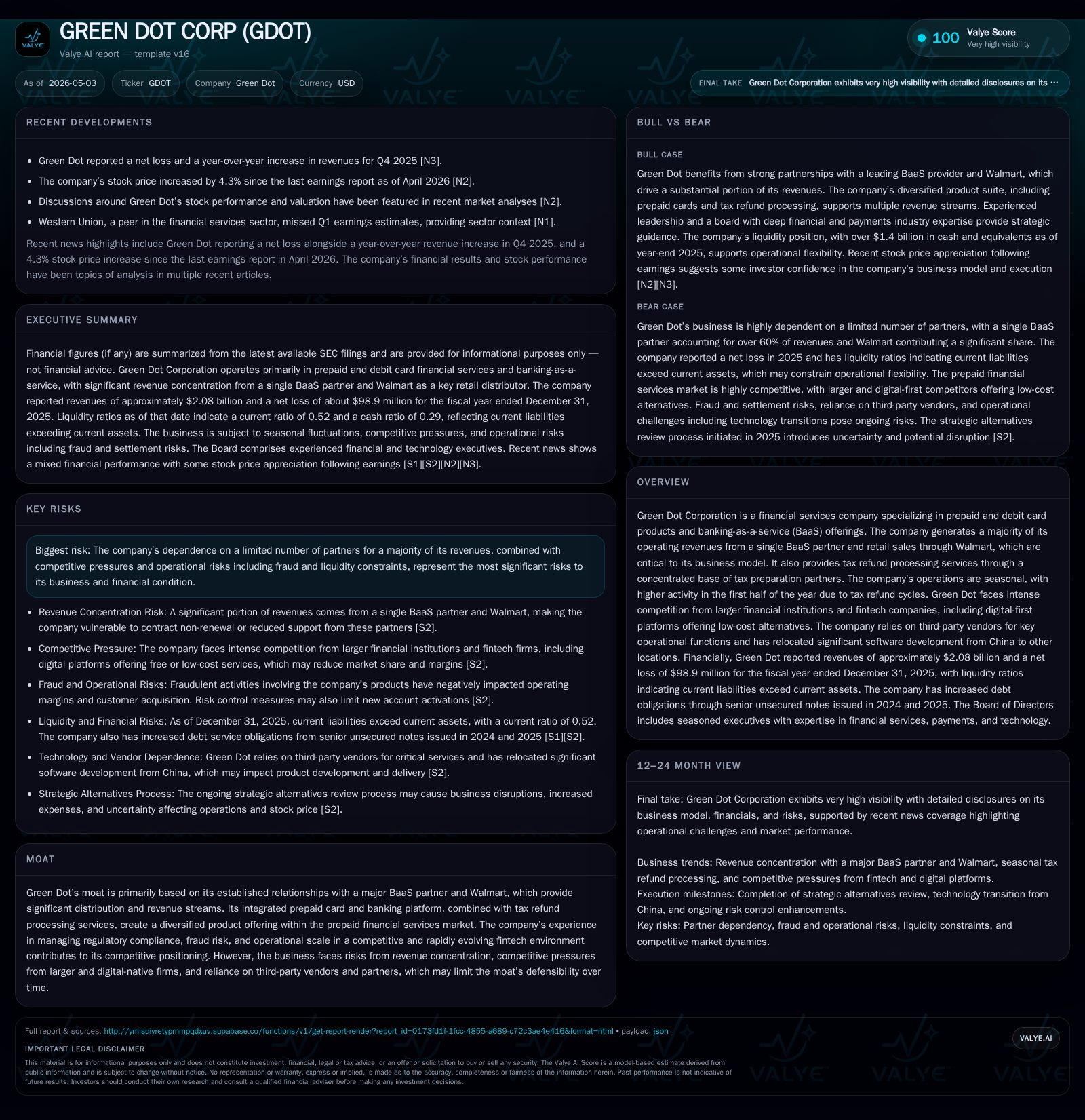
Green Dot Corporation operates primarily as a prepaid card and banking-as-a-service provider, heavily reliant on key retail and BaaS partners, notably Walmart and a single BaaS partner generating over 60% of its revenues. The company is navigating a strategic alternatives process alongside a pending merger with CommerceOne Financial Corporation. Its business results remain sensitive to partner contract renewals, regulatory oversight, and operational challenges including software development relocations. While Green Dot maintains an integrated platform serving prepaid financial services markets with seasonal demand peaks linked to tax cycles, competitive pressure from banks and fintech disruptors coupled with revenue concentration underscores growth risks. Future performance hinges on execution of integration plans, maintaining partner relationships, and regulatory compliance.
Recent Operating Update
Green Dot’s most recent quarterly filing dated November 10, 2025 [S2] details ongoing strategic activity: management disclosed initiation of a strategic alternatives review initiated in March 2025. This process introduces near-term operational uncertainty affecting employee retention, customer behavior, and partnerships critical to revenue generation. Further developments include a pending merger announced in late November 2025 [S15][S23], where Green Dot will combine with CommerceOne Financial Corporation through a series of subsidiary mergers, aiming to create a larger fintech platform with enhanced scale.
This merger triggers compensatory incentives for executives to maintain focus during integration as outlined in the April 2026 event filing [S3]. These corporate changes frame the near-term operating picture where regulatory compliance remains salient following prior regulatory actions.
Business Model
Green Dot operates primarily as a provider of prepaid debit cards and banking-as-a-service (BaaS) solutions. The core revenue generation model is transactional: customers utilize prepaid cards loaded via retail distributors (notably Walmart), generating fee income including interchange fees when cards are used. A substantial share of these fees stems from a single leading BaaS partner representing around two-thirds of total operating revenues [S2]. Retail sales through Walmart's stores account for close to 7-8% of revenues [S2]. Additionally, Green Dot processes tax refunds tied to its concentrated partnerships with tax preparation firms, leveraging seasonal cycles where refund activity peaks predominantly in H1 annually.
The company’s offerings merge prepaid card products with backend banking functions via its wholly-owned Green Dot Bank subsidiary. This setup allows capturing interchange fee income exempt from certain regulatory limits such as those imposed under Dodd-Frank but exposes the company to evolving interchange scrutiny [S25]. Revenue drivers encompass transaction volume levels influenced by customer adoption rates, usage frequency, retention metrics, as well as pricing structures governed by contract terms.
Operationally, Green Dot outsources significant functions including call centers and software development; recently it transitioned much development away from Shanghai due to geopolitical risk considerations back toward domestic or other international locations [S27]. Such moves are critical to maintain stability but also add complexity and cost.
Industry Structure and Competitive Position
The prepaid card market sits at an intersection between traditional financial institutions and fast-evolving fintech disruptors. Green Dot's moat leans on entrenched relationships: its major BaaS partnership provides scale access while Walmart acts as a primary retail distribution hub ensuring broad consumer reach across demographics less served by conventional banking. However, this concentration presents exposure should contracts lapse or volumes decline.
Competition is intense; large banks offer similar card services embedded in broader product suites accompanied by robust balance sheets facilitating marketing scale. Fintech companies emphasize mobile-first experiences with lower friction onboarding and often reduced costs, appealing especially to younger or digitally native customers.
Green Dot's experience handling regulatory compliance obligations—heightened due to its bank holding structure—and fraud risk management confers operational resilience but not immunity from disruption risk. The company also faces potential pressure from changing interchange fee regulations that could force repricing strategies impacting customer acquisition or retention efforts [S25].
Growth Drivers
Key growth drivers include expansion within its core BaaS client base by broadening product offerings such as digital wallet integrations or lending capabilities through its banking platform. Scaling direct-to-consumer digital channels beyond retail partners offers potential incremental revenue streams but requires investment in tech infrastructure and marketing.
New product rollouts aiming at leveraging consumer behavior shifts toward cashless payments represent another avenue for growth; however, timing lags exist between deployment and meaningful financial contribution given necessary client adoption curves [S5][S6].
Cross-selling opportunities leveraging its tax refund processing network could deepen wallet share per customer during cyclical peak periods.
Risks / Watchpoints / Growth Constraints
Revenue concentration stands paramount among risks. Over 60% reliance on one BaaS partner along with substantial Walmart dependency flags vulnerability to contract renewal outcomes or shifts in transaction behavior triggered by macroeconomic conditions or competitor initiatives [S2]. Operationally, reliance on third-party vendors for key services adds points of failure that could impair customer experience or delay innovation launching [S27].
Regulatory penalties remain consequential; Green Dot faced a $44 million civil monetary penalty arising from a Federal Reserve consent order in 2024 which creates ongoing compliance costs and uncertainties around evolving supervisory expectations [S10]. Additionally, interchange fee rate changes driven by legislation or payment network policy pose margin erosion risk requiring delicate pricing strategy adjustments day-to-day.
Financial leverage has increased due to issuance of senior unsecured notes maturing in September 2029; debt service obligations limit free cash flow flexibility amidst competitive pressures [S14][S16]. The company's current ratio stands at approximately 0.52 reflecting that current liabilities materially exceed current assets raising short-term liquidity considerations [F1].
Integration challenges related to the CommerceOne merger—including potential delays or cost overruns—represent material execution risks potentially disrupting operations or distracting management teams during critical periods [S26][S28]. Goodwill impairment related risks loom given the sizeable intangible asset base ($380.5 million goodwill as of September 2025) if growth targets are missed or market valuations deteriorate [S6].
What To Watch Next
Attention will center on progress toward completing the CommerceOne merger consummation which carries strategic importance for scale benefits realization and synergistic cost savings [S15][N2]. Monitoring renewal status of contracts with key BaaS partners and Walmart will be vital given their outsized influence over revenue trajectories.
Management commentary on customer activation trends post-tax season alongside any new product launches or distribution expansions will indicate success in offsetting competitive headwinds. Regulatory developments impacting interchange fees or bank holding company obligations merit continued scrutiny given their profitability impact potential.
Financial Snapshot Summary (Fiscal Year Ending December 31, 2025) [F1]
Latest financial snapshot
Despite over $2 billion in revenue generation reflecting operational scale within prepaid financial services products, profitability remains challenged due primarily to elevated operating expenses — possibly tied to restructuring costs associated with strategic reviews and merger activities — resulting in a net loss during fiscal 2025.
The company's current ratio stands at approximately 0.52 reflecting that current liabilities materially exceed current assets, which may require careful working capital management especially through cyclical troughs outside peak tax refund demand windows [F1].
Overall leverage from senior unsecured notes constrains flexibility but can be managed assuming stable cash flows from core transactional businesses continue.
This analysis is based solely on publicly filed SEC documents through April 2026 combined with recent press disclosures and does not constitute investment advice.
Disclaimer: This is research-only, informational analysis and not investment advice. It may include AI-generated interpretation and general industry context. Always verify important details using primary sources.

Comments