
Super League Enterprise Boosts Playable Media Platform Via Strategic Acquisitions Amid Financial Headwinds
New acquisitions and leadership changes mark Super League's renewed focus on interactive advertising growth despite recent losses.
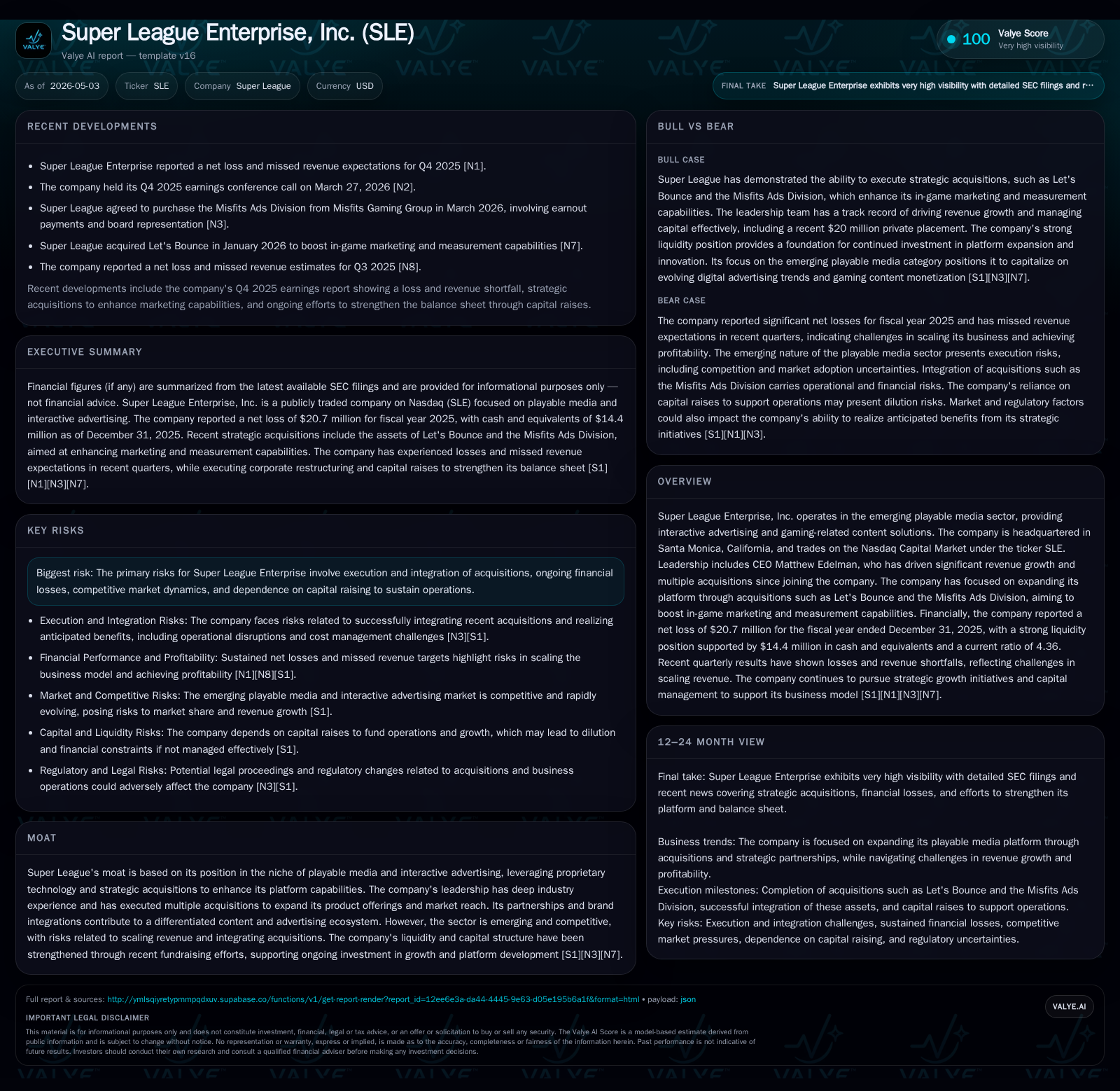
Super League Enterprise, Inc. reported continued operating losses and revenue challenges in its latest fiscal year but has strategically expanded its playable media platform through acquisitions such as Let's Bounce and the Misfits Ads Division. Leadership restructurings and multiple capital raises have bolstered liquidity, positioning the company to integrate recent acquisitions aimed at enhancing its interactive advertising and in-game marketing measurement capabilities. While the emerging sector remains competitive and execution risks persist, Super League’s proprietary technology and strategic asset consolidation underpin its efforts to grow advertiser engagement within gaming demographics.
Latest Operating Update and Strategic Highlights
Super League Enterprise disclosed fiscal year-end results in a March 2026 filing alongside an earnings call that confirmed continuing net losses ($20.7 million) despite pushing advances in interactive advertising solutions for gaming platforms [S3][F1][N1]. Revenue underperformance was noted during a broader corporate restructuring led by CEO Matthew Edelman—who assumed his Chairmanship in early 2026 after becoming CEO in April 2025. This leadership transition followed strategic capital raises exceeding $26 million across six months culminating in a notable $20 million private placement to stabilize operations [S1].
Key operational developments included the completion of two significant acquisitions: Let's Bounce—the purchase agreement executed January 2026—and the Misfits Ads Division acquisition announced in March 2026 [S25][S26]. These moves are positioned as foundational expansions enabling deeper advertiser integration within the company's growing playable media ecosystem. Additionally, executive hires accompanying these transactions aim to elevate commercial execution tasked with scaling digital properties focused on younger demographics [S25]. Despite these proactive steps toward business expansion, recent quarterly disclosures highlighted revenue shortfalls that accentuate near-term execution risks inherent to integrating disparate assets while driving topline growth under financial constraints [N1][N2].
Business Model and Platform Overview
Super League Enterprise operates at the intersection of playable media content creation and interactive advertising delivery within gaming environments—leveraging proprietary technologies that allow brands to embed marketing directly into player experiences. The core revenue stream derives from advertisers purchasing placements that are integrated natively into games or interactive media offerings across platforms primarily utilized by Gen Z and millennial audiences [S1][N3].
The company's product suite encompasses owned platforms, third-party developer partnerships, and recently acquired assets like Let's Bounce (a creator of social gaming apps) alongside the Misfits Ads Division which enriches analytics and ad measurement capabilities critical for performance-based digital marketing strategies [S25][S26]. This combination strengthens Super League's ability to provide granular campaign tracking impossible through traditional display ads alone—an increasingly demanded feature given shifts toward privacy regulations undermining cookie-based tracking.
User engagement metrics (platform session duration, active user counts) serve as fundamental KPIs underpinning value propositions to brand clients who prioritize immersive ad exposure over passive impressions. The company also benefits from embedded switching costs: advertisers committed via platform-specific contracts face barriers to migration due to custom integration requirements and proprietary measurement tools developed internally. However, monetization scaling depends heavily on broadening advertiser base beyond current gaming-focused verticals—demanding continuous product innovation aligned with evolving gamer preferences.
Competitive Environment and Industry Positioning
Within an emerging but fast-evolving sector encompassing playable media content providers and interactive ad tech specialists, Super League occupies a niche increasingly coveted by legacy digital advertising giants seeking footholds inside gaming ecosystems. Its competition ranges from startups targeting gamified marketing solutions to established players like Unity Technologies offering in-game monetization SDKs.
Super League’s competitive advantage stems from its strategic acquisitions that provide not only content assets but also backend measurement sophistication tailored uniquely to its audience segment. While scale disadvantages remain relative to entrenched digital ad platforms (Google, Meta), the company's integrated approach combining content ownership with direct advertiser interfaces offers a differentiated ecosystem that appeals specifically to brands aiming for authentic engagement with hard-to-reach younger consumers [S1].
Regulatory shifts increasing restrictions on consumer data use impose both constraints and opportunities; Super League's first-party data model embedded within games provides resilience against third-party cookie deprecation trends that hamper competitor universal targeting methods. Nevertheless, industry standards around ad effectiveness measurement inside playable media remain nascent thus requiring ongoing investments to establish credibility across advertiser portfolios.
Growth Drivers Anchored in Acquisition Integration
The strategic acquisition of Let's Bounce adds complementary social gaming content rapidly growing user engagement volumes while enabling cross-platform brand integrations capable of upselling existing advertisers. Meanwhile, bringing Misfits Ads Division under the Super League umbrella enhances campaign analytics depth—including real-time attribution—potentially unlocking higher CPMs by improving ROI transparency for clients [S3][S25].
Management signals optimism that accelerating rollout of unified reporting dashboards post-acquisition will translate into increased advertiser retention rates and expansion of revenue per customer. Internal KPIs pertinent here include monthly active users (MAU), average session times evidencing sustained attention spans valuable for branded content campaigns, plus uplift in conversions traced through bespoke tracking modules installed across acquired properties [S1].
CEO Edelman's restructuring efforts reflect a disciplined approach focusing on synergies between acquired businesses especially around salesforce consolidation and product roadmaps aimed at seamless user experience integration—critical for maximizing inventory monetization efficacy at scale [S1]. Furthermore, incremental new product launches leveraging combined IP aim to diversify revenue lines via subscriptions or premium interactive content tied to brand sponsorships rather than purely impression-based models.
Risks and Operational Challenges Ahead
Despite clear strategic intent, execution risks dominate near-term outlooks given complexity integrating multiple diverse acquisitions simultaneously while managing cost structures under persistent operating losses [S2][S3]. The sector's rapid innovation cycle coupled with emerging standards for measuring success places pressure on management teams to deliver tangible advertiser outcomes quickly or risk client churn.
Further risk revolves around capital market dependency; although liquidity appears robust presently with over $14 million cash equivalent balance and no reported debt at year-end 2025—supporting active R&D and commercial expansion—the company remains unprofitable suggesting future financings may be necessary if organic revenue ramp delays materialize [F1]. Competitive encroachment from global digital ad titans investing heavily into gamified ad formats also poses margin compression threats.
Technical risks relate partly to maintaining platform stability amid integration of disparate codebases acquired via Let's Bounce or Misfits Ads Division; any user experience degradation could deter engagement levels critical for advertiser value realization. Management must also navigate shifting regulatory environments affecting data privacy compliance which is particularly salient given player demographic sensitivities around consent frameworks.
Upcoming Catalysts and Key Milestones
Investors should monitor forthcoming quarterly earnings scheduled after each fiscal quarter close which are expected to provide updated revenue figures reflecting initial impacts from acquisition synergies becoming tangible operationally. Successful realization of earn-out triggered payments related to Let's Bounce based on achieving $500K and $1M net revenues during calendar 2026 represent concrete milestones signaling commercial traction of acquired assets [S25].
Moreover, announcements detailing enhancements to integrated analytics products stemming from Misfits Ads Division technology rollouts could serve as inflection points validating management’s platform consolidation thesis. Client renewal rates—especially among marquee advertisers—and expansion into additional gaming verticals or international markets will serve as further demand markers.
Finally, any updates regarding capital structure evolution including new financing rounds would be relevant watching points given historical reliance on external capital injections for sustaining growth trajectories documented since mid-2025 restructuring initiatives.
Financial Position Snapshot
This analysis is based solely on publicly available filings as referenced; it does not constitute investment advice or a recommendation regarding securities of Super League Enterprise, Inc.
Disclaimer: This is research-only, informational analysis and not investment advice. It may include AI-generated interpretation and general industry context. Always verify important details using primary sources.

Comments