
New Fortress Energy Advances Debt Restructuring and Strategic Refinancing
NFE’s April 2026 $50 million Brazil Bridge Term Loan marks key incremental financing amid ongoing restructuring efforts to stabilize liquidity and preserve LNG operations.
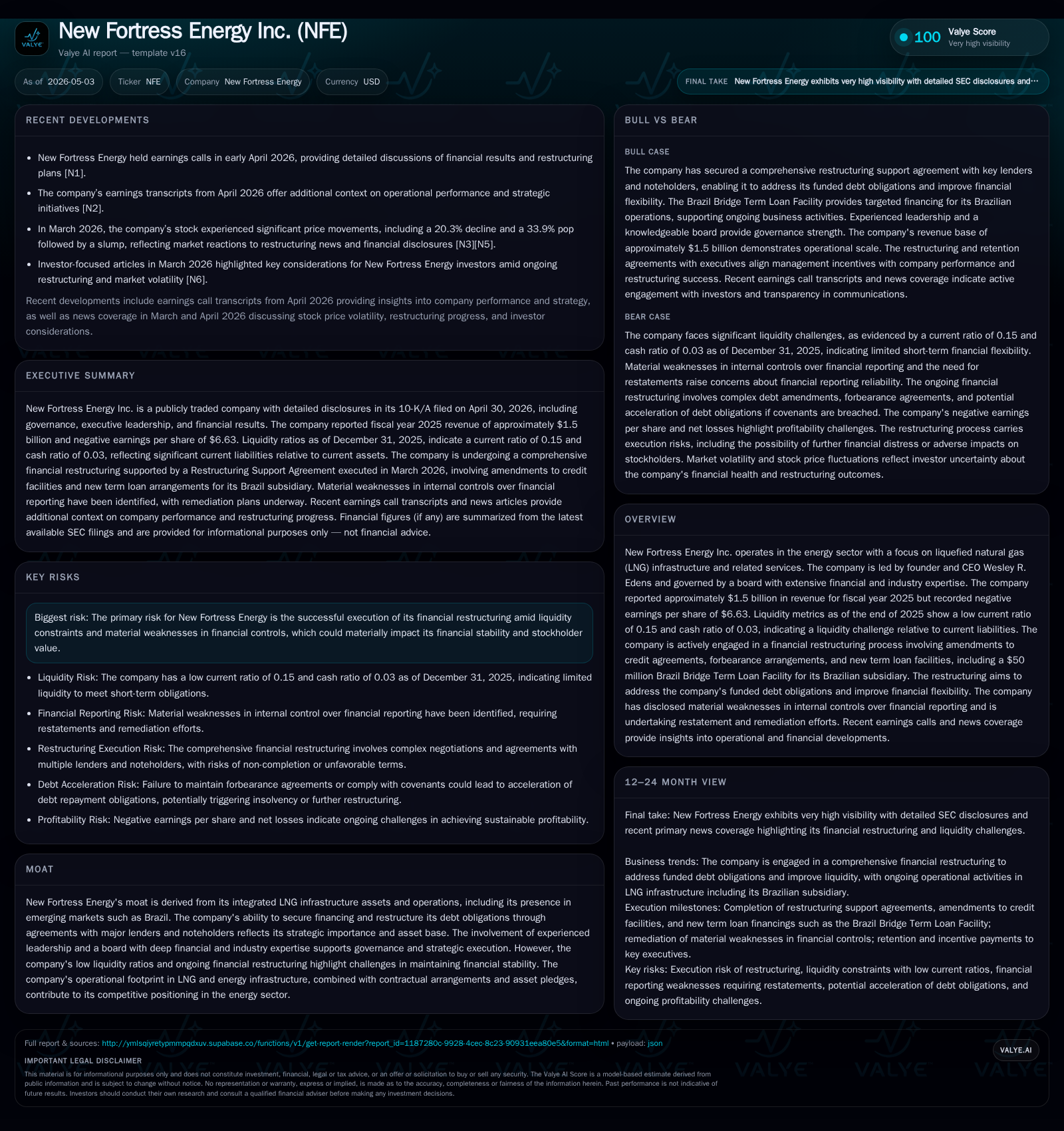
In April 2026, New Fortress Energy (NFE) secured a $50 million senior secured bridge loan facility for its Brazilian subsidiary, NFE Brazil Holdings Limited, as part of broader debt restructuring initiatives. This financing aims to support near-term operational continuity in Brazil while the company actively pursues comprehensive restructuring support agreements with its lenders. Despite generating $1.5 billion in revenue for fiscal 2025, NFE contends with severe liquidity constraints highlighted by a current ratio of 0.15 and total debt exceeding $8.3 billion. The company’s integrated LNG infrastructure assets in emerging markets underpin its business model, yet challenges remain in executing restructuring plans and remediating internal financial controls.
Recent Debt Refinancing and Credit Agreement Update
On April 14, 2026, New Fortress Energy's Brazilian subsidiary entered into a senior secured multiple draw term loan facility totaling $50 million—the Brazil Bridge Term Loan Facility—under a new credit agreement with Wilmington Savings Fund Society acting as administrative agent [S3]. This facility is integral to maintaining operational liquidity within NFE Brazil amid the broader restructuring context. The loan matures upon refinancing events or other customary triggers including change-of-control or incurrence of additional indebtedness by NFE Brazil or its subsidiaries [S19].
The covenants embedded in this credit agreement encompass routine reporting requirements and restrict actions that might harm lender collateral or the borrower’s financial position.
Given NFE’s severely constrained liquidity profile—reflected by a current ratio of only 0.15 as of year-end 2025—and substantial funded debt exceeding $8.3 billion [F1], this incremental funding is critical to maintaining Brazil operations without disruption during this period of heightened financial uncertainty.
Business Model Analysis: Integrated LNG Infrastructure and Emerging Market Focus
New Fortress Energy operates an integrated liquefied natural gas (LNG) infrastructure business primarily focused on emerging markets such as Brazil [S1]. Its model centers on building, owning, and operating LNG liquefaction facilities along with downstream distribution assets. Revenue streams are generated mainly from long-term energy sales agreements that provide contractual cash flow stability despite sizable operating losses reported recently — operating income recorded negative $1.12 billion for fiscal 2025 despite nearly $1.5 billion in revenue [F1].
The company effectively combines asset ownership with commercial contract coverage that includes fixed fees plus variable volumetric components tied to LNG throughput volumes and market prices. This blended approach aims to mitigate volume risk while enabling participation in upside from growing demand for cleaner-burning natural gas over traditional fuels.
NFE’s exposure to emerging markets is a double-edged sword: while countries like Brazil feature robust growth potential fueled by increasing energy consumption and environmental policy shifts favoring natural gas versus coal or oil-based fuels, these markets also present regulatory complexity and political risk that challenge project permitting and capital investment timelines.
Competitive Positioning within the Evolving LNG Sector
In the competitive landscape of LNG infrastructure, New Fortress Energy differentiates itself through an integrated value chain approach encompassing liquefaction facilities coupled with end-market distribution capabilities tailored for developing economies [S1]. This integration facilitates operational efficiencies and closer control over supply logistics compared to entities solely focused on upstream or transport segments.
Still, the sector remains highly capital intensive with high barriers to entry due to the scale of LNG facility construction costs and stringent safety/environmental regulations. Larger multinational energy companies with stronger balance sheets maintain competitive advantages through superior access to capital markets and diversified asset portfolios.
Furthermore, client switching costs hinge on contractual obligations and infrastructural lock-in—once buyers commit to LNG supply via dedicated terminals or pipelines, shifting suppliers may entail significant cost or disruption risks. Regulatory complexity intensifies competition dynamics; in emerging markets such as Brazil, permitting uncertainties can delay projects or increase compliance costs affecting timelines.
Growth Opportunities: Market Expansion, Asset Utilization, and Contractual Coverage
NFE targets growth primarily through increased utilization of existing liquefaction capacity spurred by rising natural gas consumption particularly in developing economies transitioning their power generation mix towards lower carbon alternatives [S1,N1]. Expanding volumes underpin margin improvement if fixed costs are diluted over larger throughput.
Further opportunities exist via securing additional long-term purchase agreements expanding contractual coverage that stabilize cash flow visibility beyond spot market volatility. Geographic diversification following strategic separation steps concerning Brazilian operations may unlock distinct investment pathways more aligned with local regulatory regimes [S4,S7].
Additionally, evolving energy market trends favor cleaner fuels amid global climate initiatives potentially catalyze structural demand growth rather than cyclical peaks typical of commodity markets. New Fortress’s assets positioned strategically across multiple countries support capturing such structural growth drivers.
Key Risks: Liquidity Constraints, Financial Controls, and Restructuring Execution
The dominant risk theme centers on NFE’s strained liquidity position as evinced by its current ratio of merely 0.15 reflecting current liabilities vastly outweighing current assets [F1]. This gap underscores acute refinancing needs in tandem with operational cash burn pressures.
Compounding this are material weaknesses identified in internal control over financial reporting (ICFR) that led to multiple required restatements including reclassification adjustments relating to capitalization of interest payments and classification errors between investing versus financing activities—factors that raise concerns about financial governance robustness during critical restructuring phases [S8,S12].
Execution risk also looms large given the complexity of negotiations encapsulated within the RSA involving multiple creditor groups encompassing secured notes holders across various tranches alongside term loan lenders subject to stringent milestone deadlines through late 2026 [S4,S20]. Failure to meet requisite approvals—including stockholder votes on significant charter amendments permitting equity issuances exceeding previously authorized levels—and timely closing could precipitate accelerated defaults or forced asset sales adverse to value preservation.
Near-Term Watchpoints: Refinancing Milestones and Operational Developments
Key upcoming milestones revolve around satisfying RSA conditions including definitive documentation execution, requisite High Court sanctioning of restructuring plans under UK insolvency provisions applicable to indirect subsidiaries (PlanCos), and U.S. recognition proceedings under Chapter 15 enacted concurrently [S4,S20]. These legal procedural steps underpin binding creditor compromises releasing obligations on funded debt instruments upon transaction close.
Stockholder approval outcomes expected at the Company’s 2026 Annual Meeting will be closely monitored due to prospective proposals amending corporate charters to permit share issuances exceeding current limits by over 20%, adjustments allowing reverse stock splits aimed at maintaining NASDAQ listing compliance alongside incentive plan share pool expansions crucial for retaining key personnel incentives amid transition periods [S20].
Progress in remedying ICFR deficiencies documented throughout fiscal 2025 culminating in formal remediation plans outlined for forthcoming annual reports will serve as a barometer of governance improvements vital for investor confidence rebuilding efforts making transparency paramount during ongoing restructuring communications [S8,S12].
Operationally, monitoring utilization rates at core LNG facilities especially in Brazil post-restructuring bridge loan deployment will provide traction signals reflecting whether liquidity support translates into stabilized commercial performance aligning with projected volume ramp-ups discussed in recent earnings calls [N1,N2].
Current Financial Snapshot: Liquidity and Leverage Metrics
Latest financial snapshot
| Metric | Value | Period |
|---|---|---|
| Cash & equivalents | $226mm | |
| 2025-12-31 | ||
| Total debt | $8.3bn | |
| 2025-12-31 | ||
| Net debt | $8.1bn | |
| 2025-12-31 | ||
| Current assets | $1329mm | |
| 2025-12-31 | ||
| Current liabilities | $8.7bn | |
| 2025-12-31 | ||
| Current ratio | 0.15x | |
| 2025-12-31 |
Source: SEC companyfacts cache [F1].
| Metric | Amount (USD) | Date |
|---|---|---|
| Revenue | $1.5 billion | FY2025 |
| Cash & Equivalents | $226 million | |
| 2025-12-31 | ||
| Total Debt | $8.33 billion | |
| 2025-12-31 | ||
| Current Assets | $1.33 billion | |
| 2025-12-31 | ||
| Current Liabilities | $8.65 billion | |
| 2025-12-31 | ||
| Current Ratio | 0.15 | |
| 2025-12-31 |
The balance sheet reflects considerable leverage pressure amplified by limited liquid assets relative to near-term liabilities suggesting continued reliance on successful execution of restructuring deals paired with working capital management discipline moving forward [F1,S3].
This analysis is based exclusively on information as reported in recent SEC filings supplemented by industry knowledge; it does not constitute investment advice or a recommendation regarding securities of New Fortress Energy Inc.
Disclaimer: This is research-only, informational analysis and not investment advice. It may include AI-generated interpretation and general industry context. Always verify important details using primary sources.

Comments