
MODIV Industrial’s 2025 Financial Reset and Strategic Position in Industrial REITs
Updated SEC filings reveal MODIV Industrial's recent financial performance and strategic initiatives amid evolving industrial real estate market dynamics.
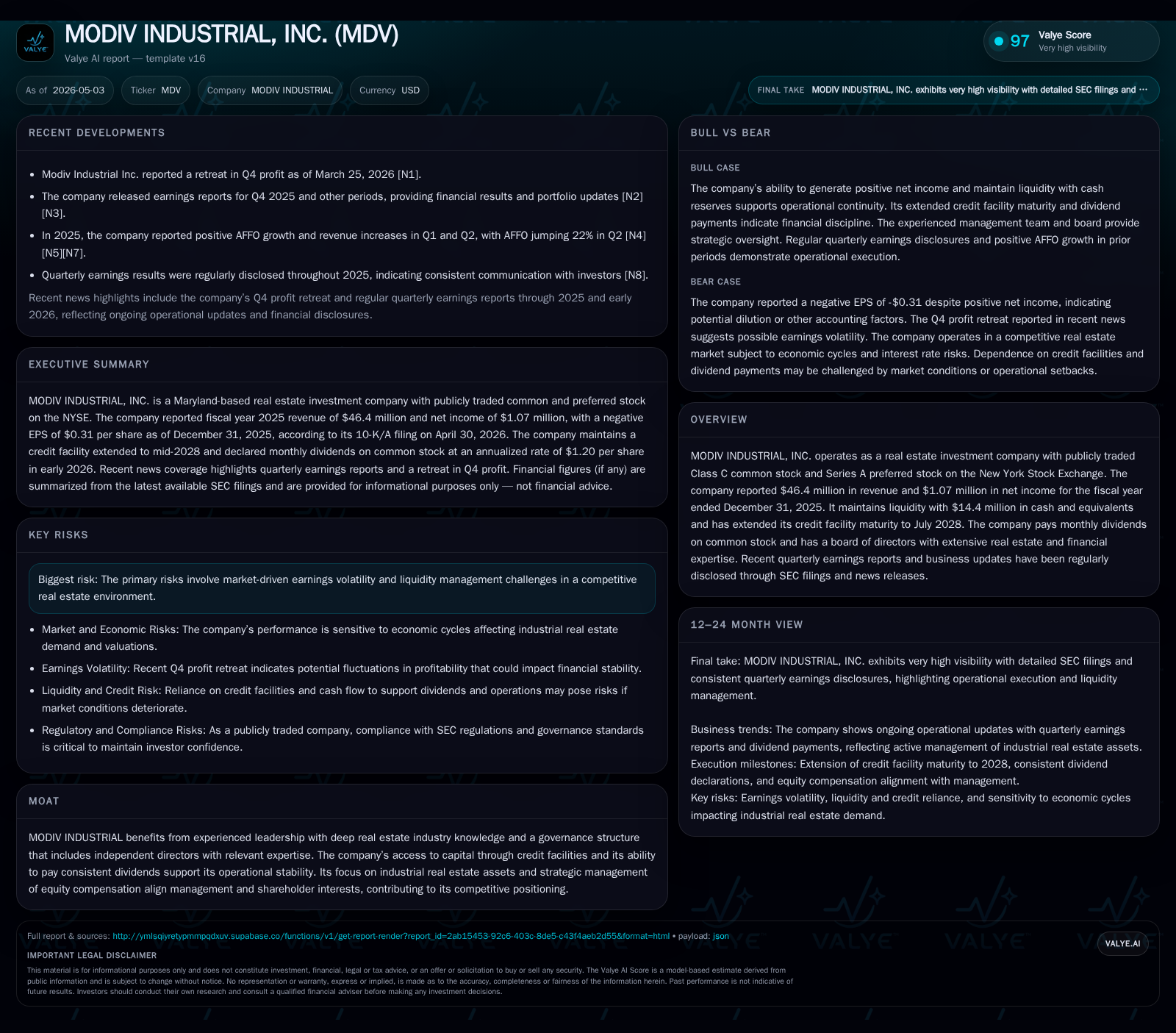
MODIV Industrial, Inc. reported $46.4 million revenue and $1.07 million net income for fiscal year 2025, demonstrating modest profitability amid continued operational challenges. The company extended its credit facility maturity to July 2028, reinforcing liquidity management efforts. As an industrial-focused REIT with monthly dividends and an experienced governance team, MODIV maintains a focused business model balancing stable rental income against a substantial debt load. Future growth depends on optimizing portfolio lease terms, maintaining occupancy, and strategic capital management in a competitive supply-constrained environment.
Recent Operating Update: Insights from Latest SEC Filings
MODIV Industrial’s most recent quarterly report filed November 14, 2025 [S2], paired with the March 25, 2026 event filing [S3], provides the latest authoritative snapshot of the company’s operating and financial posture. For the year ended December 31, 2025, revenue totaled approximately $46.4 million with net income of about $1.07 million [F1]. This modest profit level underscores ongoing pressure on margins despite stable top-line performance.
Key strategic moves highlighted include the extension of MODIV’s credit facility maturity to July 18, 2028 [S27], affording greater runway to navigate refinancing cycles amid volatile capital markets. The company remains committed to paying monthly dividends on its common stock at $0.10 per share per month through mid-2026 [S10][S28]. Leadership changes also occurred: longtime CFO Raymond Pacini transitioned to Executive Vice President after stepping down in early 2026, succeeded by John C. Raney who brings deep legal and operational expertise [S14].
These recent disclosures signal that while MODIV maintains financial discipline and continuity in shareholder distributions, the firm is simultaneously focused on strengthening its balance sheet and operational resilience.
MODIV's Business Model: Industrial Real Estate Focus With Investor-Friendly Structures
As detailed in the amended annual report filed April 30, 2026 [S1], MODIV operates primarily as a real estate investment trust concentrating on industrial properties leased mostly to commercial tenants under medium- to long-term leases that generate predictable rental streams. Revenue is largely composed of contractual rents forming recurring cash flows essential for dividend funding.
The monthly dividend policy—at an annualized rate of $1.20 per share common stock—is investor-friendly but must be balanced against net income constraints emerging from operating costs and interest expenses given significant leverage [S10][F1]. The company leverages experienced executives with background in real estate finance and governance to drive value creation through active portfolio management and capital structure optimization.
Management alignment is reinforced by equity compensation plans designed to focus efforts on sustainable NOI growth and prudent risk management [S1]. Robust lease terms with industrial tenants—often benefiting from e-commerce logistics demand—support stable occupancy levels contributing to consistent rent collections.
Competitive Landscape and Industry Dynamics for Industrial REITs
MODIV’s competitive arena is shaped by intense demand for industrial real estate driven primarily by e-commerce growth, supply chain reshoring trends, and limited new industrial construction in key markets [S1]. These factors enhance pricing power through longer weighted average lease terms (WALT) and higher tenant retention rates compared to other commercial property types.
Still, the competitive landscape requires active leasing strategies amid constrained development pipelines that occasionally restrict expansion capacity. Industrial assets generally command strong net operating income (NOI) margins supported by efficient operational models; however capital markets volatility can pressure valuations especially for smaller REITs like MODIV where scale limits economies.
Regulatory considerations such as zoning restrictions impact new industrial developments but also preserve asset scarcity enhancing long-term asset values. Tenants’ behavior shows preference for stable landlords capable of maintaining property quality and flexible lease structures adapting to evolving supply chain needs.
Growth Opportunities: Portfolio Optimization and Capital Management
MODIV’s near-term growth avenues revolve around increasing revenues via lease renewals at improved rental rates reflective of market tightness [S3][S1]. Prudent acquisitions or dispositions aimed at optimizing portfolio mix could also contribute to enhanced NOI margins if selectively executed.
Capital management actions underpinning growth include refinancing existing debt at favorable terms—as exemplified by the January 2026 amendment extending credit facility maturity to mid-2028—which lowers refinancing risk and provides liquidity cushions [S27]. Efficient use of available cash balances ($14.38 million at year-end) alongside debt enables potential share repurchases or incremental investments aligning with shareholder value objectives.
Structural tailwinds from supply-demand imbalances in industrial space foster organic demand-driven growth prospects over medium terms if occupancy rates remain high. Key performance indicators like renewal spreads above expiring rents and portfolio occupancy will be critical metrics to track execution effectiveness.
Risks and Constraints: Market Volatility and Liquidity Management
Despite strengths, MODIV faces meaningful risks including earnings volatility influenced by tenant default risk or rent deflation possibilities during economic downturns as noted in risk disclosures [S2]. Additionally, liquidity constraints are nontrivial given a total debt load exceeding $262 million offset by relatively small cash reserves yielding approx. $248 million net debt at fiscal year-end [F1].
Interest rate fluctuations pose refinancing cost pressures particularly given current macroeconomic uncertainties impacting credit markets. Regulatory shifts affecting tax treatment or real estate valuations could further constrain flexibility.
The company’s ability to sustain dividends depends heavily on stable rental incomes coupled with effective cost control; any material disruption would challenge payout consistency given narrow net income margins recorded recently.
Upcoming Catalysts: Monitoring Guidance and Execution Milestones
Investors will want to monitor MODIV’s upcoming quarterly results releases following the March 25, 2026 event filing cadence for trends in leasing velocity, occupancy changes, and earnings quality signals [S3][N1]. Management commentary regarding full-year outlooks or adjustments in distribution policies will provide insight into strategic recalibration considering market conditions.
Key refinancing milestones aligned with credit facility expiration in July 2028 frame a critical horizon for evaluating capital structure sustainability. Portfolio acquisition or disposition announcements will serve as additional catalysts indicative of growth or simplification initiatives.
Tracking lease renewal spreads against market benchmarks alongside occupancy metrics on supplemental data published post-quarter-end remain practical barometers of underlying business momentum.
Financial Snapshot: Liquidity, Debt, and Dividend Sustainability
Latest financial snapshot
| Metric | Value | Period |
|---|---|---|
| Cash & equivalents | $14mm | |
| 2025-12-31 | ||
| Total debt | $262mm | |
| 2025-12-31 | ||
| Net debt | $248mm | |
| 2025-12-31 |
Source: SEC companyfacts cache [F1].
| Metric | Amount (USD) |
|---|---|
| Revenue | $46.39 million |
| Operating Income | $15.82 million |
| Net Income | $1.07 million |
| Cash & Equivalents | $14.38 million |
| Total Debt | $262.07 million |
| Net Debt | $247.69 million |
This snapshot as of December 31, 2025 encapsulates the core financial state underpinning MODIV’s operations [F1]. The relatively thin net income juxtaposed with significant leverage illustrates tight margin dynamics where operational gains are critical for dividend coverage sustainability.
The extension of credit facility maturity reduces near-term refinancing pressure yet mandates careful balance sheet stewardship over coming years. Monthly dividends paid consistently reflect a commitment to shareholder returns but must be reconciled continuously against underlying cash flow generation amid variable market conditions.
This analysis synthesizes the latest SEC filings alongside sector context to map MODIV Industrial’s position within the industrial REIT landscape. The company’s blend of focused industrial assets, disciplined capital strategy, and governance quality underpins operational stability while exposing areas sensitive to cyclical fluctuations and leverage management challenges.
Disclaimer: This article is an industry analyst review based solely on publicly available SEC filings and news disclosures as cited; it does not constitute investment advice or recommendations about any security or issuer mentioned.
Disclaimer: This is research-only, informational analysis and not investment advice. It may include AI-generated interpretation and general industry context. Always verify important details using primary sources.

Comments