
Coursera’s Q1 2026 Results Highlight Merger Risks and Growth Challenges
Coursera’s Q1 earnings reveal operational pressures and underscore uncertainties tied to its pending Udemy merger amid competitive and macroeconomic headwinds.
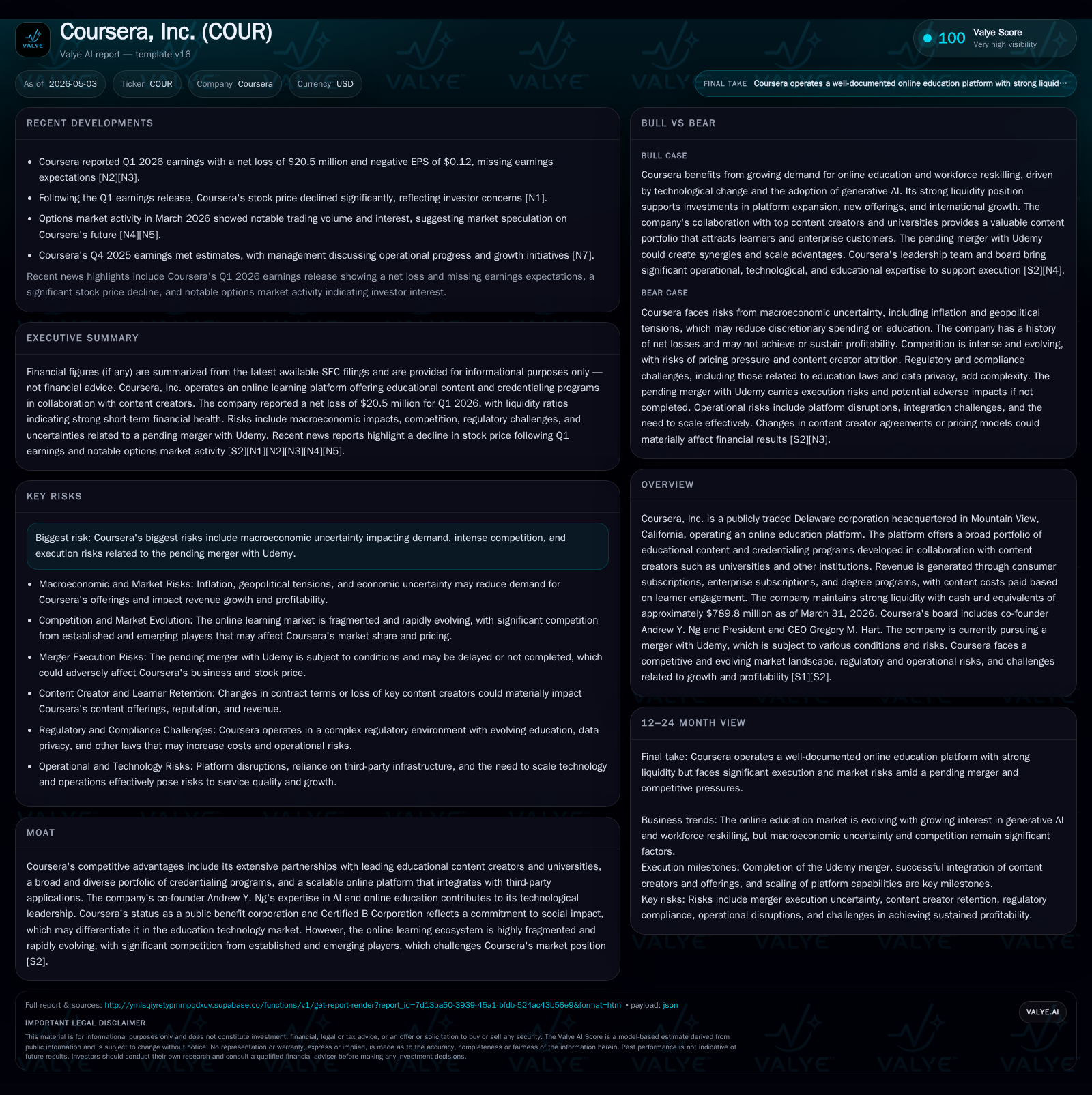
In Q1 2026, Coursera reported mixed operational signals marked by challenges in growth rates and learner engagement, set against a strong balance sheet supporting runway. The company continues navigating the complex integration risks related to its all-stock merger with Udemy, with regulatory approvals pending and potential execution headwinds. Coursera’s diversified revenue model leverages consumer, enterprise, and degree programs anchored in deep partnerships with universities, but the evolving online education market and macroeconomic factors temper near-term demand visibility. Future growth depends on successful integration, expanding paid learner conversion, and innovation including AI-driven offerings.
Q1 2026 Operating Update: What Moved in the Latest Filing
Coursera’s latest quarterly disclosure ([S2], filed 2026-04-30) reveals a nuanced performance profile as the company wrestles with slowing top-line momentum amid ongoing investment in product innovation and marketplace repositioning. The company ended the quarter with robust liquidity—cash and equivalents stood at approximately $789.8 million as of March 31, 2026—with a current ratio of roughly 2.47 signaling healthy short-term financial flexibility ([F1]). However, revenue growth faced headwinds from a combination of macroeconomic softness impacting consumer spend and pricing pressures within enterprise accounts.
Executives publicly addressed operational challenges linked to learner engagement metrics not meeting earlier projections, an issue that directly influences Coursera’s variable content costs given their model ties content expense payments to active learner usage ([S2], [S3]). This dynamic underscores margin volatility risks inherent in their revenue-cost contract structure.
Strategically pivotal is Coursera's pending all-stock merger with competitor Udemy announced in December 2025 ([S3], [S4]). While regulatory green lights have been forthcoming—including early termination of FTC review waiting periods—the transaction remains subject to additional customary conditions such as shareholder approval and final antitrust clearance. The filings highlight typical deal-phase tensions: contractual constraints on alternatives pursued by either party, risk of termination fees if the deal fails to close, litigation exposure from merger-related lawsuits, plus operational distractions that could weigh on near-term growth execution ([S2], [S6]).
Business Model Breakdown: Revenue Streams and Contract Dynamics
Coursera monetizes its platform through three primary channels: individual consumer subscriptions for access to courses; enterprise accounts supplying corporate clients with workforce development solutions; and fully accredited online degree programs developed in partnership with universities ([S1]). Each pathway brings distinct revenue mechanics:
- Consumer Subscriptions: Users pay monthly or annual fees for access to premium content; conversion rates from free users are critical KPIs influencing volume.
- Enterprise Subscriptions: Large-scale contracts with organizations often structured around seat licenses and volume tiers create relatively stable recurring revenue but face negotiating pressures.
- Degree Programs: Higher-priced offerings tied to institutional partnerships generate revenue per enrollment but may require upfront investments in curriculum development.
Content costs pose a unique leverage factor in Coursera’s margin profile since many contracts stipulate payments correlated directly to active learner engagement rather than fixed licensing. This variable cost basis increases operational risk if user activity dips unexpectedly or if content creators demand more favorable terms during renewals ([S1]).
Competitive Positioning: Scale, Partnerships, and Technological Moats
Coursera distinguishes itself through its extensive collaborations with leading academic institutions worldwide—a moat built over years fostering a broad array of credentialing programs ranging from professional certificates to accredited degrees ([S1],[S2]). This deep university ecosystem enhances credibility relative to marketplace peers primarily focused on unaccredited or non-degree content. Additionally, the company benefits from co-founder Andrew Ng’s stature in AI education technology circles, which supports internal capabilities for pioneering generative AI-based learning enhancements.
The certification as a public benefit corporation and Certified B Corporation adds a layer of social mission alignment that could resonate with socially conscious consumers and partners—a subtle but meaningful differentiator in an industry increasingly scrutinized for impact beyond pure commerce ().
However, the online learning sector remains highly fragmented with aggressive competition from Udemy (pre-merger), LinkedIn Learning/Microsoft Learning platforms, edX (now part of another group), and emerging niche players. Switching costs for learners are relatively low given freely available alternatives and evolving industry standards around digital credentials, pressuring Coursera’s retention strategies ([S2]).
Growth Drivers: Market Potential, Product Innovation, and AI Integration
Growth vectors for Coursera include expanding penetration into global markets less saturated by digital education offerings alongside higher-value product innovations. The company is ramping up efforts to convert free-tier users into paying subscribers—a core structural challenge given shifting consumer purchasing behavior post-pandemic ([S2]). Enterprise sales initiatives continue expanding globally but contending with economic slowdowns tempered demand.
Importantly, Coursera is integrating generative AI functionality across its platform—from automated tutoring to personalized learning pathways—which management cites as a potential catalyst to reaccelerate engagement metrics. While promising technologically, this remains nascent in adoption curves. Its efficacy will be a key performance signal over coming quarters (, [S2]).
Risks and Constraints: Merger Execution, Macroeconomic Sensitivity, and Regulatory Challenges
Critical near-term risks converge around merger completion contingencies. The deal imposes substantive contractual obligations limiting alternative transactions while exposing Coursera to termination fee liabilities should obstacles arise ([S2]). Litigation risks linked to stockholder suits could generate additional legal expenses or delay closure.
Macroeconomically, inflationary cost pressures coupled with potential recessionary impacts globally could dampen discretionary expenditure on education services both at individual consumer levels and within corporations’ training budgets. Regulatory scrutiny around data privacy (especially GDPR compliance) plus evolving U.S. Department of Education rules post-Loper Bright judicial shifts introduce compliance cost burdens that may constrain operating flexibility ([S6],[S11]).
Content partner negotiations remain a wildcard; these deals drive substantial portions of cost structure that can be sensitive to re-pricing demands or contract duration mismatches disrupting financial predictability ([S2]).
Upcoming Catalysts: Guidance, Milestones, and Integration Progress
Looking forward, investors will focus closely on quarterly earnings releases where management may update guidance reflecting merger progress or adjusted demand assumptions ([S5]). Approval milestones from foreign regulators—potentially announced later this year—will materially influence deal certainty ([S4]). Post-close integration agenda execution will require detailed monitoring of synergy realization timelines alongside retention of key talent across both merging organizations.
Market adoption metrics such as paid learner conversion ratios from freemium users will serve as important barometers for organic growth sustainability amid intensifying competition ( [S2],[N1],[N2]).
Financial Overview: Liquidity Profile and Operational Efficiency Snapshot
Latest financial snapshot
| Metric | Value | Period |
|---|---|---|
| Cash & equivalents | $790mm | |
| 2026-03-31 | ||
| Current assets | $893mm | |
| 2026-03-31 | ||
| Current liabilities | $362mm | |
| 2026-03-31 | ||
| Current ratio | 2.47x | |
| 2026-03-31 |
Source: SEC companyfacts cache [F1].
| Metric | Value (USD) | Date |
|---|---|---|
| Cash & Equivalents | 789,800,000 | |
| 2026-03-31 | ||
| Current Assets | 893,400,000 | |
| 2026-03-31 | ||
| Current Liabilities | 362,400,000 | |
| 2026-03-31 | ||
| Current Ratio | 2.47 | |
| 2026-03-31 |
While Coursera recorded an operating loss of $77.4 million annually (latest available figure ending Dec 31, 2025), it maintains ample cash reserves that underpin resilience through integration uncertainties ([F1]). This liquidity cushion enables continued investments in platform development even as revenue ramps slowly under competitive pressure.
This analysis reflects information solely available up through early May 2026 based on public SEC filings [S1]-[S26] and verified third-party news sources [N1]-[N5]. It omits investment advice or valuation opinions by design.
Disclaimer: This is research-only, informational analysis and not investment advice. It may include AI-generated interpretation and general industry context. Always verify important details using primary sources.

Comments