
NETGEAR Battles Profit Pressure While Securing the FCC Edge on Foreign Routers
The company’s latest quarter reveals earnings beats offset by revenue declines amid strategic regulatory gains that could underpin future product and software leadership.
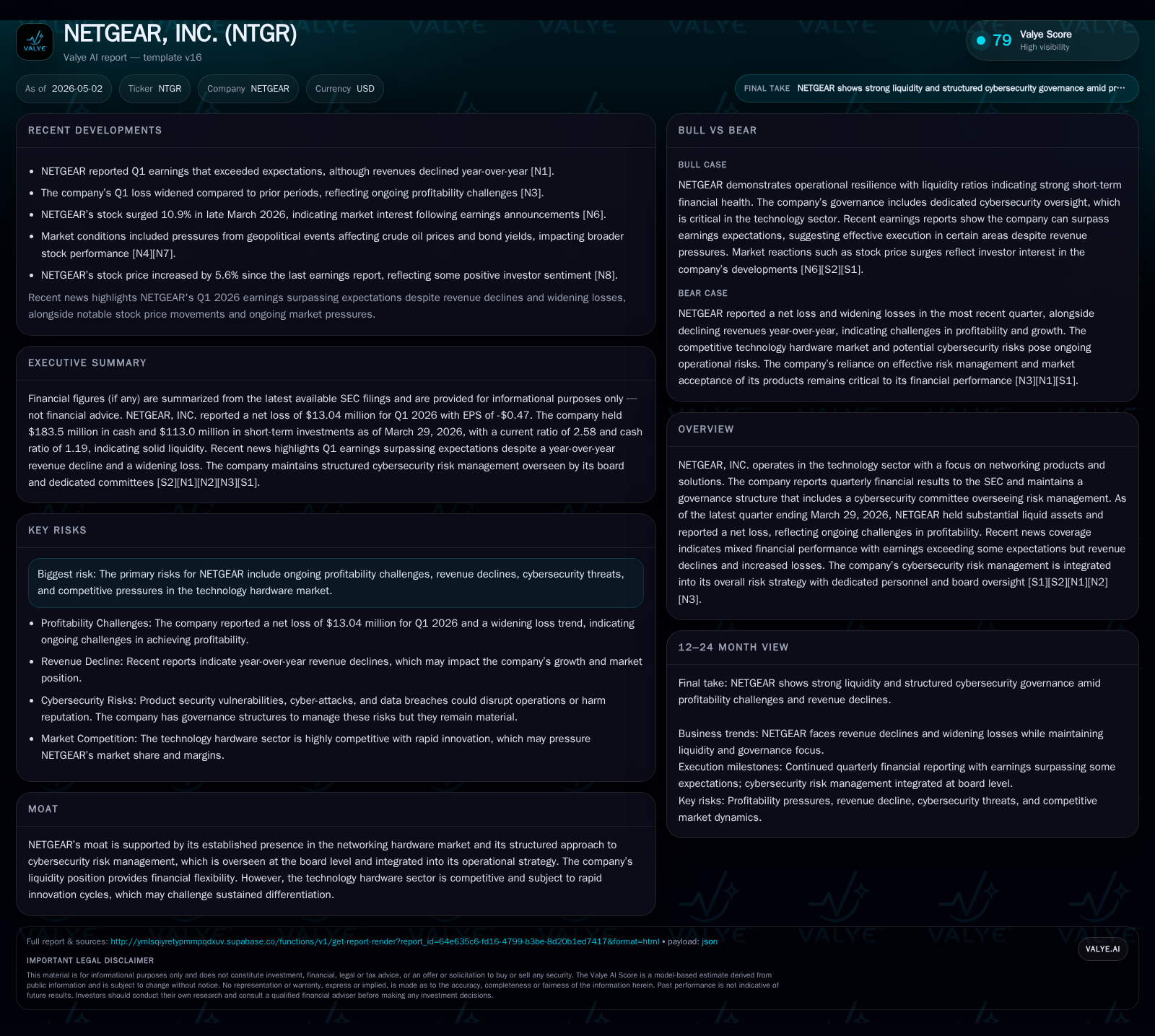
NETGEAR's Q1 2026 results delivered a notable earnings beat but saw year-over-year revenue decline paired with widening net losses, reflecting ongoing profitability challenges. Critically, NETGEAR became the first consumer router vendor to obtain conditional FCC approval under new regulations concerning foreign-made routers, enabling indefinite new launches and software updates—an advantage competitors have yet to secure. This regulatory milestone, combined with NETGEAR’s established cybersecurity governance and product portfolio, underpins its competitive position in a fast-evolving networking hardware market. While facing intense pricing pressure and cybersecurity risks, growth opportunities hinge on exploiting this regulatory edge, expanding software update revenues, and deepening SMB market penetration.
Recent Quarterly Results Signal Mixed Momentum
In its fiscal Q1 ended March 29, 2026, NETGEAR reported earnings that exceeded analyst expectations even as overall revenue contracted compared to prior periods. The quarter’s financials showed sales headwinds alongside a widening net loss, a duality reflecting both demand softness in key segments and elevated operating costs associated with product innovation and risk management [S2][N1][N2]. The company’s ability to post an earnings beat despite these pressures demonstrates some operational resilience but underscores persistent challenges in returning to profitability. Revenue declines signal structural or cyclical softness that may reflect broader sector constraints or intensified competition.
Navigating Regulatory Milestones: FCC Conditional Approval for Foreign-Made Routers
In April 2026, NETGEAR won a critical regulatory victory by becoming the first retail consumer router manufacturer granted conditional approval under the U.S. Federal Communications Commission’s new rules addressing "foreign produced" networking equipment perceived as national security risks [S6][S10]. This approval allows NETGEAR to continue launching new routers and releasing software updates indefinitely without the restrictions set to apply starting March 2027.
This regulatory edge effectively differentiates NETGEAR from peers who either have not yet obtained such approval or face limitations on updating existing products post-2027. Given the industry reliance on ongoing firmware improvements for security patches, performance enhancements, and feature rollouts, this clearance is strategically important. It not only protects existing product usability but also enables agile responses to evolving network threats via timely software refreshes.
However, the competitive landscape remains dynamic as other vendors may pursue similar approvals; meanwhile, legacy devices from competitors without updates will persist in the market—maintaining pressure on NETGEAR’s pricing and market share [S6][N2].
Understanding NETGEAR’s Business Model and Product Quality Dynamics
NETGEAR operates primarily through designing, manufacturing, and distributing networking hardware products targeted at home consumers and small-to-medium businesses (SMB). Revenue streams derive from both product sales—ranging from routers to extenders—and complementary software update licenses that deliver ongoing cybersecurity protections and feature enhancements [S1].
Product quality is anchored in reliability combined with embedded cybersecurity controls overseen by a dedicated cybersecurity committee at the Board level. This governance structure integrates cybersecurity risk management at every stage of product lifecycle—from design through post-sale support—limiting vulnerabilities in an increasingly hostile IT environment [S1][S15].
Customer adoption tends toward high retention because network hardware switching involves complexity and disruption risks; thus software subscription renewals represent a growing revenue lever. However, hardware innovation cycles remain critical given rapid technology advances (e.g., Wi-Fi standards evolution) driving replacement demand.
Competitive Positioning Within a Rapidly Evolving Networking Hardware Industry
The networking hardware space is crowded with well-established incumbents offering broad product portfolios alongside agile startups introducing niche innovations. NETGEAR faces persistent pricing pressure exacerbated by commoditization of hardware components amid global supply chain variability. Its ability to differentiate hinges upon synergizing hardware with robust cybersecurity features and responsive software updating capabilities supported by its FCC clearance [S1][N3].
Capacity constraints are less emphasized currently but could arise as demand fluctuates based on macroeconomic conditions or technology adoption rates. The company’s focus on SMB segments allows it to capture specialized needs but invites competition from enterprise-focused providers adapting their SMB offers.
Rapid innovation cycles require continuous R&D investment to introduce next-generation WLAN standards support (e.g., Wi-Fi 7) while maintaining backward compatibility—a non-trivial technical challenge impacting development timelines and cost structures.
Key Growth Drivers: Demand Expansion, Software Differentiation, and Market Penetration
Growth initiatives center on capitalizing early on the FCC conditional approval by accelerating new foreign-made router releases that competitors cannot match immediately. This creates an opportunity window for enhanced unit shipments supported by marketing push tied directly to uninterrupted software upgrade capabilities [S6][N2].
Expanding revenues from software update licensing constitutes another crucial lever. Given rising cyber-threat landscapes, customers value sustained device protection; monetizing this via effective subscription models can improve margin profiles over time.
Further penetration into SMB markets leverages tailored networking solutions augmented with managed services, positioning NETGEAR beyond commodity hardware into more sticky service ecosystems.
Tracking KPIs such as incremental unit shipments post-FCC approval announcement or booking trends for software renewals will be telling signals of how quickly these growth drivers convert into financial performance improvements.
Risks and Constraints: Profitability Headwinds, Competitive Pressures, and Cybersecurity Challenges
Despite regulatory advances, several risks cloud near term outlooks. Persistent losses driven by compressing gross margins echo intensified cost structures linked to R&D spending for innovation and compliance overheads around cybersecurity risk mitigation policies detailed extensively in SEC filings [S7][S15].
Cybersecurity risk itself remains elevated despite sophisticated governance frameworks. Product security flaws or breaches could precipitate reputational damage or regulatory penalties given the sensitivity of networking infrastructure to exploits.
Competition status quo constrains pricing power as alternative vendors aggressively defend market share; lagging technology refreshes or failed differentiation could intensify revenue declines.
Regulatory uncertainty persists beyond the current FCC conditional approvals — either through changes in national security policies or extension of Covered List restrictions — potentially impacting future product strategies.
What Investors Should Monitor Next
Upcoming catalysts include subsequent quarterly earnings releases providing updated data points on revenue trends post-FCC approval rollout phases [S2]. Watch for competitor announcements regarding their own regulatory approvals which would alter competitive dynamics considerably [S3].
Monitoring renewal rates of software licenses will shed light on customer retention effectiveness amidst margin pressures.
Additional proxy indicators consist of shipment volumes correlating with newly launched models benefiting from unrestricted software update status.
Latest Financial Snapshot
Latest financial snapshot
| Metric | Value | Period |
|---|---|---|
| Cash & equivalents | $183mm | |
| 2026-03-29 | ||
| Current assets | $643mm | |
| 2026-03-29 | ||
| Current liabilities | $249mm | |
| 2026-03-29 | ||
| Current ratio | 2.58x | |
| 2026-03-29 |
Source: SEC companyfacts cache [F1].
| Metric | Amount (USD) |
|---|---|
| Cash & Equivalents | $183,476,000 |
| Current Assets | $642,818,000 |
| Current Liabilities | $248,722,000 |
| Current Ratio | 2.58 |
NETGEAR maintains a strong liquidity buffer as reflected by its $183 million cash reserve combined with a current ratio above 2.5—indicating ample short-term asset coverage relative to liabilities [F1]. This financial flexibility supports ongoing research investments and buffers operational losses noted in recent quarters.
This analysis is for informational purposes only and does not constitute investment advice or recommendations.
Disclaimer: This is research-only, informational analysis and not investment advice. It may include AI-generated interpretation and general industry context. Always verify important details using primary sources.

Comments