
Fermi Inc. Updates Spotlight Leadership Shift and Execution Risks for Project Matador
Recent executive changes and ongoing development challenges underscore the critical execution risks facing Fermi’s flagship infrastructure project.
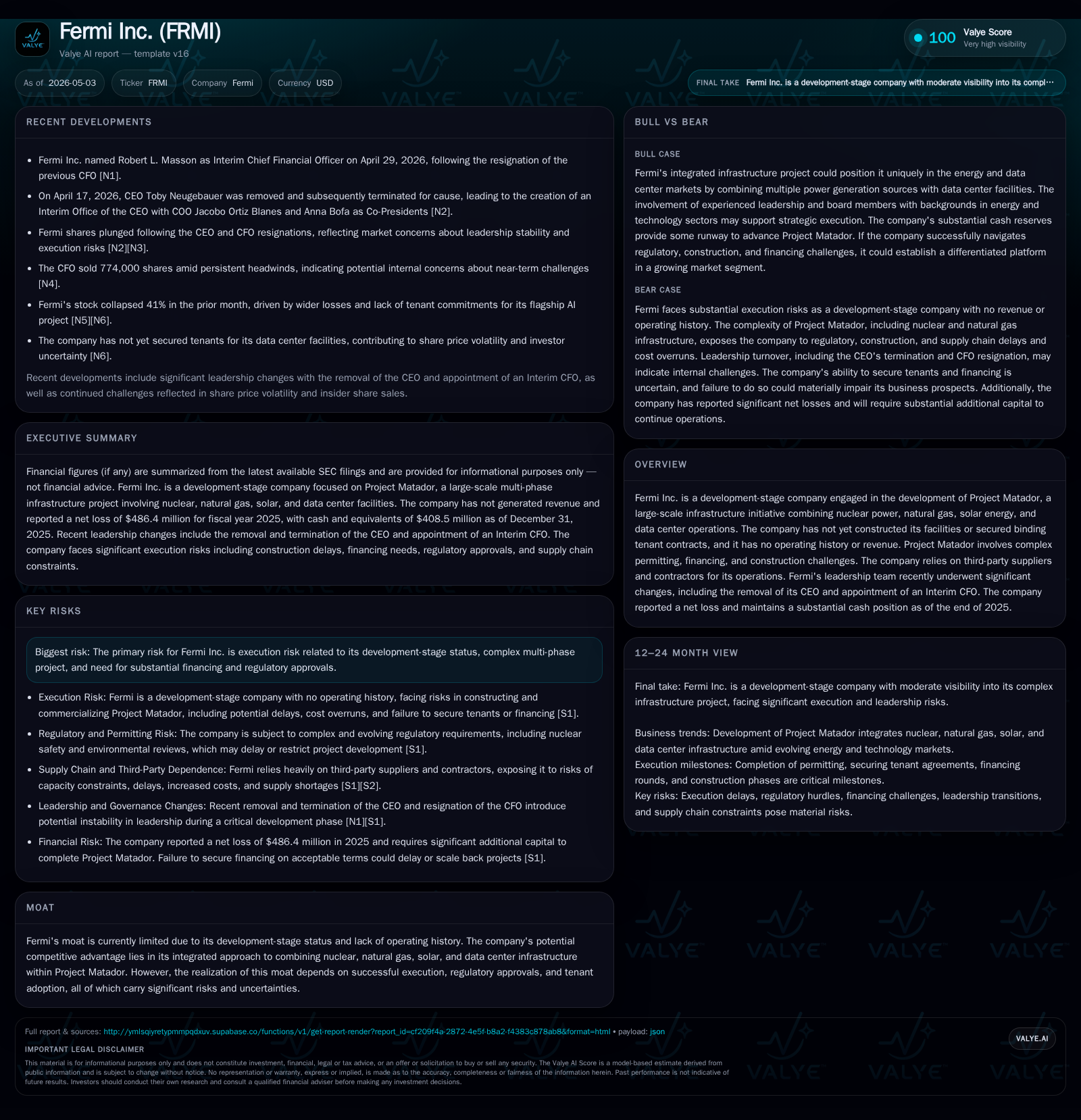
Fermi Inc. remains a development-stage company focused on its ambitious Project Matador, an integrated energy and data center campus combining nuclear, natural gas, and solar power. The latest quarterly filing reveals no tenant commitments or construction start, while recent leadership upheaval includes removal of the CEO and appointment of an interim CFO, contributing to operational uncertainty. Execution risks linked to regulatory approvals, financing, supply chain dependencies, and tenant acquisition dominate the near-term outlook. The company’s cash position provides a runway for continued development but hinges on successful milestone achievements in funding and leasing to advance.
Latest Operating Developments: Executive Changes and Strategic Posture
Fermi Inc.’s most recent quarterly report filed November 12, 2025 underscores its ongoing status as a development-stage company with no operating revenue or tenant contracts executed for its flagship Project Matador. Crucially, the latest disclosures confirm that no construction has yet begun, underpinning persistent execution risk [S2]. In parallel to these operational realities, significant leadership turnover has occurred early in 2026. On April 17, 2026, Toby Neugebauer was removed from his role as CEO and subsequently terminated for cause by month-end, also relinquishing his board seat [S7][S24]. The Company established an interim Office of the CEO led jointly by COO Jacobo Ortiz and board observer Anna Bofa to steer daily operations during the search for a permanent replacement [S7]. Additionally, longtime CFO Miles Everson resigned in April amid ownership shifts within investor groups [S14]. On April 29th, Robert L. Masson was appointed Interim CFO with no current compensation arrangements announced [S20][N1].
This leadership flux injects uncertainty into Fermi’s ability to execute the multifaceted development plan requiring close coordination among regulatory bodies, financiers, contractors, and prospective tenants. Such executive instability is particularly impactful given the capital-intensive and technically complex nature of Project Matador’s hybrid infrastructure strategy.
Business Model Overview: Project Matador’s Integrated Energy-Data Center Proposition
Fermi’s business model revolves around delivering an integrated infrastructural ecosystem designed to serve emerging hyperscale AI data center demands through a unique hybrid energy platform. Project Matador aims to co-locate nuclear power generation with natural gas plants and solar farms coupled with data center facilities on contiguous land near Texas Tech University System properties for which Fermi holds leasehold interests [S1]. This combination seeks to provide a cost-efficient, reliable power source tailored for high-density computational loads.
Revenue potential stems primarily from long-term leases of data center space to AI service providers and other cloud infrastructure tenants who demand consistent power availability and increasingly sustainable energy portfolios. However, as confirmed in the annual report amendment and quarterly filings, no binding tenant agreements are secured to date. Thus far Fermi remains solely responsible for developmental expenditures absent operational cash flows or contractually committed revenue streams [S1][S2].
The company outsources manufacturing and construction heavily to third parties across all components—including nuclear module providers—which while necessary amplifies project risk exposure to vendor performance and supply chain disruptions.
Industry Positioning: Competitive Context and Partner Dependencies
Fermi operates at the intersection of advanced energy infrastructure provision and hyperscale data center real estate markets—both highly complex industries characterized by high capital intensity, regulatory scrutiny, and lengthy development horizons. Their integrated approach is novel but unproven at scale.
Competitive barriers include regulatory licensing especially concerning nuclear facilities; niche expertise required for simultaneous multi-modality energy integration; plus the challenge of attracting anchor tenants without previous operational proof points. Tenant switching costs remain low in this nascent phase due to absence of signed leases or facility readiness.
Supplier dependence is prominent; delays or cost inflation among nuclear technology vendors or solar equipment suppliers materially influence schedule adherence given limited internal manufacturing capability [S2]. Regulatory approvals represent another key bottleneck given federal/state jurisdiction complexities around nuclear plant siting.
Growth Drivers: Capital Raising, Tenant Acquisition, and Technology Integration
Progress toward commercial viability hinges on three intertwined pillars:
- Tenant Acquisition: Success requires securing binding lease agreements from large-scale hyperscale AI operators at prices supporting project economics. The company stresses potential financing on acceptable terms remains uncertain—delays here could cascade across timeline estimates [S2].
- Technology Integration: Fermi’s deployment of MATRIX—an AI-powered project management platform—is intended to streamline scheduling, procurement coordination, and operational oversight during construction phases representing a technological differentiator if proven at scale [S1][S2].
Maintaining site control via leasehold interest with Texas Tech University System is essential for preserving optionality until financial closure is achieved.
Risks and Constraints: Execution Complexities, Regulatory Hurdles, and Market Uncertainty
Beyond leadership volatility discussed above, risks are abundant:
- Execution Risk: Zero operating history combined with unprecedented scale multi-phased build heightens probability for delays or budget overruns.
- Regulatory Risk: Nuclear permitting processes involve long lead times with uncertain outcomes potentially affecting construction start.
- Technology Obsolescence: Rapid AI evolution may shift data center design parameters faster than Project Matador can adapt.
- Financing Risk: Inability to procure sufficient capital on favorable terms threatens delay or downsizing scenarios.
- Tenant Adoption Risk: Without signed tenants there is no certainty adopted pricing levels or pace can sustain projected financial models.
- Supply Chain Dependencies: Reliance on specialized vendors exposes project timelines to external disruption.
- Security Threats: Cyber/physical attacks pose potential integrity threats to hybrid grid systems requiring robust countermeasures [S2].
Near-Term Catalysts: Leadership Stability, Binding Tenant Deals, and Financing Milestones
Key milestones likely to influence Fermi’s prospects include:
- Completion of permanent CEO recruitment stabilizing strategic direction.
- Formalization of compensatory arrangements with newly appointed CFO Robert Masson signaling governance normalization [S3].
- Public announcements confirming binding tenancy deals validating market demand assumptions.
- Advancement in permitting processes particularly safety approvals related to nuclear components.
- Successful closings on major project financing rounds enabling physical buildout commencement.
Investor attention will closely monitor public disclosures aligning with these critical execution markers throughout mid-to-late 2026 timeframe [N1][S4].
Financial Profile: Liquidity Status and Capital Structure Snapshot
As of December 31, 2025, Fermi held cash and equivalents of approximately $409 million against total debt of about $149 million, resulting in a net cash position near $260 million [F1]. This cash buffer provides a degree of short-term liquidity capacity despite substantial net losses reflecting pre-revenue developmental spend scale. However, reliance on successive capital raises remains critical given absence of operational cash flow generation. Conservative capital stewardship will be necessary until tenant revenue streams materialize.
Disclaimer: This analysis is based exclusively on publicly available filings as listed herein through May 2026. It aims solely to provide an informed perspective on Fermi Inc.’s current business situation without offering investment recommendations or price forecasts.
Disclaimer: This is research-only, informational analysis and not investment advice. It may include AI-generated interpretation and general industry context. Always verify important details using primary sources.

Comments