
BiomX Inc. Expands AI Defense Portfolio with ZorroNet and DR. Frucht Acquisitions Amid Clinical Program Challenges
Recent acquisitions reposition BiomX as a hybrid biotech-defense entity, highlighting new revenue streams but also raising integration and liquidity concerns.
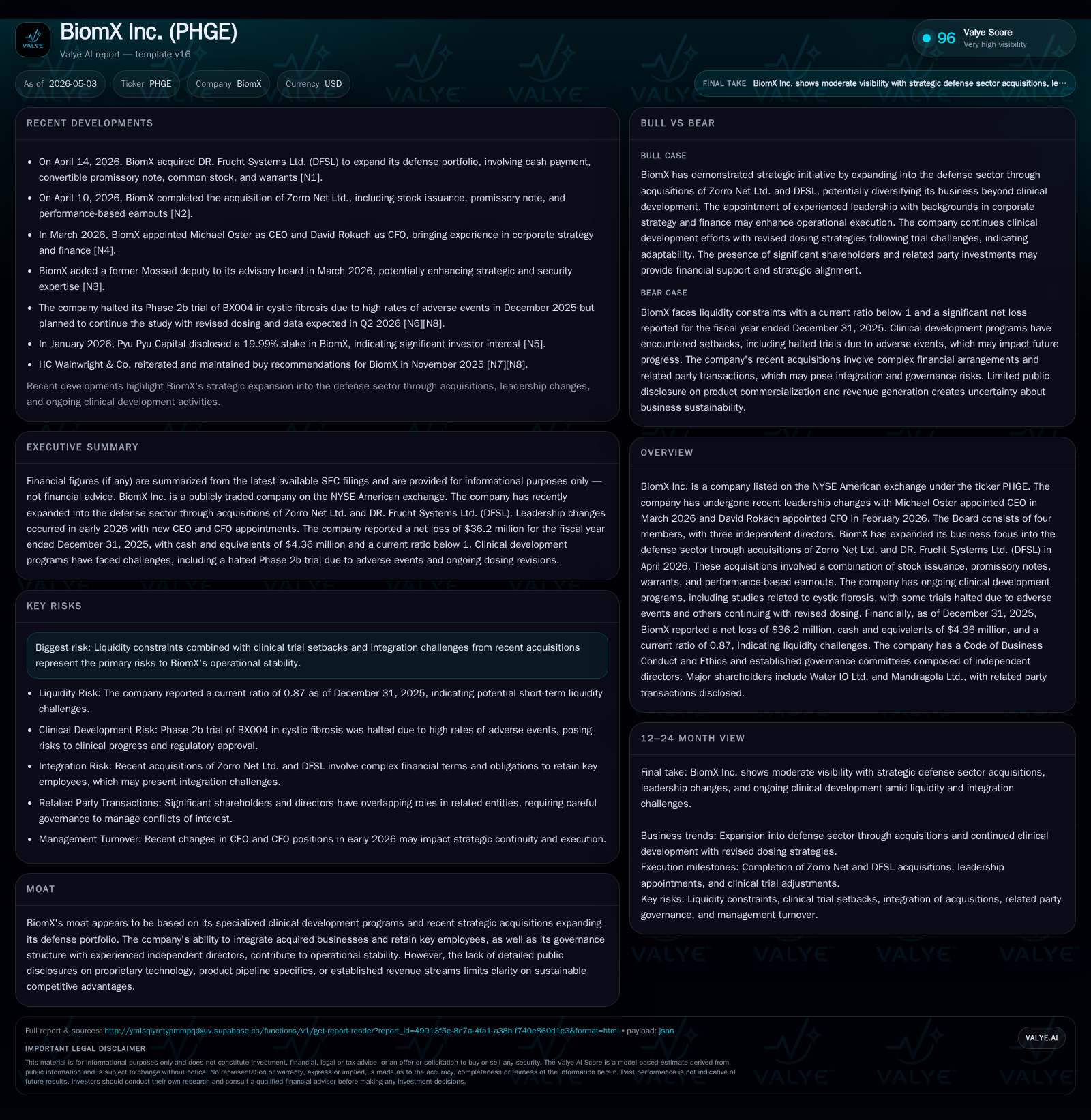
BiomX Inc. has reshaped its business model by acquiring two Israeli defense technology firms—ZorroNet Ltd. and DR. Frucht Systems Ltd.—adding AI-powered surveillance and laser radar detection capabilities to its portfolio. The strategic pivot diversifies BiomX beyond its original clinical-stage biotherapeutics focus, which currently faces clinical trial setbacks and financial pressures. These acquisitions introduce immediate revenue potential through operational contracts like the supply agreement with Israel Railways but also increase execution complexity amid tight liquidity, as indicated by a current ratio below 1.0 and modest cash reserves. Management changes further emphasize a strategic shift, with new leadership aiming to integrate these defense assets and stabilize operations. Going forward, successful integration of acquired businesses, regulatory approvals related to ownership changes, and potential milestone revenues from defense contracts will be critical growth markers.
Recent Operating Update: Strategic Acquisitions Shift Business Trajectory
The most recent material development for BiomX Inc. (PHGE) was its April 2026 completion of two significant acquisitions: ZorroNet Ltd., an Israeli AI-powered defense technology company specializing in autonomous threat detection systems, and DR. Frucht Systems Ltd. (DFSL), a developer of laser radar-based security solutions [S10][S17][S24]. These transactions mark a sharp strategic pivot from BiomX's original biomedical focus toward integrating proprietary AI-enabled defense platforms.
ZorroNet’s acquisition closed on April 10, 2026, involving issuance of 1.3 million common shares to Water IO Ltd., $1.25 million non-convertible promissory notes, plus performance-based earnouts tied to revenue or EBITDA milestones [S10]. Immediately following closing, ZorroNet secured a framework supply agreement with Israel Railways for animal detection alert stations covering existing installations plus potential future units under discretionary orders—a contract that establishes recurring revenue streams through station maintenance fees on a per-unit pricing schedule [S3].
On April 13, BiomX exercised an exclusive purchase option granted at March-end to acquire a majority stake (60%) in DFSL from Mandragola Ltd., via a combination of cash ($750K), an unsecured convertible promissory note ($3M), issuance of common shares (~923K), pre-funded warrants, plus warrants exercisable over five years tied to share prices above $12/share [S17][S24]. The DFSL platform offers four main applications: counter-drone (UAV) detection/response, virtual fencing for perimeter security, wide-area surveillance coverage, and metro safety systems—deployed in transport infrastructure settings demanding low false-alarm reliability.
In addition to the payments made at closing, DFSL's former owners are entitled to bonuses equal to 5% of annual revenues above $25 million post-2027 fiscal year—a significant incentive aligning BiomX’s growth aspirations in this segment [S24]. However, the substantial equity-linked compensation requires shareholder approval given NYSE American’s rules limiting single-transaction dilution beyond 19.99% of outstanding shares.
Business Model: Dual Biotech-Defense Revenue Streams
Originally focused on microbiome therapeutics to address indications like cystic fibrosis, BiomX’s core business model relies on advancing clinical trials backed by milestone-driven funding approaches alongside eventual commercialization royalties or product sales [S1]. Revenue from this segment remains nascent due to early-stage development challenges.
The recent acquisitions pivot BiomX’s model towards technology licensing and sale of integrated security solutions characterized by recurring service contracts (maintenance/support) tied to physical infrastructure deployments (e.g., rail networks). Both ZorroNet and DFSL bring tangible operational revenue streams grounded in deployed AI surveillance products within critical infrastructure protected environments.
Revenue drivers include:
- Per-station pricing for hardware maintenance/upgrades (ZorroNet).
- Sales of AI-enabled autonomous detection units.
- Long-term service contracts for software updates, incident monitoring.
- Performance rewards linked to meeting technical metrics or revenue thresholds (DFSL earnouts).
Margins could improve if economies scale with volume orders or automation reduces installation/service costs over time; however integration overhead may compress short-term profitability margins.
Industry Structure & Competitive Position
In the niche intersection of AI-driven defense technologies focused on ISR (intelligence, surveillance & reconnaissance), perimeter intrusion detection, and counter-UAS systems, competitive dynamics hinge on technological sophistication — especially the quality of real-time computer vision algorithms combined with sensor hardware like LADAR — along with credibility within military/government procurement channels.
ZorroNet’s operational presence at Israeli Defense Forces bases and relationships with contractors such as Elbit Systems position it favorably inside a highly specialized ecosystem requiring trusted suppliers with field-proven solutions; this serves as an initial competitive moat absent large incumbents dominating localized Israeli defense tech niches [N1][N2].
DFSL complements via legacy LADAR expertise tailored for civilian/homeland security applications challenging traditional radar-based systems; its deployment in transportation systems highlights diversification into broader critical infrastructure protection markets that often face escalating drone threats.
The hybrid biotech-defense orientation post-acquisitions creates unique cross-sector opportunities but also risks diluting focus versus pure-play competitors specialized solely in either life sciences or defense tech domains.
Growth Drivers
Key near-term growth drivers stem from:
- Expansion of Israel Railways framework agreement usage contingent on their operational needs leading to additional unit orders under discretionary terms [S3].
- Commercial ramp-up of DFSL’s LADAR platforms across transportation hubs or border security deployments evidencing reliable low false-positive rates.
- Clinical program advancement targeting cystic fibrosis indications with ameliorated dosing protocols following paused trials due to adverse events; successful progress could unlock milestone payments or partnerships enhancing upfront revenues [S1].
- Integration synergies between newly acquired entities promoting bundled or upsell offerings combining AI computer vision with sensor fusion technologies.
- Strategic management changes introducing experienced leadership adept at blending biotech R&D rigor with complex defense contract execution [N3].
Risks and Growth Constraints
Despite promising opportunities, several risks cloud BiomX’s path:
- Clinical Trial Setbacks: Current halted cystic fibrosis studies due to safety signals constrain near-term biotech value creation absent positive data readouts or revised protocol success [S1].
- Integration Complexity: Absorbing two distinct technology companies demands significant organizational alignment efforts — culture clashes or retention failures among key technical personnel could derail intended synergies [S10][S17].
- Liquidity Pressures: Latest balance sheet figures show cash & equivalents at $4.36 million against current liabilities exceeding $6.37 million yielding a current ratio below unity (0.87), while total debt exceeds $10 million netting approximately $6.4 million excluding cash—indicating constrained operating runway without successful capital raises or rapid commercialization gains [F1].
- Shareholder Approval Dependencies: Issuance of conversion shares/warrants tied to convertible notes implicates shareholder voting risks that can delay capital structure optimization required for debt repayments or growth funding [S24].
- Competitive Defense Market Uncertainties: While positioned in niche AI-defense verticals, emerging competitors or shifting procurement priorities could limit contract renewals or new wins.
What To Watch Next
Upcoming milestones crucial for assessing BiomX’s evolving story include:
- Volume growth trends under Israel Railways supply framework: follow purchase order activity indicating scaling adoption beyond initial fifteen units [S3].
- Regulatory approvals related to the change-of-control transfer involving DFSL holdings including Israel Innovation Authority consent influencing grant eligibility continuity [S24][S17].
- Progress updates on cystic fibrosis clinical trial modifications including any resumption announcements or safety data releases from ongoing studies [S1].
- Stockholder meetings addressing share issuances tied to Mandragola convertible instruments impacting dilution risk timing [S24].
- Operational integration success metrics such as retention of key personnel from acquired units and combined R&D pipeline initiatives blending biotech insights with AI-security capabilities.
Financial Profile Snapshot as of December 31, 2025 [F1]
Latest financial snapshot
| Metric | Value | Period |
|---|---|---|
| Cash & equivalents | $4mm | |
| 2025-12-31 | ||
| Current assets | $6mm | |
| 2025-12-31 | ||
| Current liabilities | $6mm | |
| 2025-12-31 | ||
| Current ratio | 0.87x | |
| 2025-12-31 |
Source: SEC companyfacts cache [F1].
| Metric | Value | Period End |
|---|---|---|
| Cash & Equivalents | $4.36M | |
| 2025-12-31 | ||
| Current Assets | $5.58M | |
| 2025-12-31 | ||
| Current Liabilities | $6.38M | |
| 2025-12-31 | ||
| Total Debt | $10.75M* | |
| 2023-12-31** | ||
| Operating Income | -$41.47M | |
| 2025-12-31 | ||
| Net Income | -$36.20M | |
| 2025-12-31 | ||
| *Note: Total debt figure is best-effort as of end 2023 due to lack of newer data; assumed partially stable going forward. | ||
| **Debt maturity profile details not fully disclosed but convertible promissory notes linked to recent acquisitions carry defined maturities through April 2029. |
Cash reserves remain limited relative to liabilities amidst operating losses exceeding $36 million in FY25 suggesting capital intensiveness typical of transitional biotech companies expanding into complex defense sectors.
This analysis draws primarily upon the company’s latest SEC filings including Form 8-K event reports dated April 16 and surrounding announcements regarding strategic acquisitions completed in early April 2026 alongside disclosures from the annual report filed April 30, 2026 offering deeper insight into governance practices and financial obligations.
No investment advice is provided herein; rather the intent is an objective evaluation based strictly on documented sourced evidence.
Disclaimer: This is research-only, informational analysis and not investment advice. It may include AI-generated interpretation and general industry context. Always verify important details using primary sources.

Comments