
W. R. Berkley Strengthens Niche Leadership on Robust Q1 Results
Berkley’s Q1 2026 performance underscores its decentralized model and specialty insurance focus amid evolving market dynamics.
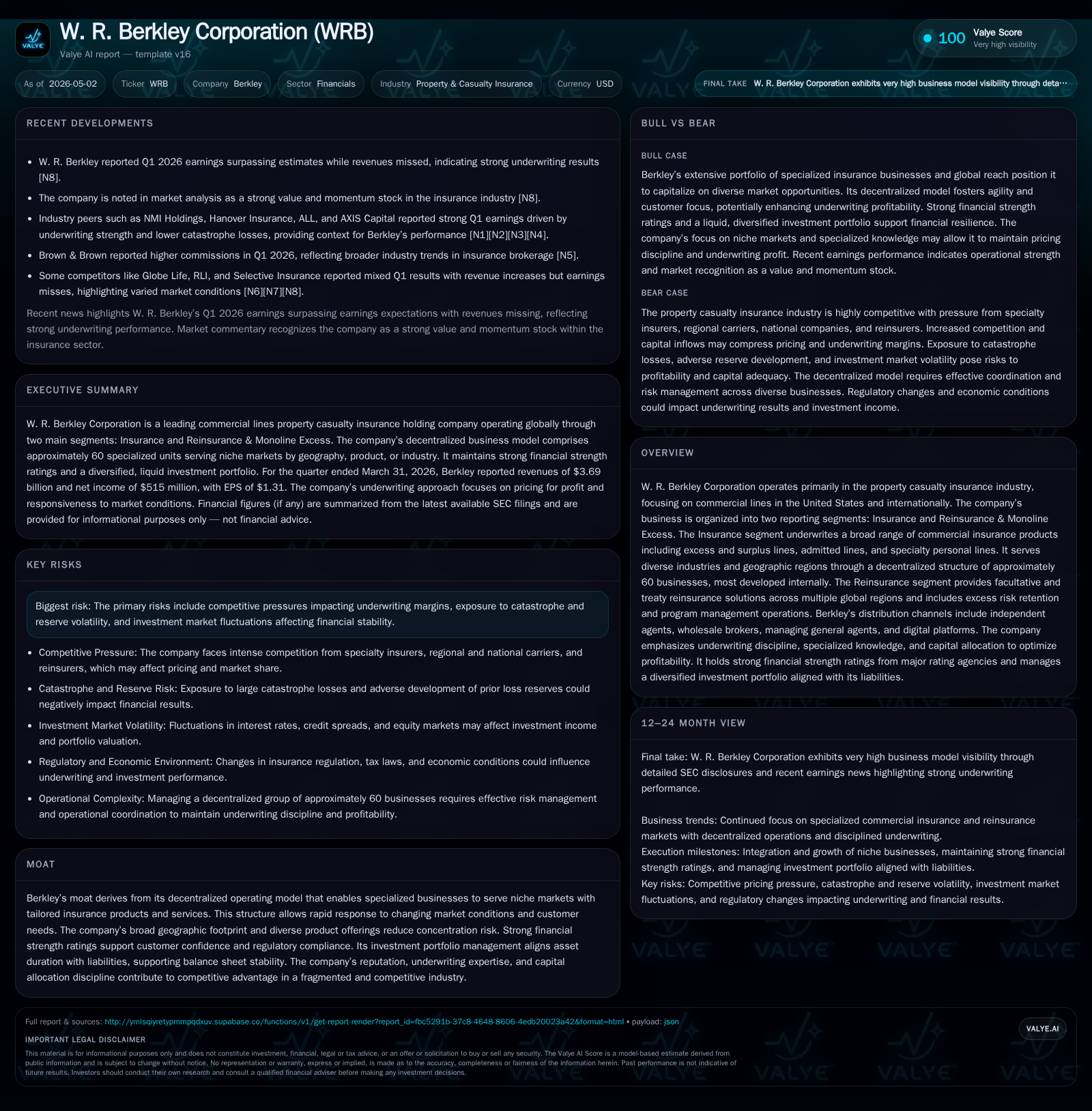
W. R. Berkley Corporation reported strong first-quarter 2026 results, marked by earnings that exceeded expectations despite a slight revenue shortfall and investment income volatility. The company’s decentralized structure, operating around 60 specialized businesses, supports nimble responses to niche commercial insurance markets and global reinsurance demand. Berkley’s competitive position is bolstered by A.M. Best’s superior rating and diversified distribution channels. Growth drivers include expansion into emerging specialties like cyber security and healthcare, geographic diversification, and disciplined capital management, while risks center on market cyclicality and reserve uncertainty.
Q1 2026 Operating Update: Key Changes and Implications
W. R. Berkley Corporation's first quarter 2026 earnings report [S2] released on May 1 underscores a quarter of resilient performance amidst mixed investment outcomes. The company's net income to common stockholders was $515 million for Q1 2026 compared to $418 million in the comparable period last year [S2], reflecting operational strength despite a marginal revenue miss noted in external commentaries [N9]. This earnings beat was driven primarily by favorable underwriting results coupled with effective expense control.
However, Berkley’s net investment income in the quarter displayed notable volatility: gains on fixed maturity securities were offset by losses in real estate-related investments (-$7.3 million) and equity securities suffered unrealized losses nearing $4.5 million [S2]. Notably, the firm employs put and call options solely as hedges within its merger arbitrage trading account—valued with a notional amount of $1 million—to limit downside risk from market swings [S2]. Overall investment fluctuations appear consistent with broader market turbulence impacting alternative assets.
The liquidity posture remains solid with cash and equivalents exceeding $2.28 billion at quarter-end per companyfacts data [F1], supporting operational flexibility during periods of investment income variability.
Berkley’s Business Model: Decentralization and Specialty Insurance Expertise
Berkley operates in a highly specialized segment of the property casualty insurance market via two distinct but complementary segments: Insurance and Reinsurance & Monoline Excess [S1].
The Insurance segment predominantly writes commercial insurance business encompassing excess & surplus lines, admitted lines, and specialty personal lines across the U.S., as well as selected international markets including Asia-Pacific, South America, Mexico, UK, Australia, Canada, Continental Europe, and Scandinavia [S1].
The Reinsurance segment underwrites facultative and treaty contracts globally, offering excess risk retention solutions alongside program management operations primarily situated in the U.S., Europe, South Africa, Asia-Pacific regions [S1].
Central to Berkley’s strategic advantage is its decentralized operating framework comprising approximately 60 autonomous but capital-backed business units—53 internally developed—that focus on serving niche customer demands requiring deep technical expertise [S1]. This structure permits swift local market responsiveness while leveraging centralized functions such as capital allocation, investment management, reinsurance strategy coordination, actuarial oversight, risk management discipline and financial compliance [S1].
Distribution is diversified through relationships with independent agents (front-line underwriters), wholesale brokers who facilitate access to higher-risk or complex cases, managing general agents (MGAs) entrusted with delegated underwriting authority in specialty sectors, as well as increasingly important digital platforms [S1]. Customer intimacy enabled by proximity allows tailored risk solutions fostering higher retention rates.
Industry Positioning: Competitive Landscape and Distribution Nuances
The property casualty insurance sector is cyclical with significant pricing fluctuations driven by economic cycles impacting both supply—chiefly available industry capital—and demand for coverage [S1]. Berkley's broad product portfolio in commercial lines aligns with stable structural demand due to regulatory mandates (e.g., workers’ compensation), contract obligations (professional liability), and evolving risks such as cyber threats.
The competitive universe includes major multinational insurers deploying vast capital pools targeting volume-driven growth; regional players carving localized specializations; mutual insurers often competing on service terms; insurtech firms leveraging technology for underwriting efficiencies; plus specialized MGAs exploiting niche opportunities [S1].
Financial strength ratings play an outsized role in positioning: Berkley commands an A+ rating from A.M. Best—the second highest possible—signaling superior ability to meet policyholder claims which sustains broker confidence and renewal transactions under price pressure environments [S1]. This rating embeds a reputational moat that can foster durable pricing power despite the industry's fragmentary nature.
Furthermore, Berkley's multi-channel distribution not only diversifies risk exposure to any one intermediary type but enhances market reach across distinct customer segments unwilling or unable to access traditional carriers.
Growth Drivers: Niche Expansion, Geographic Reach, and Capital Discipline
A key growth vector for Berkley is deliberate formation of new businesses targeting emergent specialty fields demanding sophisticated underwriting approaches such as healthcare cyber security—which benefits from rising digital risk exposure—and agriculture insurance addressing weather-related volatility in farming economies [S1]. The company's track record includes building almost all (~53) of its operating entities internally ensuring cultural alignment with risk appetite standards.
International expansion complements this product-level diversification. Berkley continues penetrating underserved markets within Asia-Pacific economies exhibiting accelerating commercial infrastructure development along with South America where formal insurance penetration remains low relative to economic size [S1]. Established footholds in UK markets offer mature corridors for specialty personal lines growth.
Disciplined capital allocation governs deployment decisions seeking incremental underwriting profit margins while maintaining strong loss reserve adequacy signals critical for sustainability given long-tail nature of many lines written. Focus on retaining underwriting discipline amidst softening rate cycles changes allows prioritization of profitable niches over pure volume gain.[N14]
Broker upgrades from firms like BMO Capital reaffirm positive momentum expectations anchored on these structural growth attributes combined with prudent risk management practices [N14].
Risks and Constraints: Market Cyclicality, Reserve Volatility, and Competition
Despite underlying strengths, Berkley faces risks typical of property casualty insurers highlighted extensively in its annual filings [S1]. Market cyclicality presents a dual-edged sword wherein premium rate adequacy can deteriorate swiftly if competition intensifies or catastrophic events accelerate claims frequency/severity unexpectedly.
Reserve adequacy—a cornerstone accounting estimate involving actuarial judgment—is subject to uncertainty from emerging social inflation trends impacting injury compensation amounts or shifting regulatory interpretations broadening coverage scopes post-policy issuance timeline [S1]. Such factors can force reserve strengthening charges adversely affecting near-term earnings.
Competitive pressures persist from new entrants armed with fresh capital allocating aggressively into lucrative specialty niches potentially compressing premiums further. Technology-enabled insurtechs may disrupt traditional distribution or underwriting paradigms requiring frequent innovation investment by incumbents like Berkley to maintain relevance.
Natural catastrophe exposures remain inherent risks with episodic potential for loss spikes complicating prior accident year reserve evaluations thus necessitating calibrated excess reinsurance arrangements validating overall risk retention limits.[S1]
What to Watch Next: Guidance Cues and Execution Milestones
Forward-looking indicators include Q2 updates on premium rate trajectories across key commercial lines enabling validation or adjustment of pricing strategies amid ongoing inflationary conditions [S2]. Monitoring reserve development patterns particularly from prior accident years will corroborate the effectiveness of underwriting adjustments implemented recently.
Investment performance fluctuations deserve attention following Q1 real estate-related mark-to-market losses; stabilization here would indicate alignment with broader capital market recovery trends.[S2]
Analyst commentary or changes in A.M. Best ratings should also be tracked since such shifts materially influence broker shelf space allocation impacting renewal volumes.
Execution against internal targets on launching specialty units or expanding geographic footprint will provide tangible checkpoints reflecting strategic progress beyond financial metrics alone.
Financial Snapshot: Liquidity, Investment Performance, and Profitability
At quarter-end March 31, 2026, Berkley held $2.28 billion in cash and cash equivalents bolstering liquidity buffers prudent for claim payment obligations or opportunistic investments [F1]. Net income for Q1 stood robust at approximately $515 million substantially ascending from prior year levels demonstrating operational efficacy despite headwinds from unsteady net investment returns including realized losses within real estate holdings totaling roughly $7.3 million [S2].
Fixed maturity securities gains partially offset these declines indicating measured duration matching between assets and liabilities continues serving as an effective balance sheet stabilizer in volatile markets [S2][S1]. Committee use of derivatives remains restrained exclusively for hedging merger arbitrage positions limiting balance sheet complexity exposure [S2].
This financial profile reflects an insurer balancing growth aspirations with conservative capitalization ensuring it can sustain claims during adverse cycles while nurturing profitable specialty niches integral to its moat.
This analysis is based solely on public SEC filings up to May 2026 provided herein along with pertinent recent news sources without speculative assumptions or investment recommendations.
Disclaimer: This is research-only, informational analysis and not investment advice. It may include AI-generated interpretation and general industry context. Always verify important details using primary sources.

Comments