
Rithm Property Trust Repositions With Flexible CRE Strategy in Latest Quarterly Update
Rithm Property Trust’s Q1 2026 results solidify its strategic pivot to a diversified commercial real estate investment focus, unlocking new growth avenues amid sector dislocations.
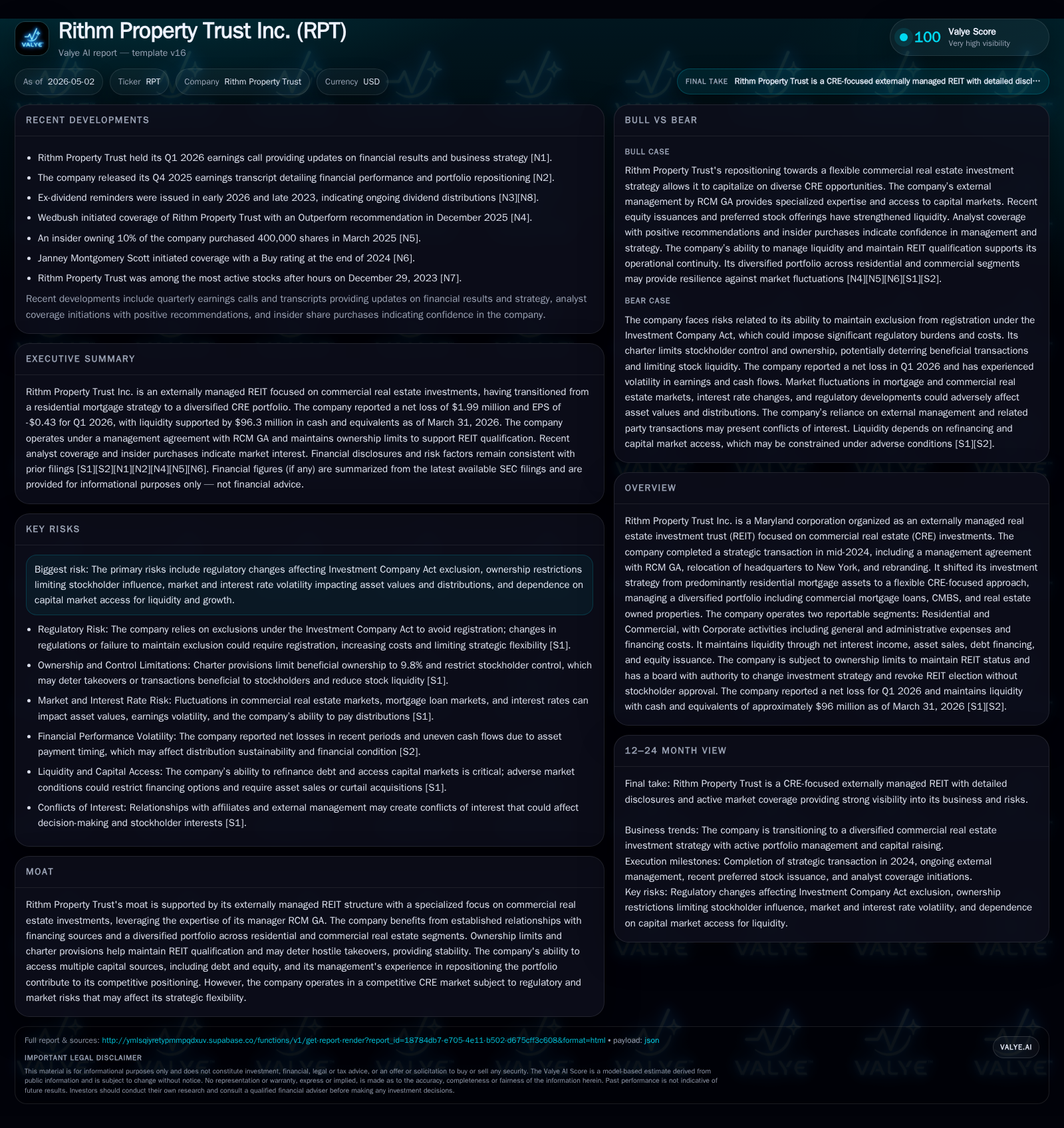
In its latest 10-Q filing for Q1 2026, Rithm Property Trust reported ongoing execution of its strategic repositioning following the mid-2024 transaction with Rithm Capital. The company transitioned from a primarily residential mortgage asset base to a flexible, externally managed commercial real estate (CRE)-focused platform that includes commercial mortgage loans, CMBS, and real estate owned properties. This shift aligns with market dynamics exhibiting CRE financing challenges and sector dislocations, presenting selective acquisition opportunities. The externally managed REIT structure leverages management expertise and diversified asset classes to navigate regulatory constraints while maintaining liquidity and access to capital markets amid ongoing volatility. Notwithstanding the evolving operational profile, the firm faces risks from regulatory developments, market rates volatility, and capital market dependence.
Latest Quarterly Operating Update: Shifts and Results
Rithm Property Trust's first quarter 2026 report (10-Q filed May 1, 2026) marks an important milestone in its transition following the transformative mid-2024 strategic transaction. In that prior event, Rithm finalized a management agreement with RCM GA Manager LLC which assumed external management duties starting June 11, 2024, alongside relocating headquarters to New York and rebranding efforts culminating in December 2024 [S1]. Operationally, servicing of mortgage loans was transferred to Newrez LLC—an affiliate managing servicing rights under unchanged terms [S1].
The Q1 filing confirms the ongoing shift from a predominantly residential mortgage portfolio towards a flexible commercial real estate strategy incorporating originating and acquiring diverse CRE-related investments: senior loans, subordinated/mezzanine positions, CMBS tranches, preferred equity stakes, as well as managing owned real estate assets [S2][N1]. This repositioning aligns with management commentary emphasizing market conditions characterized by refinancing challenges that create attractive risk-adjusted entry points for CRE investors [N1].
No material changes were noted in risk factors compared to prior disclosures [S2].
Business Model and Asset Strategy: From Residential Mortgage to Flexible CRE
Rithm operates as an externally managed Maryland REIT focusing on commercial real estate investments. Its business model generates revenue primarily through net interest income from mortgage loan portfolios—both originated and acquired—as well as gains from asset sales and acquisition-related fees. Under new management via RCM GA, the company shifted away from its historical residential mortgage exposure—including reperforming loans (RPLs), non-performing loans (NPLs), RMBS securities—and now pursues a broader CRE mandate encompassing multiple asset types [S1].
The portfolio's diversification includes commercial mortgage loans that offer structural seniority or subordinate positions enhancing yield potential versus traditional residential exposures. Additionally, CMBS investments provide exposure to structured CRE credit with varying tranching for tailored risk-return profiles. Ownership of real estate assets complements lending activities by offering direct property exposure where valuation upside or operational improvements are feasible [S1][F1].
Management contracts underpin the revenue mix as RCM GA earns fees aligned with asset origination and servicing activities. This external manager relationship provides scalability benefits but adds complexity due to fee structures impacting overall margins.
Product/service quality has evolved: residential mortgage assets historically carried higher prepayment risk and borrower sensitivity to economic cycles; conversely commercial loans often feature longer durations with leases collateralizing underlying properties. However, CRE assets are more sensitive to sector-specific disruptions like office demand shifts or retail vacating pressures—a factor requiring active credit assessment post-transition.
Industry Positioning: Competition, Capital Access, and Regulatory Framework
Within the competitive CRE investment space, Rithm’s advantage stems from its established financing infrastructure facilitated through repurchase agreements, secured bonds payable via securitization trusts, and relationships cultivated by RCM GA’s team [S1][S5][S6]. These allow access to both short-term liquidity tools (repurchase financing) and long-term fixed rate notes (secured bonds) aligning funding maturity with asset profiles.
Regulatory considerations profoundly shape operations. To preserve Investment Company Act exclusions under Sections 3(c)(5)(C) or 3(c)(6), the company ensures at least 55%–80% of assets qualify as real estate or related interests—guidance that constrains asset holdings and mandates periodic asset compliance reviews [S1][S25].
Ownership limits further maintain REIT status—capping single stockholder influence—which may deter activist pressures or hostile takeovers but also restrict shareholder base dynamics [S1]. Concurrently, competition intensifies among CRE loan originators requiring nimble capital deployment strategies amid fluctuating credit spreads.
The company's moat is reinforced by specialized manager experience, extensive capital market access channels including equity issuance capabilities evidenced by recent preferred stock raises [S7], but contingent on navigating regulatory headwinds that could alter permissible asset classes or leverage thresholds.
Growth Drivers: Market Dislocations, Diversification, and Manager Expertise
Rithm’s growth outlook hinges on exploiting refinancing challenges within the CRE sector exacerbated by rising interest rates and tightening lending standards. These conditions create pressure points where borrowing entities seek liquidity solutions or restructuring leading to acquisition opportunities in senior debt or subordinate layers adding yield enhancement potential [S1][S19][N1].
The company’s diversified approach across debt types — including direct mortgage loans combined with structured CMBS positions — offers asymmetric return profiles while managing risk via collateral quality analyses.
Managerial expertise through RCM GA facilitates sourcing proprietary deal flow including servicing-related income streams post-transfer agreement implementation [S1][S3]. Incremental liquidity from asset sales balanced against opportunistic deployments supports both organic portfolio growth and capital recycling.
Equity issuance capacity demonstrated by the Series C Preferred Stock offering bolsters financial flexibility necessary for navigating uncertain financing markets [S7]. Ongoing refinancing activity across existing short-term facilities will be pivotal for scaling investment velocity during periods of dislocation.
Risk Factors and Headwinds: Regulatory, Market Volatility, and Financing Dependency
Structural risks revolve around possible adverse SEC guidance revisions that might restrict Investment Company Act exclusions applicability thereby compelling portfolio adjustments or forced disposals at suboptimal times [S25]. Such shifts can impair valuation consistency impacting distribution reliability.
Interest rate sensitivity persists; increased rates elevate funding costs while dampening borrower refinance activity negatively influencing underlying collateral valuations and cash flow yield quality [S19][S26]. This squeeze affects net interest spread returns crucial for sustaining dividend levels according to REIT payout mandates.
Capital markets dependency is significant given reliance on short-duration repurchase agreements subject to margin calls requiring prompt liquidity provisioning [S8]. Failure to refinanced maturing secured bonds or repurchase lines at favorable terms could curtail acquisition capacity or necessitate accelerated asset sales depressing returns.
Ownership restrictions intended to protect REIT qualification limit institutional shareholder influence potentially restraining governance evolution or capital structure adaptation [S1]. Overall volatility in public equity prices may also hinder efficient equity raises needed during turbulent cycles.
What to Watch Next: Upcoming Milestones and Demand Indicators
Key near-term indicators include quarterly earnings releases expected later in 2026 which will update progress on portfolio performance metrics such as loan delinquency trends, CMBS recovery rates, acquisitions volume, servicing fee income growth, and realized gains/losses from maturities or sales [S2][N1].
Refinancing outcomes related to secured bonds payable maturity schedules represent critical execution points determining financing cost trajectory amidst prevailing credit spreads [S7].[N1]
Potential regulatory clarifications—particularly regarding SEC staff no-action letters or concept release developments concerning qualifying real estate assets—could materially impact portfolio composition strategies necessitating investor vigilance [S25].
Market demand signals such as CRE occupancy rates for key sectors (office/industrial/retail) indirectly influencing borrower creditworthiness remain essential factors for underwriting assumptions embedded within asset valuations.
Financial Condition Snapshot: Liquidity, Leverage, and Capital Resources
As of March 31, 2026, the balance sheet shows approximately $96.3 million in cash & equivalents providing liquidity support for margin call obligations under repurchase agreements as well as general corporate needs [F1]. Total debt figures available date back to September 30, 2016, at about $119 million, with net debt around $23 million after cash adjustments [F1]. While these figures provide a historical reference, no more recent debt or leverage metrics have been disclosed in the latest filings [S2][S3].
Capital resources are augmented by preferred stock issuances totaling over $50 million net proceeds during early 2025 replenishing equity buffer capacity for future expansions or refinancing needs [S7].[N1]
The financing framework balances interim reliance on repurchase facilities alongside longer duration secured bond issuances providing flexibility but necessitating active liability management given volatile secondary markets affecting rollover pricing.
Disclaimer: This analysis is based on publicly available SEC filings including Rithm Property Trust Inc.’s latest quarterly reports as of May 2026 without any investment advice provided. The purpose is strictly informational grounded in disclosed operating facts.
Disclaimer: This is research-only, informational analysis and not investment advice. It may include AI-generated interpretation and general industry context. Always verify important details using primary sources.

Comments