
First Western Financial Bolsters Private Trust Platform with Strategic Growth in Western States
Robust Q1 2026 results affirm First Western's niche strength in integrated wealth management across key Western markets.
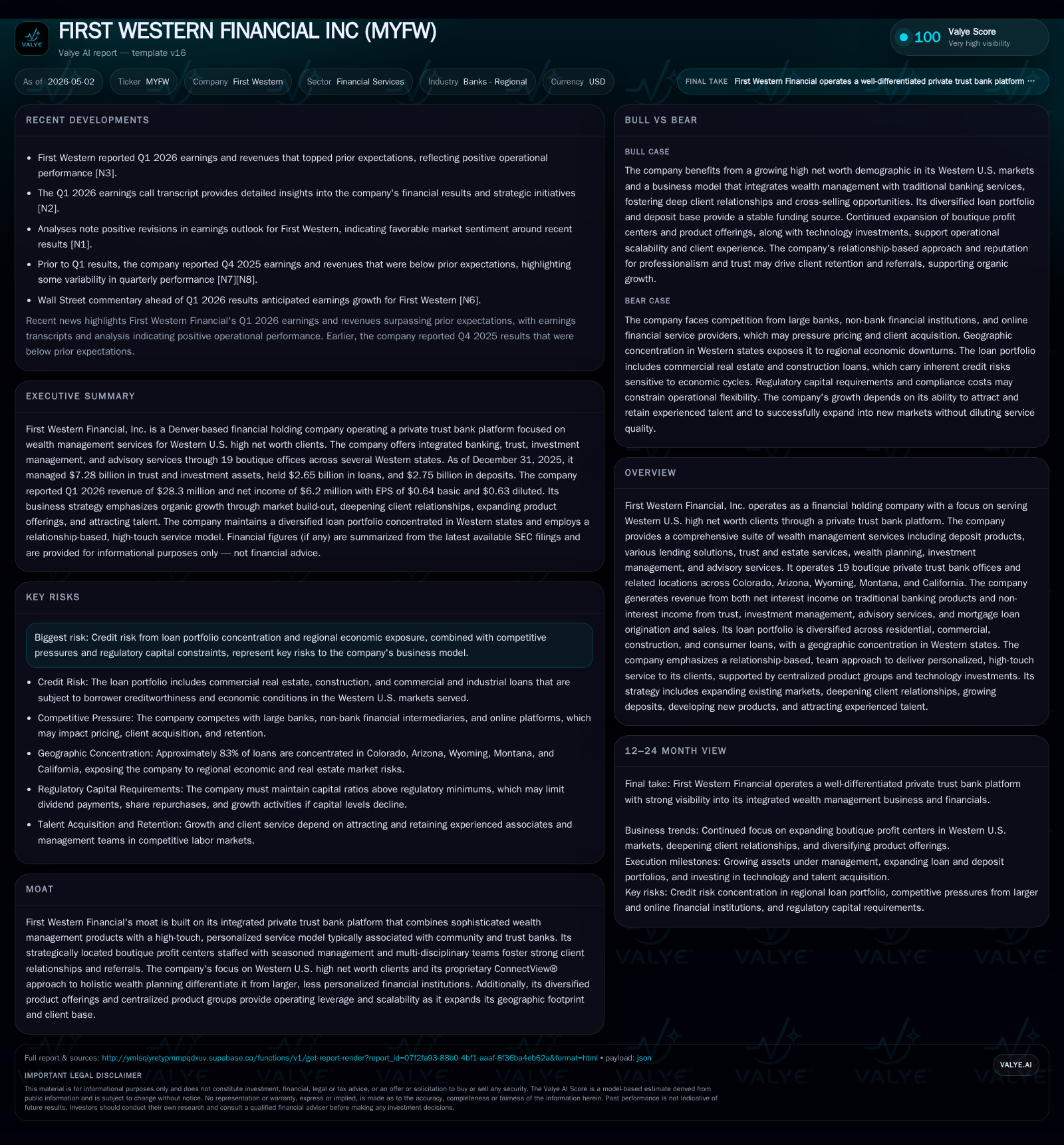
First Western Financial, Inc. reported strong first-quarter 2026 results highlighted by growth in both net interest income and non-interest income, driven by its private trust bank model emphasizing personalized wealth management for high-net-worth clients in the Western U.S. The company’s integrated product suite—combining fiduciary, advisory, lending, and mortgage services—and its network of boutique profit centers underpin a differentiated competitive position. Key growth catalysts include targeted geographic expansion and deeper wallet share via the proprietary ConnectView® wealth planning platform. Risks remain concentrated around regional credit exposure and regulatory capital constraints, but a solid capital base and active risk management support sustainable growth.
Q1 2026 Operating Results Highlight Sustained Momentum
First Western Financial posted first-quarter 2026 results that outpaced consensus expectations across key metrics according to its May 1 10-Q filing [S2] and corroborating event disclosures on the same day [S3]. The company exhibited notable expansion in net interest income alongside a meaningful uplift in non-interest income derived from trust advisory services and mortgage origination activities. This dual income stream acceleration signals robust demand for First Western’s integrated wealth management offerings among its affluent Western U.S. client base.
The company’s commentary emphasized effective utilization of its strategically positioned boutique private trust bank offices—termed internally as ‘profit centers’—across core states such as Colorado and Arizona to drive localized client acquisition and deposit growth. Early indications from these profit centers revealed continued traction in lending volume complemented by stable asset flows under advisement. Notably, mortgage loan production scaled effectively during the quarter benefiting from proprietary processing efficiencies. This operating update affirms First Western’s momentum entering 2026 amid a favorable market environment for personalized private banking services [N3].
Integrated Private Trust Bank Model Underpins Revenue Diversity and Client Loyalty
First Western Financial operates an integrated private trust bank business model uniquely tailored to high-net-worth individuals (HNWIs), entrepreneurs, professionals, families, their businesses, and philanthropic interests predominantly within five Western states [S1]. The core revenue-generating mechanism combines net interest income from traditional banking products — including commercial loans, consumer mortgage lending, and deposit services — with diversified non-interest income streams stemming from fiduciary services (trusts), investment and wealth advisory offerings, plus mortgage loan origination coupled with secondary market sales.
Their proprietary ConnectView® wealth planning approach differentiates the firm by delivering holistic financial planning that integrates investment management goals with banking needs on a relationship-centric basis. This methodology fosters significant client loyalty by aligning multifaceted financial components under experienced multi-disciplinary profit center teams supported by centralized fiduciary and product experts. These teams act as trusted advisors who customize products based on deep understanding of client objectives rather than commoditized offerings typical among larger banks or standalone advisor firms.
As of December 31, 2025, the company oversaw $7.28 billion in assets under management (AUM) within fiduciary/advisory portfolios while balancing $2.65 billion in loans excluding loans held for sale alongside $2.75 billion in deposits supporting this lending activity [S1]. Non-interest income accounted for approximately 27.4% of total pre-expense revenues during fiscal 2025 reflecting the critical role of trust-based fee income plus mortgage banking gains which provide margin diversification beyond interest spreads.
Industry Positioning: Boutique Focus in Competitive Regional Banking
Within the competitive landscape of regional banks serving affluent clientele on the West Coast and intermountain West regions, First Western Financial distinguishes itself through its boutique private trust bank platform comprised of nineteen offices spanning Colorado to California via Arizona, Wyoming, and Montana [S1][S13]. Unlike larger national banks that often pursue scale with broad retail products or commoditized wealth segments inaccessible to smaller operators without national brand power, First Western leverages local market expertise through entrepreneurial profit centers.
This decentralized yet coordinated structure cultivates strong personal relationships epitomized by high-touch service traditionally associated with community banks married with institutional-quality investment stewardship characteristic of trust banks. While pricing power remains moderate given competitive regional dynamics among community banks and independent advisory firms offering standalone wealth services, First Western’s ability to cross-sell multiple complex products within an integrated client ecosystem affords it strategic resilience [N2].
This positioning mitigates disruption risk from digital-only entrants or large universal banks where scale mandates standardized solutions that may not satisfy the nuanced requirements prevalent among HNW western clients accustomed to personalized advisory.[N3]
Growth Catalysts Driven by Geographic Expansion and High-Touch Advisory Services
The foundation for growth rests on manageable organic expansion within current markets that exhibit strong demographic tailwinds characterized by increasing concentrations of high-net-worth households fueled by entrepreneurial success stories typical across western states such as Colorado's tech hubs or California’s established wealth corridors [S13]. Additionally, First Western is expanding wallet share through enhancing cross-product penetration anchored especially on its mortgage origination platform which has evolved into a scalable channel complementing lending held-for-sale activities [S6][N1].
Continued proliferation of its ConnectView® comprehensive wealth planning platform further differentiates it by deepening engagement with clients thereby potentially increasing retention rates as well as enabling fee capture across interrelated wealth pillars. Centralized product groups yield operating leverage enabling expanded branch networks without proportional cost increases thereby improving profitability over time as new locations mature into profitable profit centers [S1].
Potential exists for disciplined inorganic growth via acquisitions aligned with existing regional concentrations or expansion into adjacent markets sharing similar affluent demographic profiles—though such moves require regulatory coordination given capital requirements tied to Basel III frameworks currently implemented [N2].[N8]
Risks and Constraints Rooted in Regional Credit Concentration and Regulatory Capital
Risk factors remain prominently anchored around credit concentration within the loan portfolio which is heavily weighted (>80%) toward borrowers residing or conducting business within five western states predominantly comprising owner-occupied/non-owner occupied commercial real estate exposures secured primarily by real property liens [S16][S19][S21][S12]. Although underwriting practices emphasize prudent collateral valuation (typically capped at 75%-80% loan-to-value) alongside guarantor cash flow evaluations targeting minimum DSCR thresholds (~2.0x), cyclical economic downturns or sector-specific real estate softness could impair asset quality necessitating heightened allowance provisioning.
Additionally, regulatory capital considerations under Basel III have introduced constraints via mandated capital conservation buffers (2.5% CET1 above minimum ratios) which limit discretionary dividend payments or share repurchase programs if breached; however current filings confirm First Western remains well-capitalized without reliance on debt leverage providing flexibility to support ongoing organic growth initiatives safely [S8][F1].[S10]
Competitive pressure persists in attracting deposits at favorable spreads amid rising interest rate environments impacting net interest margins; technology investments required to sustain cybersecurity compliance per FFIEC/FDIC guidance also introduce operational cost considerations extending beyond pure banking operations [S16].[N7]
Upcoming Milestones and Investor Watchpoints for 2026
Investors should monitor quarterly earnings releases closely for updates on net interest margin trends affected by funding cost shifts as well as ongoing non-interest revenue composition changes reflecting traction or headwinds across advisory fees versus mortgage loan sales volumes particularly given higher secondary market turnover dynamics expected this year [N8].[S3]
Deposit trends remain a bellwether signaling competitive positioning within targeted geographies along with loan pipeline developments especially construction and commercial real estate originations where underwriting discipline intersects cyclical demand factors.
Further clarity regarding any acquisition activity or new profit center openings will provide insight into strategic execution against stated geographic expansion plans targeting affluent western communities.[N7] Incremental adoption metrics for ConnectView® usage intensity or breadth could serve as proxy indicators for wallet share gains.
Management commentary on technology platform enhancements addressing digital delivery preferences among younger HNW cohorts versus security imperatives will also yield clues about sustaining long-term customer engagement.
Summary of Latest Financial Profile
Supporting these operating imperatives is First Western’s robust balance sheet profile characterized by no outstanding debt reported as per recent data points coupled with substantial cash equivalents reserves documented historically at $310 million—providing ample liquidity buffer absent reliance on wholesale funding sources [F1].[S2]
Reported shareholders’ equity stood at $265.6 million as of December 31, 2025 sustaining strong core capital ratios exceeding regulatory minimums including Basel III CET1 buffers that underpin dividend capacity albeit within prescribed limits to preserve safety margins [S8]. Total assets approximated $3.15 billion demonstrating a middle-market regional financial institution scale consistent with its focused private trust bank strategy.
Total deposits exceeded $2.75 billion evidencing effective core funding supports loan growth ambitions while mitigating liquidity risks inherent in brokered deposit reliance common amongst comparable peers [S7]. This disciplined financial foundation reinforces confidence in sustainable execution of First Western's strategic model marrying high-touch personalized service with an integrated suite of wealth management solutions tailored to the evolving financial needs of affluent western U.S. clients.
This analysis reflects information available through May 2026 based on SEC filings including latest quarterly reports (10-Q), recent company disclosures (8-K), annual Form 10-K filings along with supplementary industry context derived from recent news coverage. Financial metrics emphasize most current data points consistent with disclosed natural reporting periods without extrapolation beyond validated sources. No investment advice or recommendations are provided herein.
Disclaimer: This is research-only, informational analysis and not investment advice. It may include AI-generated interpretation and general industry context. Always verify important details using primary sources.

Comments