
Employers Holdings Enhances Underwriting Focus Amid Expanded Product Launch
EIG's latest quarter reveals strategic underwriting discipline and a new excess workers’ compensation offering targeting self-insured employers, positioning it for niche growth.
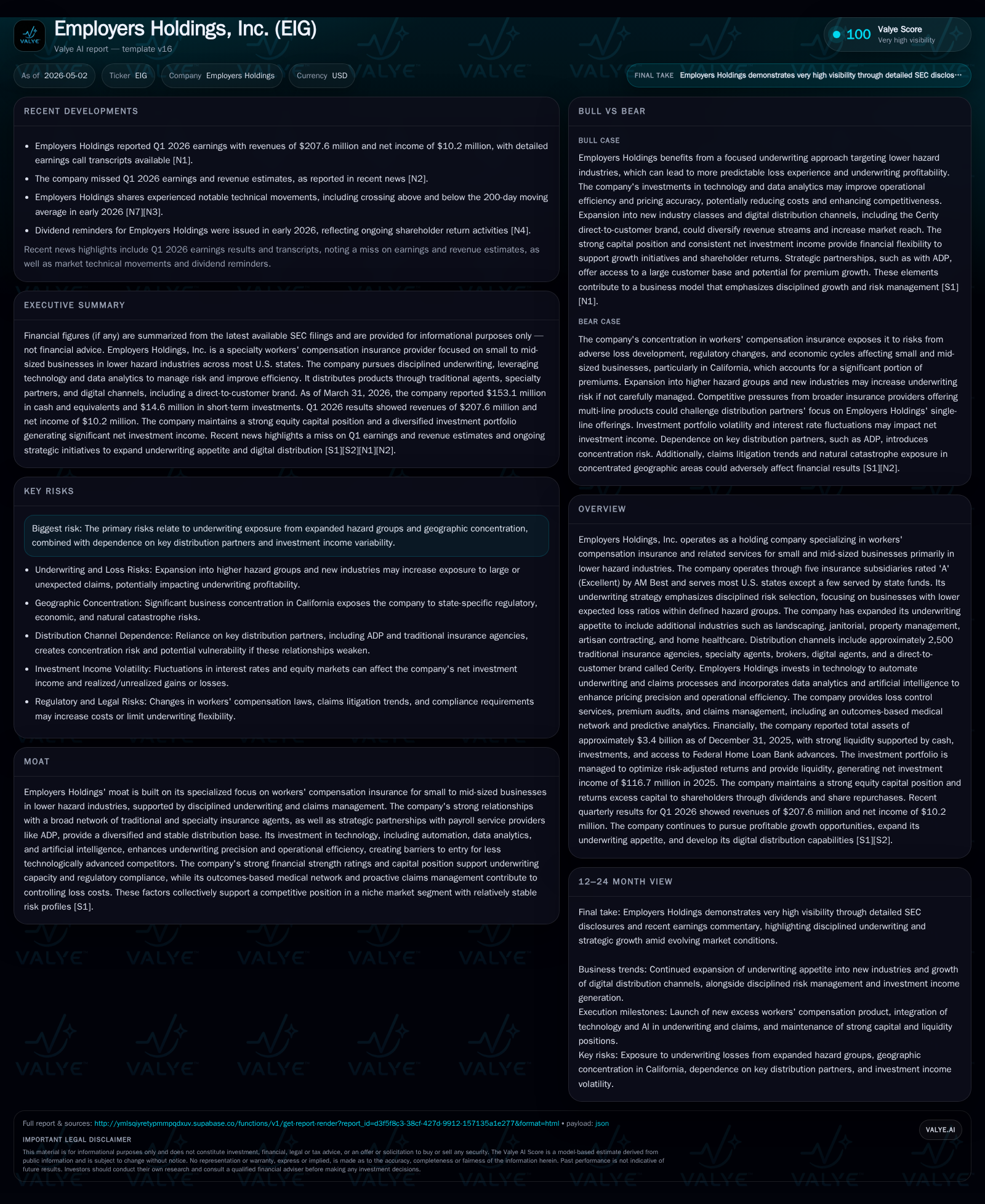
In Q1 2026, Employers Holdings, Inc. underscored its disciplined underwriting focus amidst launching an excess workers’ compensation product aimed at self-insured businesses in select U.S. states. This move complements its established presence in small to mid-sized firms within lower hazard industries and leverages a broad and evolving distribution network including traditional agencies and digital channels. While competitive pressures and expanded risk appetites pose watchpoints, the company’s strong AM Best ratings, technology investments, and financial position support measured growth strategies going forward.
Quarterly Operating Update Highlights and Implications
In its latest quarterly filing dated May 1, 2026, Employers Holdings reported operational developments emphasizing both its steadfast underwriting discipline and a strategic product expansion. Foremost among these is the February 2026 launch of an excess workers' compensation insurance product targeted at self-insured employers across several U.S. states. This initiative is keyed towards enterprises that traditionally manage their own retention layers but seek additional coverage beyond their limits. The excess product effectively broadens EIG's addressable market while leveraging its specialized knowledge of workers’ compensation risks in lower hazard industries [S2][S3].
Despite this expansion, EIG maintained focus on disciplined underwriting in the quarter, recognizing the tight margin nature of workers' comp insurance. The company continues to target small to mid-sized business segments characterized by predictability in loss ratios due to their concentration in lower hazard classifications such as landscaping, janitorial services, property management, artisan contracting, and home healthcare. This specialization supports stable long-term profitability even as the company navigates intensified competition [S2][N2].
The recent earnings report indicated a slight miss on revenue compared to estimates but reflected ongoing effort to balance growth with underwriting rigor. Management commentary from the earnings call also underscored cautious optimism about the excess product's early traction while emphasizing continuous investment in technology-driven underwriting tools to enhance risk selection precision [N1][N2].
Business Model: Niche Workers’ Compensation Insurance with Targeted Distribution
Employers Holdings operates primarily through specialty insurance subsidiaries — each rated “A” (Excellent) by AM Best — providing workers’ compensation coverage specifically tailored for lower hazard industries serving small to midsize employers [S1]. Its business model centers on disciplined risk selection bolstered by proactive claims management supported by outcomes-based medical networks that help control indemnity expense trends.
Revenue is generated mainly from net premiums earned from these policies alongside investment income from its large fixed maturity portfolio. Pricing hinges critically on actuarial assessment of expected losses plus associated loss adjustment expenses (LAE), commissions to agents, and underwriting expenses. Robust data analytics and AI-enhanced predictive modeling underpin premium rate setting to minimize adverse selection risks.
Distribution comprises approximately 2,500 insurance agencies encompassing traditional general agents, specialty agents with expertise in niche sectors, wholesale brokers who facilitate complex placements, digital channel partners that optimize customer acquisition costs, plus direct sales via Cerity Insurance Company’s consumer-focused brand. This multi-pronged distribution ensures broad market access while maintaining deep relationships crucial for retention under long-term policy structures [S1].
Technology investments enhance operational efficiency by automating rules-based underwriting workflows and improving claims triage effectiveness. This reduces overhead escalations common in workers’ compensation lines and strengthens margins through more precise loss forecasts.
Industry Positioning and Competitive Dynamics
Within the national workers’ compensation insurance arena—a highly competitive field—Employers Holdings occupies a distinct specialist position focused solely on one line of business. While this strategic narrowness aids mastery over segment-specific risks and claims patterns, it also means EIG competes against multi-line carriers capable of bundling products at reduced aggregate premiums to attract clients [S1][S29].
Regional differences further complicate market dynamics; for example, California accounts for almost half of EIG’s premiums where regulatory frameworks are stringent but stable for well-capitalized carriers with strong claims management expertise. Other states served exclude jurisdictions like North Dakota or Ohio where state funds dominate the workers’ comp marketplace.
Competitors range from large national insurers with expansive underwriting resources to professional employer organizations (PEOs) offering bundled employment services inclusive of workers’ comp coverage. This mix pressures EIG to defend pricing adequacy carefully without sacrificing account quality. The company’s AM Best “A” rating fortifies broker confidence but does not wholly insulate against pricing compression given prevalent low-margin industry cemented by indemnity cost inflation concerns.
Growth Opportunities: Product Expansion and Tech-Enabled Distribution
The newly launched excess workers' compensation product represents a strategic lever enabling EIG to tap into self-insured enterprises requiring broader risk layering beyond primary plans—a segment historically underserved by specialists focusing on standard coverages [S1][S2]. This aligns with observed market demand for tailored stop-loss type products particularly amongst mid-sized companies aiming to contain catastrophic exposure.
Complementing this is EIG's gradual extension into adjacent lower hazard classifications such as artisan contracting or home healthcare providers—markets benefiting from demographic trends like increased gig economy participation and aging populations requiring home care services.
Technological initiatives target both front-end customer acquisition through improved digital agent platforms and back-end operational enhancements using AI-driven loss prediction models that optimize premium accuracy and early claim interventions reducing ultimate claim costs. Strategic partnerships with payroll service providers like ADP augment these efforts by enabling integrated data flows that improve policyholder risk assessments dynamically.
Additionally, geographic expansion opportunities exist given the company's infrastructure scalability via its information technology backbone; however, these must navigate regulatory restrictions inherent in state-based insurance markets.
Risks and Operational Challenges in an Evolving Market
Primary risk vectors revolve around underwriting volatility especially as EIG expands into broader hazard groups which historically have more unpredictable loss emergence patterns. The accuracy of initial risk classifications remains dependent on reliable policyholder disclosures—a known challenge compounded by potential payroll or claimant fraud which can distort premium adequacy evaluations [S1].
Reliance on a diverse agency-broker network introduces dependency risks related to commission structures and distribution terms that may pressure margin sustainability during periods of price competition escalation [S2].
Investment income variability stemming from fixed income yields sensitive to interest rate cycles also represents a material earnings headwind especially as capital allocation balances insurer surplus requirements with return objectives.
Regulatory compliance complexity across multiple states further adds administrative burdens with potential fines or premium tax uncertainties negatively impacting operations if mismanaged.
Forward-Looking Milestones and Market Signals
Key near-term indicators include evaluation of combined ratio trends following the rollout of the excess workers’ compensation line—watching especially for any adverse reserve development signaling mispricing or unanticipated claims severity increases.[S2]
Monitoring policy count growth within newly underwritten hazard classes will shed light on market acceptance of expanded appetite strategies while channel diversification metrics will gauge success in digital agent penetration alongside traditional agencies.
Execution against technology integration roadmaps—especially those deploying AI for real-time risk adjustments—will be critical for sustaining underwriting margins amid intense pricing competition.[N1]
Finally, quarterly earnings releases remain pivotal events providing updated commentary on loss development factors and capital deployment priorities including share repurchase activity consistent with past programs totaling several hundred million dollars over recent years.[S10]
Appendix: Latest Financial Snapshot
Latest financial snapshot
| Metric | Value | Period |
|---|---|---|
| Cash & equivalents | $153mm | |
| 2026-03-31 | ||
| Total debt | $125mm | |
| 2026-03-31 | ||
| Net debt | $-28mm | |
| 2026-03-31 |
Source: SEC companyfacts cache [F1].
| Metric | Value (USD millions) | Date |
|---|---|---|
| Cash & Equivalents | 153.1 | |
| 2026-03-31 | ||
| Total Debt | 125.0 | |
| 2026-03-31 | ||
| Net Debt (Debt - Cash) | -28.1 | |
| 2026-03-31 |
This net cash position underscores Employers Holdings’ solid liquidity profile as it supports underwriting capacity amid measured growth initiatives in both new products and geographies [F1].
This analysis is based solely on publicly available filings and news sources as referenced; it does not constitute investment advice or recommendations.
Disclaimer: This is research-only, informational analysis and not investment advice. It may include AI-generated interpretation and general industry context. Always verify important details using primary sources.

Comments