
Weyerhaeuser Accelerates Land Solutions Growth in Shifting Housing Market
The latest quarterly results highlight Weyerhaeuser’s strategic pivot towards expanding its land solutions amidst fluctuating demand in housing and wood products.
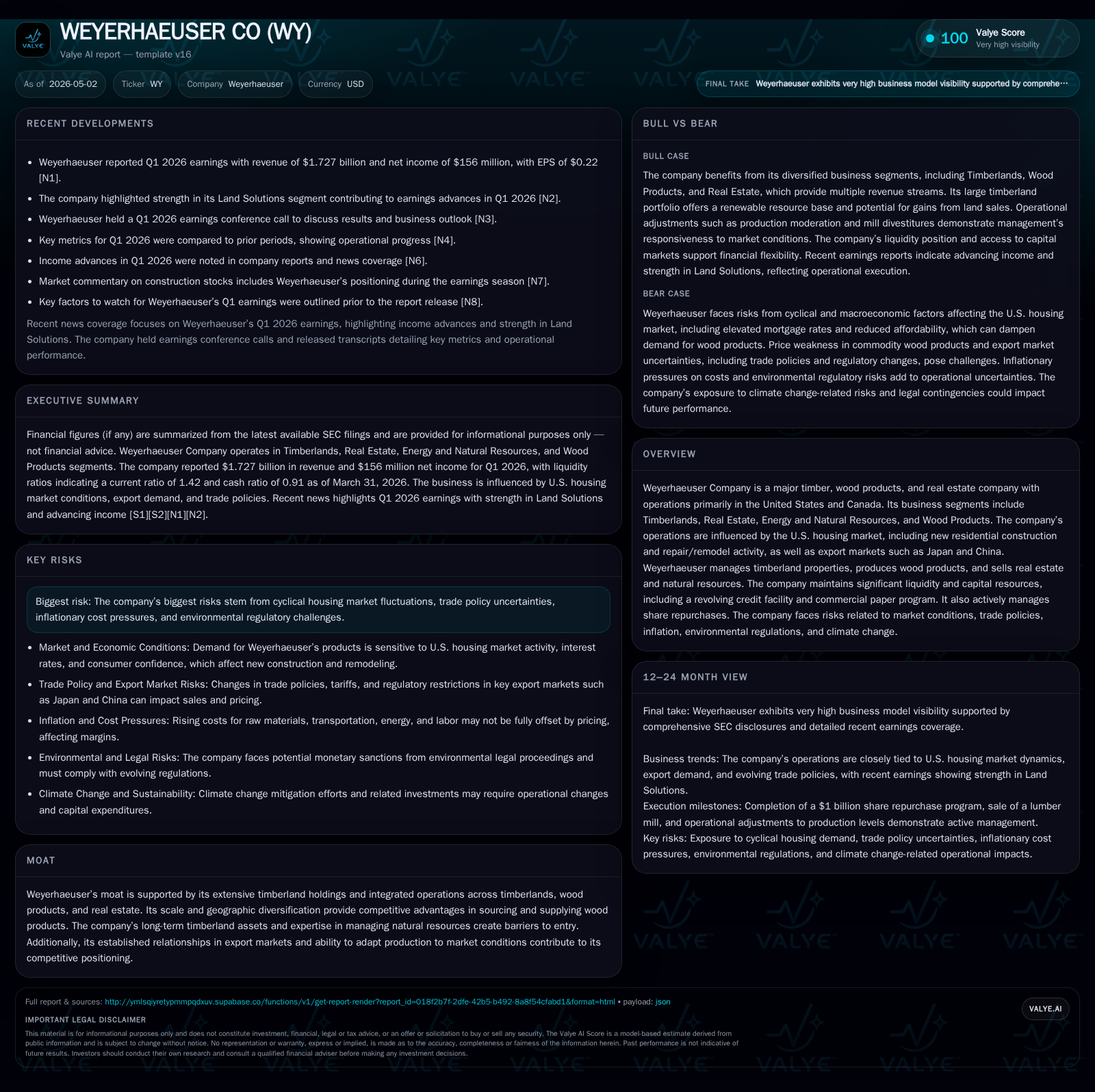
In its Q1 2026 10-Q, Weyerhaeuser reported a notable ramp-up in land solutions revenue, signaling a tactical shift to leverage its real estate assets amid ongoing cyclical pressures in timber and wood product end markets. The company’s vertically integrated model balances timberland operations, wood products manufacturing, and real estate sales to navigate housing market dynamics. Geographic diversification and export relationships underpin its competitive moat, while near-term growth is propelled by real estate sales expansion and selective export market penetration. Persistent risks include housing cyclicality, inflationary cost pressures, regulatory compliance costs, and trade uncertainties. Weyerhaeuser maintains a solid financial position with liquidity supporting continued share repurchases and operational flexibility.
Latest Quarterly Update: Growth in Land Solutions and Operational Highlights
Weyerhaeuser’s Q1 2026 10-Q filing reveals an operational pivot marked by accelerated land solutions activity that bolstered real estate revenues despite persistent headwinds from a slow U.S. housing market [S2]. Recent event reports confirm the company’s targeted emphasis on unlocking value from its broad timberland portfolio through increased land sales, which boosted cash flows and mitigated softness in wood products volumes [S3][N2]. This shift reflects management’s tactical response to cyclical softness in new residential construction while capitalizing on stable or growing repair/remodeling markets.
The quarterly disclosures indicate improved segment cash generation driven primarily by higher-than-expected land sale volumes, underscoring Weyerhaeuser's capacity to monetize its extensive timberlands beyond traditional timber harvesting [S2][N1]. Concurrently, wood products segments displayed resilience through product mix optimization responding agilely to variable demand from both domestic builders and export customers.
Weyerhaeuser’s Multi-Segment Business Model and Product Ecosystem
Weyerhaeuser operates across three primary segments: Timberlands; Real Estate, Energy and Natural Resources; and Wood Products [S1]. The Timberlands segment involves ownership and management of nearly 12 million acres predominantly in the U.S. and Canada, providing sustainable raw material sourcing underpinning vertical integration advantages.
The Wood Products segment manufactures lumber, engineered wood products like laminated strand boards (LSB), oriented strand board (OSB), and panels used extensively in residential construction [S1]. Vertical integration allows Weyerhaeuser to smooth supply chain disruptions, manage costs effectively, and maintain pricing flexibility.
The Real Estate segment focuses on land development and sales—termed 'land solutions'—that strategically converts timberland into residential subdivisions or other property uses when market conditions are favorable. This capability provides both capital recycling options and diversifies revenue streams away from cyclical lumber markets [S1].
Pricing dynamics vary by segment: Timberlands revenues are influenced by harvested volume and standing timber sales pricing; Wood Products pricing depends on global lumber prices linked closely to housing starts; Real Estate revenues follow timing on land parcel transactions influenced by local builder demand profiles. Switching costs are moderate given commodity-like aspects of wood products but mitigated somewhat via customer service relationships and logistical efficiencies.
Competitive Edges from Timberland Integration and Geographic Diversification
Weyerhaeuser’s scale in timberland ownership represents a formidable barrier to entry for competitors due to the capital intensity of acquiring comparable acreage with sustainable yield potential [S1]. The company’s geographic footprint spans diverse U.S. regions plus Canada which helps balance localized weather- or regulation-driven supply constraints.
Vertical integration is a key strategic advantage—owning critical timber resources while producing finished wood products enables Weyerhaeuser to calibrate output flexibly based on shifting market demand or price signals. This integration fosters cost control advantages that are hard for less integrated peers to match.
On the distribution side, established export relationships particularly with Japan and China diversify revenue sources but must be navigated carefully given still-evolving trade policies [S1]. Regulatory compliance costs related to environmental stewardship add fixed overhead burdens but also reinforce reputation as an environmentally responsible supplier.
Macro Housing Market Influences and Industry Structure Considerations
New residential construction activity remains the primary driver for Weyerhaeuser’s core product demand. U.S. single-family starts have been subdued recently due to higher mortgage rates dampening affordability [S2][S12]. However, repair & remodel segments exhibit steadier demand patterns offering partial offsetting stability.
Trade policy uncertainty around softwood lumber tariffs or quotas especially affecting exports introduces volatility risk to revenue streams [S1]. Inflationary pressures on input costs including energy, labor, transport also compress margins particularly when volume growth is sluggish [S12].
Industry structure is marked by consolidation among large timberland owners coupled with competitive pressure from alternative building materials. This necessitates continuous innovation towards efficiency improvements in processing technologies within Wood Products.
Drivers of Near-Term Growth: Expansion in Real Estate and Export Channels
The most visible growth catalyst is the ramp-up of land solutions initiatives that have incrementally unlocked new sources of cash flow beyond cyclical harvest receipts [N2][S2]. Management commentary highlights disciplined parcel selection aligned with favorable zoning approvals enhancing the attractiveness to homebuilders.
On wood products exports, targeted campaigns leveraging logistical partnerships aim at expanding shipments selectively while balancing inventory levels carefully amidst geopolitical tensions [N1][N2]. These efforts combined with incremental cost improvements foster margin expansion potential.
Wood Products also benefit from product mix enhancements focusing on higher-margin engineered products demanded by evolving building codes emphasizing sustainability.
Risks and Constraints: Regulatory, Inflationary, and Cyclical Sensitivities
Persistent risks loom primarily around housing market cyclicality—any sustained downturn impacts all product segments simultaneously [S12]. Inflationary cost pass-through lags can erode near-term profitability metrics.
Environmental regulations impose compliance costs; recent disclosures note material expenses related to wildfire risk management plus carbon regulation frameworks shaping future operating models [S12]. Trade policies hold potential disruption for export channels especially if tariffs tighten or quotas reintroduced.
Liquidity risk appears manageable given a current ratio of 1.42 as of March 31, 2026, supported by $299 million in cash and equivalents against current liabilities of approximately $1.06 billion [F1]. Total debt stood at roughly $5.6 billion netting about $5.3 billion after accounting for cash reserves reflecting moderate leverage given asset base scale [F1].
Key Milestones and Indicators to Monitor Going Forward
Investors should track upcoming quarterly earnings releases for updates on volume trends across Timberlands harvest volumes versus Real Estate land sale transactions as fundamental barometers of recovery or deceleration [S2][N3].
Watch pricing developments in lumber futures alongside updated regulatory announcements relating to forestry management or tariffs impacting exports.
Share repurchase activity under the newly authorized $1 billion program offers insight into confidence levels around free cash flow generation capacity [S13].
Operational efficiency measures within Wood Products—such as throughput rates or yield improvements—are relevant intermediate indicators tied directly to margin expansion goals communicated during earnings calls.
Current Financial Profile and Capital Resource Position
As of March 31, 2026, Weyerhaeuser held $299 million of cash & equivalents against current liabilities of approximately $1.06 billion yielding a current ratio of about 1.42 which points to adequate near-term liquidity [F1]. Total debt stood at roughly $5.6 billion netting about $5.3 billion after accounting for cash reserves reflecting moderate leverage given asset base scale [F1].
Capital allocation includes ongoing disciplined share repurchases under the $1 billion authorization initiated May 2025 with significant remaining capacity supporting shareholder returns without compromising flexibility [S13][S21].
This analysis synthesizes information drawn exclusively from public SEC filings through May 2026 complemented by recent earnings call insights to construct a detailed understanding of Weyerhaeuser's operational status, strategic positioning,and proximate outlook without speculative extrapolation beyond disclosed data. No investment recommendations are provided herein.
Disclaimer: This is research-only, informational analysis and not investment advice. It may include AI-generated interpretation and general industry context. Always verify important details using primary sources.

Comments