
Gates Industrial Advances Aftermarket Growth While Managing Debt in Q1 2026
Gates Industrial leverages its broad engineered product portfolio and global footprint to sustain aftermarket revenue growth despite industrial cyclicality and elevated leverage.
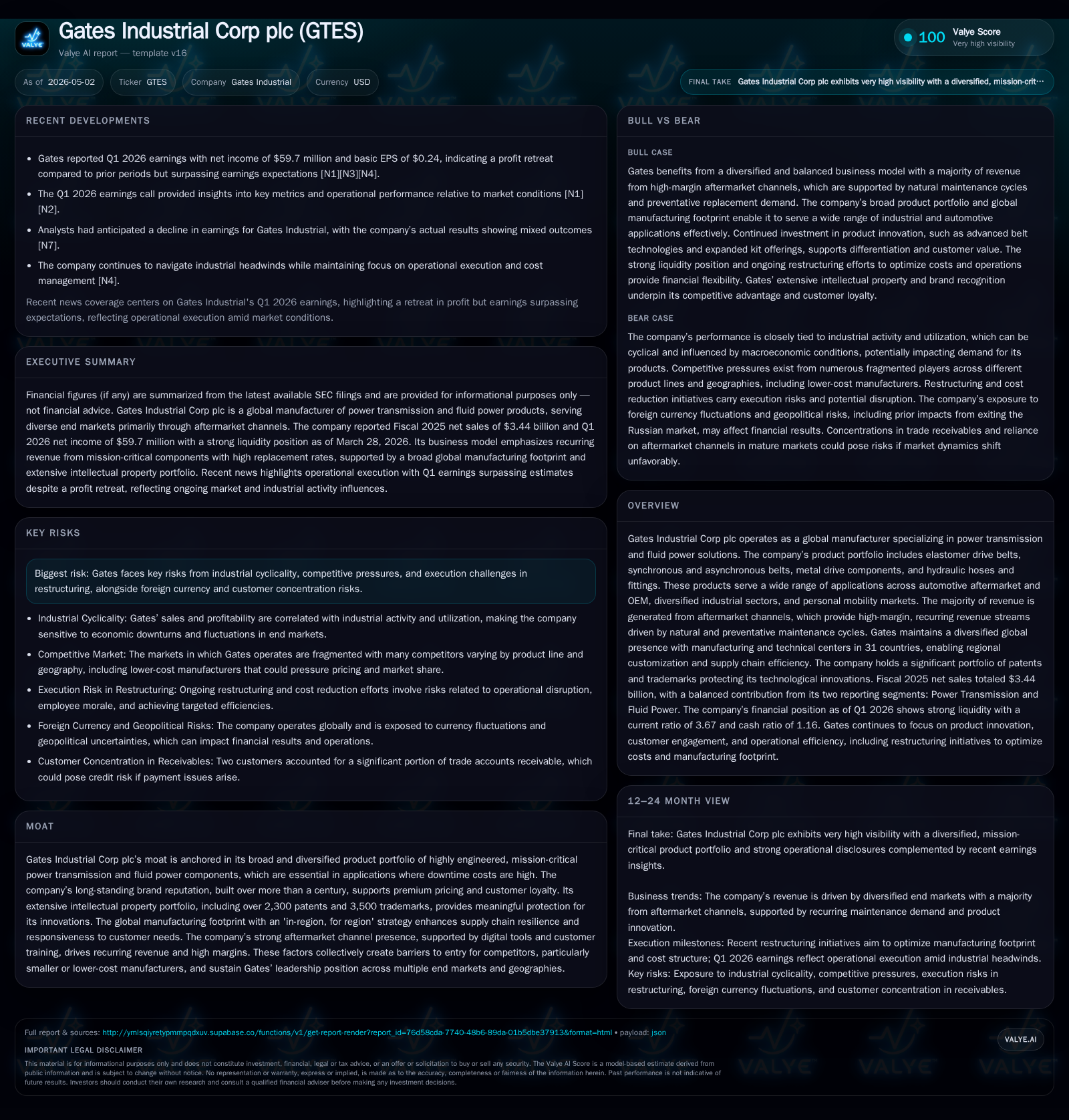
In its latest quarter ended March 28, 2026, Gates Industrial Corp plc (GTES) reinforced its position as a leading global manufacturer of power transmission and fluid power products, driven predominantly by recurring aftermarket sales. The company navigated a mixed industrial environment maintaining high aftermarket exposure, benefiting from natural maintenance cycles that underpin steady demand. Gates’ competitive moat is anchored in its expansive intellectual property and regionally responsive manufacturing footprint, supporting premium pricing and customer loyalty. However, near-term growth is moderated by cyclical industrial activity and significant leverage. Key risks include execution of restructuring initiatives and foreign exchange volatility, while future milestones hinge on expansion in emerging markets’ aftermarket channels and sustaining innovation leadership.
Recent Operating Update
Gates Industrial reported its first-quarter results for the period ending March 28, 2026, highlighting sustained momentum in its aftermarket business which constitutes the majority of its revenue base. The filing dated May 1, 2026 ([S2]) confirms no material changes in risk profiles from the prior annual report but underscores management’s focus on navigating cyclical pressures inherent in the industrial sector.
Operationally, Gates continues to leverage favorable aftermarket demand supported by the natural wear replacement cycles typical for power transmission and fluid power components. The company’s digital tools for distributors and training programs are key enablers enhancing aftermarket sales velocity by reducing downtime risk for end users ([N1]). While the OEM segment remains strategically important for technological collaboration and product innovation pipelines, it is the aftermarket channel—making up roughly 68% of total net sales globally—that sustains high-margin recurring revenue streams amid variable market conditions ([S1], [S26]).
Business Model
Gates Industrial's core business is concentrated on manufacturing highly engineered products essential for power transmission and fluid power applications. These include elastomeric belts—both synchronous and asynchronous types—metal drive components such as pulleys and tensioners, as well as hydraulic hoses and fittings.
Revenue derives primarily from two channels: aftermarket customers who purchase replacement parts driven by preventive maintenance cycles on equipment already sold; and original equipment manufacturers (OEMs) that embed Gates’ products into new machinery. Aftermarket sales typically yield higher margins due to customers’ readiness to pay premiums to avoid costly downtime ([S1]).
The company’s product relevance stems from engineering criticality: these components serve applications where reliability directly impacts operational continuity across automotive markets (both personal mobility and industrial vehicles), energy sectors like oil & gas mining equipment, agricultural machinery, and diversified industrial sectors. This diversification insulates Gates from single end-market shocks while emphasizing maintenance-driven consumable demand ([S14]).
An important strategic strength lies in Gates’ 'kits' offering targeted at automotive service shops—comprehensive replacement solutions tailored by make/model which simplify sourcing logistics while increasing share of wallet per repair job ([S1]).
Industry Structure and Competitive Positioning
Gates competes in an industry characterized by moderate concentration among large global players alongside multiple smaller niche suppliers. The technical complexity embedded in their products fosters barriers to entry. This complexity is further safeguarded by an extensive intellectual property portfolio: over 2,300 granted patents protecting innovations in materials science, product architecture and assembly processes; coupled with more than 3,500 trademarks fueling brand equity ([N1], [S1]).
Manufacturing is distributed across a broad geographic footprint of 31 countries following an “in-region-for-region” strategy supporting supply chain resilience against global disruptions ([N1]). This localization capability allows adaptation to regional customer specifications while mitigating logistics costs.
Customer engagement models emphasize long-term technical collaboration especially with OEM partners during development phases; this connection feeds Gates’ R&D pipeline ensuring continued product relevance relative to evolving application requirements ([S26]). For aftermarket customers including distributors and installers, Gates offers digital diagnostic tools shared through cloud interfaces which enhance predictive maintenance capabilities thus embedding switching costs ([N1]).
This combination of technology leadership, supply chain agility, brand premium status and digital integration establishes sustainable competitive advantages difficult for competitors—especially smaller firms—to replicate comprehensively.
Growth Drivers
Several distinct drivers underpin Gates' growth trajectory:
- Aftermarket Expansion: In mature markets such as North America and EMEA where fleet aging supports steady replacement demand benefiting aftermarket share (~73% of sales), continued penetration through kits innovation and distributor enablement propels incremental sales.
- Emerging Market Development: Among Southeast Asia and Eastern Europe regions where commercial vehicle fleets are growing but aftermarket infrastructures are nascent, Gates leverages OEM collaborations to raise brand visibility enabling future channel development ([S14]).
- Technological Innovation: Ongoing R&D investments focusing on enhanced durability materials (e.g., advanced elastomers resistant to heat/fatigue), IoT-enabled component diagnostics enhance product value propositions.
- Digital Tools & Training: Expansion of software-enabled service platforms for distributors/technicians reduces installation errors/call-backs reinforcing customer stickiness.
- Geographic Diversification: Balanced spread across Americas (~39% of net sales), EMEA, Greater China and East Asia & India spreads economic risk amidst regional industry cycles ([S5], [F1]).
Together these factors contribute structurally resilient demand patterns less dependent on any single industry or macroeconomic sector.
Risks & Watchpoints
Key challenges requiring monitoring include:
- Industrial Cyclicality: Revenue correlates strongly with manufacturing PMI indices and industrial production metrics rather than isolated verticals. Downturns in global industrial activity could dampen equipment utilization leading to reduced parts consumption ([S1]).
- Execution Risk: Ongoing restructuring initiatives aimed at optimizing cost structures carry risks around timing, employee retention impact, or operational disruptions.
- Currency Fluctuations: As a multinational entity with revenues across four commercial regions but significant cost bases also abroad foreign currency volatility can pressure margins.
- Customer Concentration: Although no single customer exceeds 10% of revenues overall some North American receivables concentration exists (~13.7% largest individual receivable) implicating credit risk exposures ([S4]).
- Supply Chain Dependencies: Dependence on raw materials subject to price inflation or availability constraints might impact cost competitiveness or delivery timelines.
Continued vigilance around these issues is critical to maintain operational stability.
What to Watch Next
Market observers should focus on:
- Incremental updates from quarterly releases quantifying progress on aftermarket penetration rates especially in emerging regions.
- Corporate commentary on restructuring milestones like facility consolidations or headcount rationalizations expected throughout FY2026.
- Innovation pipeline announcements relating to next-generation belt materials or digital platform refreshes which might deepen differentiation.
- Backlog or order book trends signaling shifts between OEM project pipelines versus reactive aftermarket restocking.
- Currency hedging outcomes versus exposure particularly given interest rate environments influencing floating borrowing costs ( [F1]).
These indicators will provide insights into sustainability of growth momentum amidst macro uncertainties.
Financial Profile (Q1 End March 2026)
Latest financial snapshot
| Metric | Value | Period |
|---|---|---|
| Cash & equivalents | $785mm | |
| 2026-03-28 | ||
| Total debt | $2.2bn | |
| 2026-03-28 | ||
| Net debt | $1455mm | |
| 2026-03-28 | ||
| Current assets | $2.5bn | |
| 2026-03-28 | ||
| Current liabilities | $679mm | |
| 2026-03-28 | ||
| Current ratio | 3.67x | |
| 2026-03-28 |
Source: SEC companyfacts cache [F1].
The company’s balance sheet reflects prudent liquidity management supporting operational needs amid cyclical volatility:
- Cash & equivalents stand at approximately $785 million providing ample short-term financial flexibility.
- Total debt amounts to about $2.24 billion with net debt near $1.45 billion considering available cash [(F1)].
- Current assets exceed current liabilities by nearly four times (current ratio ~3.67x) indicating robust short-term solvency [(F1)].
Debt instruments include secured term loans maturing beyond 2029 bearing floating rates tied to SOFR plus margin; interest rates effectively lowered following margin reductions implemented in late 2024 ([S6], [S8], [S9], [S28]). Recent voluntary principal repayments have slightly reduced debt burden easing cash interest pressure.
This analysis synthesizes publicly available information focusing on recent operating disclosures primarily from Securities Exchange Commission filings dated February–May 2026 paired with contextual understanding of Gates Industrial Corp’s business model within the engineered components industry segment.
Disclaimer: This is research-only, informational analysis and not investment advice. It may include AI-generated interpretation and general industry context. Always verify important details using primary sources.

Comments