
AGI Inc Elevates Digital Banking Reach with Smart Hub Expansion and Credit Growth
AGI Inc’s latest quarterly results reveal accelerating credit origination and network expansion that underscore the scalability of its hybrid digital banking model in Brazil.
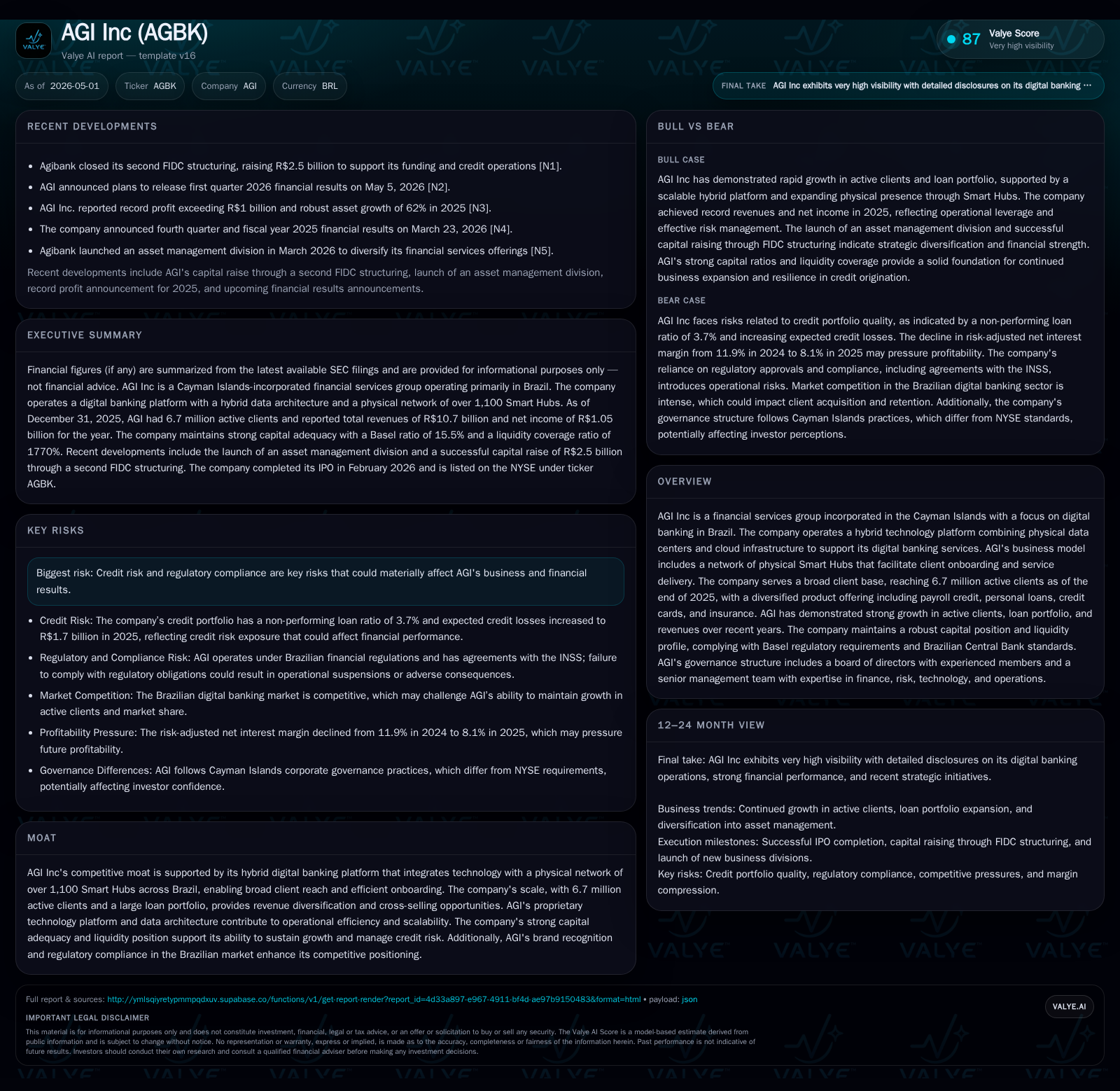
In its April 28, 2026 quarterly filing, AGI Inc reported notable expansion in credit origination supported by a successful R$2.5 billion FIDC securitization and growth of its physical Smart Hub network across Brazil. The company’s hybrid platform—integrating cloud infrastructure with over 1,100 Smart Hubs—enables efficient client onboarding and diversified digital financial product delivery. AGI serves 6.7 million active clients with an evolving portfolio skewed toward payroll loans and personal credit, backed by strong regulatory capital buffers and liquidity metrics. Key growth drivers include client acquisition acceleration, cross-product penetration, and innovative financing strategies to sustain loan portfolio scale. Conversely, regulatory shifts on revolving credit interest caps and ongoing credit risk management remain watchpoints for future performance.
Latest Quarterly Operating Update: Reinforcing Growth Momentum
AGI Inc’s recent quarterly filing dated April 28, 2026 shines a spotlight on the company’s operational acceleration within Brazil's digital banking space [S2]. Of particular note is the closure of its second FIDC (Receivables Investment Fund) securitization transaction generating R$2.5 billion in funding [N2], marking a critical financial innovation step that bolsters liquidity for scaled credit origination. This transaction underscores AGI’s strategic use of capital markets to recycle lending capacity efficiently amid robust loan demand.
Parallel to financing moves, AGI has continued expanding its brick-and-mortar footprint with over 1,100 Smart Hubs nationwide as of late 2025 [S1]. These hubs bridge physical accessibility gaps in Brazil’s diverse geography, accelerating customer onboarding and broadening service reach beyond purely virtual models typical in fintech competitors. Growth in active clients remains robust at 6.7 million by the end of 2025 — nearly doubling since 2023 — signaling increasing market penetration.
The quarterly disclosures also indicate an increase in gross credit origination volume driven predominantly by payroll loan products alongside personal credits and revolving credit lines secured through more advanced underwriting analytics embedded in their proprietary platform.
Business Model Overview: Hybrid Digital Platform Anchored by Smart Hubs
AGI operates a uniquely hybrid digital banking model combining extensive cloud-based IT architecture with physical data centers complemented by a widespread Smart Hub network [S1]. This dual structure supports the company's seamless offering of financial products such as payroll credit loans tied to social security benefits, personal loans linked to paychecks, credit cards including payroll-linked credit cards, and insurance solutions.
This architecture allows AGI not only digital scale but also retention advantages through face-to-face interaction points where customers can resolve complex queries or address trust hesitations common in emerging markets. The hubs function as mini-branch experience centers fostering onboarding velocity while maintaining service quality.
Revenue is primarily generated through interest income from an escalating loan portfolio (R$34.9 billion total loans as of end-2025) augmented by fee-based revenues from card products and ancillary insurance offerings [S1]. Margins benefit from the high proportion of payroll-deductible loans which reduce delinquency risk due to automatic repayment mechanisms.
Operational efficiency trends have improved alongside scale; the reported efficiency ratio contracted to approximately 40.6% in 2025 from higher levels in preceding years [S1], indicating better cost absorption without proportional rises in overheads due largely to technology optimization.
Competitive Position and Industry Structure in Brazilian Digital Banking
Within Brazil's expanding digital banking sector characterized by rapid fintech adoption yet persistent legacy bank resilience, AGI holds a differentiated position anchored by scale and compliance [S1]. Its network of over 1,100 Smart Hubs far exceeds most regional challengers who rely solely on mobile channels. This physical-digital nexus allows deeper market reach into Brazil's underbanked demographics.
AGI complies fully with Basel III capital frameworks enforced locally by Brazil's Central Bank—reporting a capital adequacy ratio of around 15.1%, comfortably exceeding the minimum mandated threshold of 10.5%—signaling prudent risk management and readiness for organic loan book growth [S8].
Brazil imposes several regulations shaping competitive dynamics: notably interest rate caps on revolving credit instruments (especially relevant for credit card financing) enacted under Law No.14,690/2023 which constrains yield potential on these products; stringent data privacy regimes (LGPD) requiring robust cybersecurity policies are another significant compliance factor influencing operational expenditures and reputational capital [S1].
The macroeconomic cycle remains influential as GDP traction correlates positively with consumer borrowing appetite impacting overall industry loan growth trajectories.
Key Growth Drivers: Client Acquisition, Product Diversification, and Financing Strategies
AGI's rapid active client growth (6.7 million at end-2025 vs. 3.9 million prior year) stems from aggressive outreach via Smart Hub augmentation combined with online marketing campaigns targeting salaried workers eligible for payroll loans [S1]. This product dominates approximately two-thirds of the R$34.9 billion total customer loan portfolio consistent with disciplined underwriting criteria emphasizing low default propensity segments.
Cross-selling initiatives leverage ARPAC (annual revenue per active client) averaging around R$1,967 to enhance wallet share across products—encouraging clients holding multiple financial services from payroll loans to personal lines and insurance packages introduces stickiness benefits.
Capital structure evolution includes timely use of multiple securitizations through FIDCs representing assigned receivables primarily mortgages-back payroll-deductible loans which provide capital relief while retaining economic interest via subordinated tranches held internally [S20]. These structures enable sustained lending expansion without dilutive equity issuance or excessive balance sheet encumbrance.
Proprietary AI-powered decision engines embedded within AGI's cloud platform allow real-time risk scoring refining pricing accuracy enabling competitive yet profitable lending terms amid volatile short-term rate environments.
Risks and Constraints: Credit Quality, Regulatory Environment, and Interest Rate Caps
Despite impressive scale gains, AGI faces key ongoing risks requiring active management. Non-performing loans (NPL) were cited at about 3.7% as of end-2025—a moderate uptick from prior periods but remaining well within covenanted thresholds associated with its debenture issuances [S1][S4]. Credit loss allowance ratios remain around 5.6%, signaling conservative provisioning aligned with portfolio risk profiles.
Regulatory supervision under LGPD enforces stringent cybersecurity mandates including third-party vendor controls influencing operational budgets; failure here carries reputational damage risks uncommon in fintech middle-market peers lacking rigorous governance.
Interest rate caps recently legislated limit yields especially on revolver products related to credit card debt finance imposing direct pressure on net interest margins for those product buckets [S1]. These require rebalancing product mix toward less-regulated loan categories or fee income enhancement strategies.
Macroeconomic volatility linked to Brazil’s GDP movements introduces cyclical uncertainty affecting borrower repayment behavior necessitating close monitoring of delinquency trends ahead.
Near-Term Triggers to Monitor: Earnings Release, Loan Portfolio Evolution, and Regulatory Updates
Stakeholders should focus keenly on AGI's upcoming first quarter fiscal year 2026 earnings announcement set for May 5, which will reveal Q126 revenue trends following recent securitization transactions alongside any revision to guidance reflecting macro regulation impact [N1].
Tracking new Smart Hub activations will offer tangible insight into geographic market deepening and client transaction density metrics indicative of marketing effectiveness [S2][N2].
Loan book metrics post R$2.5 billion FIDC structuring should be scrutinized for growth composition shifts particularly advancing payroll loans versus unsecured personal credits impacted differently by regulation [S2][N2].
Regulatory landscape evolutions including any Central Bank statements clarifying implementation details on interest rate caps or further LGPD amendments could materially sway operating margins or compliance costs moving forward.
Continuous evaluation of NPL progression amidst evolving economic backdrop will determine risk provisioning adequacy influencing earnings sustainability.
This analysis is based strictly on publicly available SEC filings through April 30, 2026 ([S1], [S2], [S3]) supplemented with recent news reports ([N1], [N2]). It does not contain investment advice but aims to provide a comprehensive view of AGI Inc’s operational status within Brazil’s digital banking industry context.
Disclaimer: This is research-only, informational analysis and not investment advice. It may include AI-generated interpretation and general industry context. Always verify important details using primary sources.

Comments