
CNFinance’s Evolving Collaboration Model Strengthens Small Borrower Access in China
The April 2026 quarterly filing highlights CNFinance's operational execution and ongoing strategic refinements supporting its niche in home equity loans for micro-enterprises.
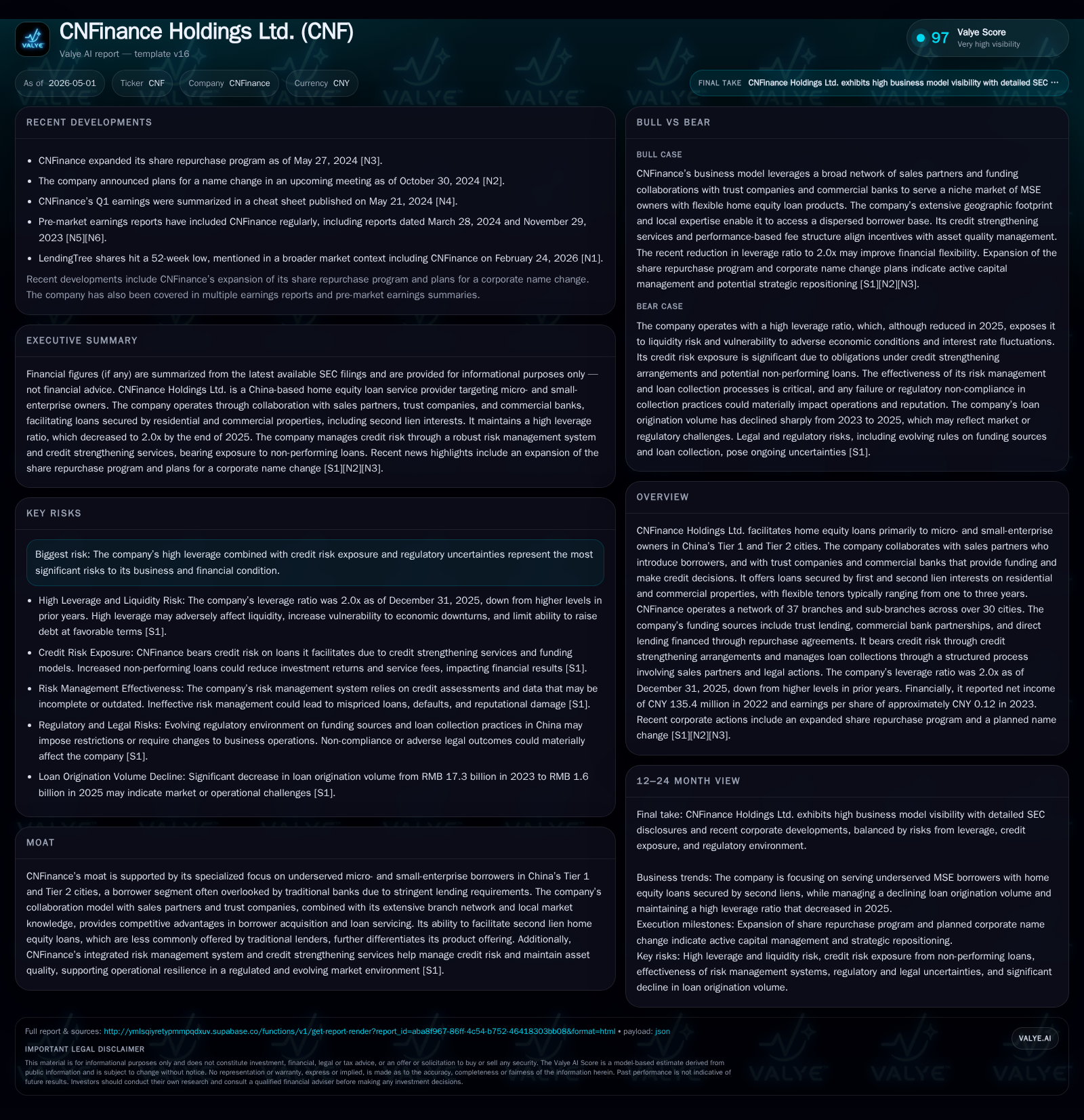
CNFinance Holdings Ltd. continues to refine and expand its collaboration-based model, connecting micro- and small-enterprise owners in China's Tier 1 and Tier 2 cities with diversified funding partners including trust companies and commercial banks. The latest quarterly disclosure emphasizes steady execution of this model amid a significant reduction in leverage and ongoing risk management enhancements. Despite regulatory challenges and shrinking loan origination volumes over recent years, CNFinance’s extensive local branch network, sales partner ecosystem, and flexible lending products maintain its competitive edge in an underserved market segment. The company's growth hinges on expanding partner channels, optimizing credit processes with funding partners, and adapting to evolving regulatory frameworks.
Latest Quarterly Operating Update: Stability and Strategic Signals
The most recent quarterly filing dated April 30, 2026 (Form 6-K) serves as the definitive update on CNFinance Holdings Ltd.'s operational status. The filing primarily reaffirms the company’s continued adherence to its collaboration-driven model without material disruption or strategy shifts. It includes a press release incorporated by reference outlining ongoing execution under existing business frameworks, showcasing strategic consistency amid a still evolving environment [S2]. No major changes were disclosed that would disrupt the core facilitation business or the partnership ecosystems driving borrower acquisition.
Such continuity is significant given the backdrop of recent regulatory tightening in China’s fintech lending sector. It underscores CNFinance's ability to maintain steady operations during periods where many peers face greater uncertainty or retrenchment.
Business Model: Facilitating Home Equity Loans for China's Micro-Enterprise Sector
At its core, CNFinance operates as an intermediary linking micro- and small-enterprise (MSE) owners holding residential or commercial properties to licensed financial institutions endowed with significant funding capacity—primarily trust companies and commercial banks [S1]. The company does not lend directly but facilitates home equity loans secured by first or notably second lien interests on collateral properties.
Borrowers are sourced predominantly through a network of contracted sales partners who identify creditworthy MSE owners. These sales partners contribute capital relative to each introduced loan—a mechanism termed "CRMP"—thus aligning incentives between CNFinance, partners, and borrowers while sharing credit risk exposure [S6].
The loans typically feature flexible tenors ranging from one to three years with principal sizes adjusted per collateral valuation and borrower creditworthiness. This flexibility suits the short-term working capital needs common among MSEs struggling to access traditional bank financing due to stringent lending requirements or inability to pledge first-lien collateral exclusively.
Commercial bank partnerships established since 2021 represent a strategic evolution allowing CNFinance to diversify borrower profiles via more competitive pricing models while still leveraging its sales partner channel for borrower introduction. The banks perform final credit approvals independently but rely heavily on CNFinance’s initial vetting [S12][S27].
Distinctive Product Offering and Risk Mitigation
What differentiates CNFinance notably is its provision of second lien home equity loans—a product largely absent from mainstream Chinese banking portfolios due to regulatory oversight constraints. These loans address an underserved financing gap for MSE owners who need additional borrowing capacity beyond primary mortgage limits [S10].
Risk mitigation is integral throughout the loan lifecycle. Borrower credit assessments are supported by an integrated online-offline platform collecting data from internal analyses alongside multiple external sources. Final underwriting authority rests with funding partners who bear ultimate credit decisions [S5][S12].
Post-loan management involves structured collections protocols coordinated between CNFinance’s local staff—operating through its 37 branches nationwide—and sales partners who share delinquency risks via CRMP arrangements. Ethical debt collection practices are codified through detailed guidance aligned with PRC laws ensuring compliance amid heightened regulatory scrutiny against abusive recovery methods [S16][S24].
In addition to credit strengthening services previously provided which ceased in early 2018, CNFinance continues managing collateral perfection and employs legal action selectively when necessary—a process complicated by regional enforcement variability but partly mitigated by strong local market familiarity [S21].
Competitive Environment and Industry Dynamics
CNFinance competes within China’s fragmented fintech lending ecosystem targeting micro- and small enterprises—a borrower segment often overlooked by large traditional banks constrained by rigid policies favoring prime corporate clients [S13]. Trust companies remain critical players providing bespoke lending vehicles such as trust plans that package investor funds into senior/subordinated tranches matched carefully against loan tenors.
The company’s competitive advantages stem from: (1) its scale—operating a wide branch network across over 30 cities including key Tier 1/2 hubs offering geographic diversification; (2) specialized expertise enabling navigation of local regulatory regimes which differ substantially across regions; (3) robust collaboration frameworks leveraging over two thousand contracted sales partners who serve as localized originators feeding quality borrowers; (4) diversified funding channels including long-standing relations with industry-leading trust funds like FOTIC; and (5) ability to offer second lien products tailored for varying client needs unavailable through many traditional bank platforms [S8][S11]. Regulatory pressures affecting some funding types induce shifts towards direct commercial bank collaborations presenting fresh competition dynamics but also expanded borrower pools for CNFinance.
Growth Drivers: Partner Expansion, Loan Diversification, and Regulatory Navigation
Expansion in contracted sales partners remains central: as of latest disclosures approximately 2,187 sales partners are onboarded though only about 127 remain actively engaged at any given time—reflecting room for efficiency gains through stronger recruitment & retention practices [S6]. These partners fuel more than 95% of all borrowers introduced under the trust lending collaboration model.
Commercial bank partnerships initiated in 2021 have gained traction despite representing a smaller share presently (~211 loans originated in 2025). This channel contributes greater borrower diversity with pricing ranging from roughly 7% to 16% annual interest—more competitive versus trust-lending rates near ~16%—which could foster product mix enhancement moving forward.
Regulatory navigation is both challenge and opportunity: emerging legislation such as Administrative Measures for Working Capital Loans introduces constraints impacting personal loans operations at banks but does not yet regulate non-bank facilitators directly. Through strong compliance programs aligned tightly with evolving standards and ethical conduct codes shared across partner networks, CNFinance aims to sustain operating licenses while optimizing product design consistent with permitted parameters [S23][S24].
Operational investments into underwriting analytics enhancement jointly undertaken with funding partners could improve credit quality metrics driving healthier portfolios potentially lowering loss provisions or bad debt reserves.
Risks and Constraints: Leverage, Credit Exposure, and Regulatory Uncertainty
Credit risk embedded in micro- enterprise clientele is inherently higher than prime consumables due to frequent unpredictability of cash flows mixed with collateral enforcement complexities including possibility of borrowers evading collections or collateral encumbrances ranking seniorly prevents full recovery [S21].
Regulatory oversight could tighten further impacting permissible funding methods used such as transferring rights under repurchase agreements or structural obligations relating to subordinated unit subscriptions required under trust plans. Imposition of capital reserve requirements could materially affect available funds deploying new loans or require conservative portfolio adjustments constraining growth timelines [S5][S23].
Dependence on third-party funding providers entails counterparty risks including potential withdrawal of financing or adverse renegotiation of terms.
Lastly misconduct risks persist related to reliance on external parties including sales partners whose actions may impact reputational standing or legal compliance despite control efforts.
Looking Ahead: Key Milestones and Operational Focus Areas
Strategic priorities appear focused on:
- Scaling effective recruitment & activation of sales partners increasing both quantity & quality metrics,
- Enhancing portfolio health through data-driven underwriting improvements co-developed with trust company & commercial bank partners,
- Monitoring evolving PRC regulatory developments closely ensuring nimble adaptation particularly around loan origination limits & data governance,
- Optimizing financing cost structure balancing trust lending reliance against expanding commercial bank funded loans,
- Maintaining disciplined collections operations aligned strictly with ethical standards strengthening recoveries amid uncertain macro backdrop,
- Tracking demand signal shifts in Tier 1/2 city MSE segments post-pandemic including loan utilization trends & borrower profile evolution.
These factors coalesce around improving utilisation efficiency of the branch/sales partner footprint complemented by broadening product breadth addressing nuanced client needs within compliant frameworks.
Financial Position: Leverage Reduction and Liquidity Overview
Per latest available financial information at December 31, 2025: CNFinance holds CNY338 million in cash & equivalents substantially exceeding reported total debt levels last measured at CNY31 million at end-2023 indicating net cash positioning consistent with stated deleveraging initiatives over recent periods [F1]. This liquidity buffer supports operational resilience enabling investments into business development even amidst muted origination volumes notably shrunk from RMB17.3 billion in 2023 down sharply to RMB1.6 billion in 2025 reflective of industry-wide tightening conditions.
Cost of capital remains elevated reflecting repurchase agreement structures featuring financing rates spanning approximately 8%–14%, heightening sensitivity to interest volatility impacting net returns on subordinate unit subscriptions inherent in trust plan consolidations reported on consolidated statements [S3][S4].
Overall financial stewardship evidences prudent reduction in leverage accompanied by adequate liquidity safeguards supportive of sustainable operations prioritized alongside growth-oriented partnership expansions ensuring balanced risk-return optimization going forward.
This analysis incorporates information extracted from the company’s SEC filings up through April 30, 2026 ([S1], [S2], etc.) along with company facts numeric data ([F1]). It aims solely to present an independent analytic commentary rooted in disclosed operating facts without providing investment guidance.
Disclaimer: This is research-only, informational analysis and not investment advice. It may include AI-generated interpretation and general industry context. Always verify important details using primary sources.

Comments