
National Steel Co Strengthens Steel Processing Presence Through Strategic Acquisitions Amid Brazil Tariff Landscape
National Steel Co’s recent acquisition of Gramperfil enhances its structural steel offerings and market penetration in Brazil’s protectionist environment.
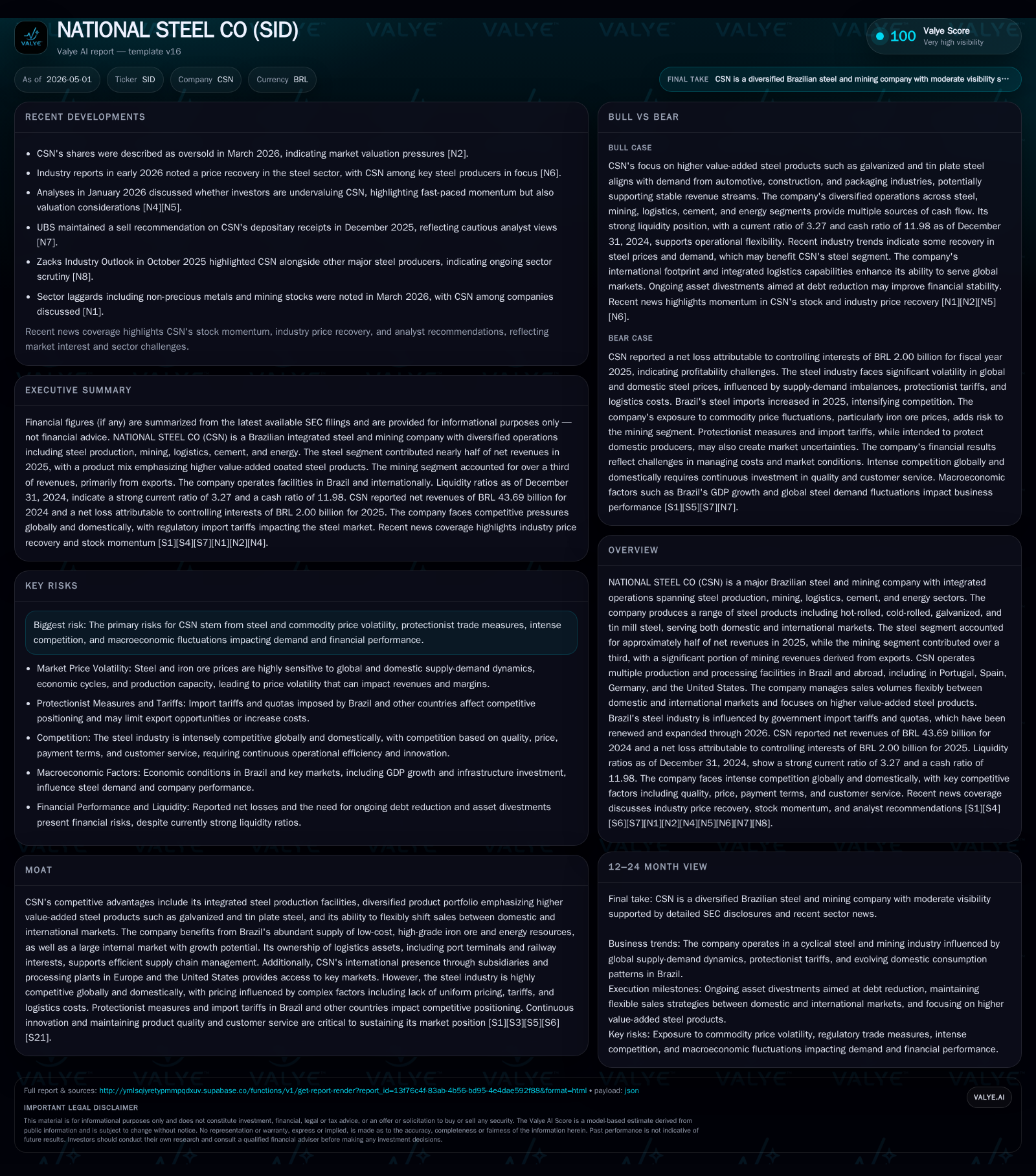
In its latest quarterly update, National Steel Co (CSN) advanced its strategic expansion into steel processing by acquiring Gramperfil, a key player in structural metal profiles for construction. This move complements CSN’s integrated steel production model, enhancing its value-added product portfolio amid Brazilian import tariffs that support domestic producers. The company leverages its logistical assets and diversified international footprint to navigate pricing complexities and competitive pressures. Growth drivers include vertical integration, market diversification, and environmental compliance investments, balanced against risks from commodity price volatility and ongoing arbitration exposures. Financially, CSN maintains robust liquidity and is actively managing leverage through asset divestments and refinancing initiatives.
Latest Quarterly Operating Developments and Their Strategic Significance
National Steel Co (CSN) disclosed through its April 30, 2026 quarterly filing [S2] key operational progress including the acquisition of Gramperfil—an established manufacturer of metal structural profiles used predominantly in the Brazilian construction sector [S3]. This strategic purchase is part of CSN’s broader initiative to deepen its presence in steel processing markets by integrating downstream products that add commercial capillarity and operational synergies. The acquisition targets structural solution segments with enhanced proximity to end customers, which is expected to translate into improved operating margins and competitive positioning.
This development aligns with the evolving Brazilian steel market shaped by government-imposed tariffs (set at 25%) coupled with import volume quotas that collectively protect domestic producers while influencing supply-demand dynamics [S1]. CSN's enhanced processing capabilities through Gramperfil provide a differentiator during tariff-induced industry segmentation.
Comprehensive Business Model and Product Mix Analysis
CSN employs an integrated business model encompassing multiple sectors: mining of iron ore and other minerals; steel production featuring hot-rolled, cold-rolled, galvanized (zinc-coated), galvalume (Al-Zn alloy coated), paint-coated steels, as well as tin mill products such as tin plate and tin-free steels; logistics comprising port terminals and railway concessions; cement production; and energy generation focusing on renewable sources [S1].
The steel segment consistently contributes about half of CSN’s net revenues with considerable gross profit share attributable to higher value-added products which command better pricing power despite the complex heterogeneity of steel grades and quality specifications impacting pricing standardization globally.
Crucially, CSN flexibly allocates volume between domestic markets benefitting from tariff shields versus export markets where prices are denominated in dollars or euros but often exhibit lower margins due to cumulative logistics costs [S1]. This adaptive sales volume management helps navigate price opacity stemming from spot versus contract pricing differentials inherent in the steel sector.
Competitive Positioning Within Brazil’s Integrated Steel Industry
CSN holds a substantial moat driven by its fully integrated steelmaking capacity that starts from ore mining—leveraging Brazil’s abundant low-cost iron ore—to producing finished steel products tailored for multiple industrial sectors. Its ownership over key logistics infrastructure such as ports and rail concessions lowers transportation costs notably compared to competitors reliant on third-party logistics providers.
The company also operates strategically placed subsidiaries abroad—with processing facilities across Portugal, Spain, Germany, and the United States—providing critical access to mature markets and diversification beyond local cyclical risks [S1].
Within Brazil’s tariff-influenced market structure—where import volumes have been tightly controlled via quota expansions since 2024—the high switching costs for customers favor integrated producers like CSN who can offer reliable supply chains alongside product breadth. Furthermore, emphasis on galvanized, tin mill steels and coated products caters to growing demand for corrosion-resistant materials in automotive and construction applications.
Key Industry Dynamics: Trade Policies, Pricing Complexities, and Logistics
Brazil’s imposition of an initial 25% import tariff on eleven steel item categories in April 2024—expanded subsequently to cover over thirty items by early 2026—has recalibrated domestic market positioning markedly. Quotas calculated with reference to average imports plus a buffer cap imports strictly while permitting manageable foreign competition intensity [S1].
Due to the fragmented nature of global steel pricing—with no exchange-traded uniform benchmarks—domestic prices are influenced heavily by internal supply-demand tightness enhanced by tariff protections. Export pricing remains subdued relative to domestic levels due to tax regimes, freight expenses, and margin compression.
CSN's ownership of logistics assets plays a pivotal role in optimizing cost structures—for both raw material inbound supplies like coal/ore as well as outbound shipments—directly supporting competitiveness against imports which incur similar logistical premium yet without local tariff shelter [S1].
Growth Catalysts: Market Penetration, Margin Expansion, and Vertical Integration
The recent Gramperfil acquisition exemplifies CSN’s targeted vertical integration strategy aimed at expanding downstream product offerings beyond commodity-grade flat rolled coils into structural metals that are integral to construction infrastructure—an expanding segment driven by Brazil’s developing urbanization trends [S3].[S1]
Domestic steel consumption shows signs of structural growth (+2.7% apparent consumption increase in 2025) supported by infrastructure investments and housing demand despite minor declines in crude output volumes regionally. Environmental compliance projects at key sites such as Presidente Vargas Steelworks with committed R$303 million investments through Dec 2026 further underpin sustainable operational expansion mandates crucial for long-term license-to-operate assurances [S1].
Additionally, export sales continue rising (+14.7% increase year-over-year rolls) signaling capacity to capitalize on foreign markets where Brazilian-origin steel benefits from product quality standards despite freight cost headwinds [S1]. Strategic asset divestment plans unveiled recently intend to recycle capital towards highest yielding segments enabling margin accretion while deleveraging the balance sheet over time [S3][S9].
Risks and Constraints: Price Volatility, Regulatory Challenges, and Arbitration Exposure
CSN faces several risks inherent to its operating environment. Commodity price volatility—particularly fluctuations in iron ore prices driven by global cycles—directly impacts mining profitability feeding into integrated margins.
Pending confidential arbitration concerning alleged defaults on iron ore supply contracts with claims valued around US$1 billion adds legal risk amidst ongoing proceedings anticipated to conclude within approximately twelve months from the last report date [S1]. Environmental liabilities remain significant albeit covered by provisions (~R$119.7 million); lawsuits related to landfill remediation mandates near Volta Redonda coupled with potential regulatory fines or coercive sanctions could disrupt operations or impose material costs [S1].
Protectionist trade policies could also shift unexpectedly given political changes or external trade disputes affecting export flows or domestic imbalances resulting in either overcapacity or undersupply scenarios.
Upcoming Milestones and What to Monitor Next
Key upcoming events include resolution updates on the iron ore arbitration expected within the next fiscal year as per legal timelines outlined in filings [S1]. Monitoring progress on environmental project completions tied to TAC obligations by December 19, 2026 will be essential from a regulatory compliance viewpoint.
Operationally, the integration success of Gramperfil along with any additional downstream acquisitions will serve as indicators of margin expansion capabilities and commercial reach gains throughout FY2026 [S2][S3]. Additionally, extension or revision of Brazilian import tariff policies will materially influence competitive dynamics domestically.
CSN's execution pace on asset divestment initiatives designed to reduce net leverage between R$15–18 billion remains critical for financial flexibility going forward [S3][S9].
Supporting Financial Profile: Liquidity and Capital Structure
As of December 31, 2025 data reported within the March 27 filing indicate cash and cash equivalents totaling R$14.4 billion complemented by financial investments earmarked primarily as collateral instruments supporting bank guarantees essential for operations in regulated sectors such as rail logistics ([S3]).
This liquidity profile affords CSN ample headroom to fund operational expansions including acquisitions like Gramperfil while progressing on substantial debt reduction targets articulated in its structured divestment plans ([S9],[S3]).
This analysis synthesizes publicly filed SEC documents up to April 30, 2026 alongside corroborating industry insights without projecting specific investment recommendations or speculative forecasts beyond documented guidance. All financial statements cited derive solely from referenced filings or company facts datasets without extrapolation.
Disclaimer: This is research-only, informational analysis and not investment advice. It may include AI-generated interpretation and general industry context. Always verify important details using primary sources.

Comments