
Republic Airways Expands Fleet and Capacity Under Multi-Year CPAs Amid Margin Pressures
The 2026 first-quarter results highlight fleet growth and operational scale gains from the Mesa merger tempered by contract revenue challenges and mix shifts.
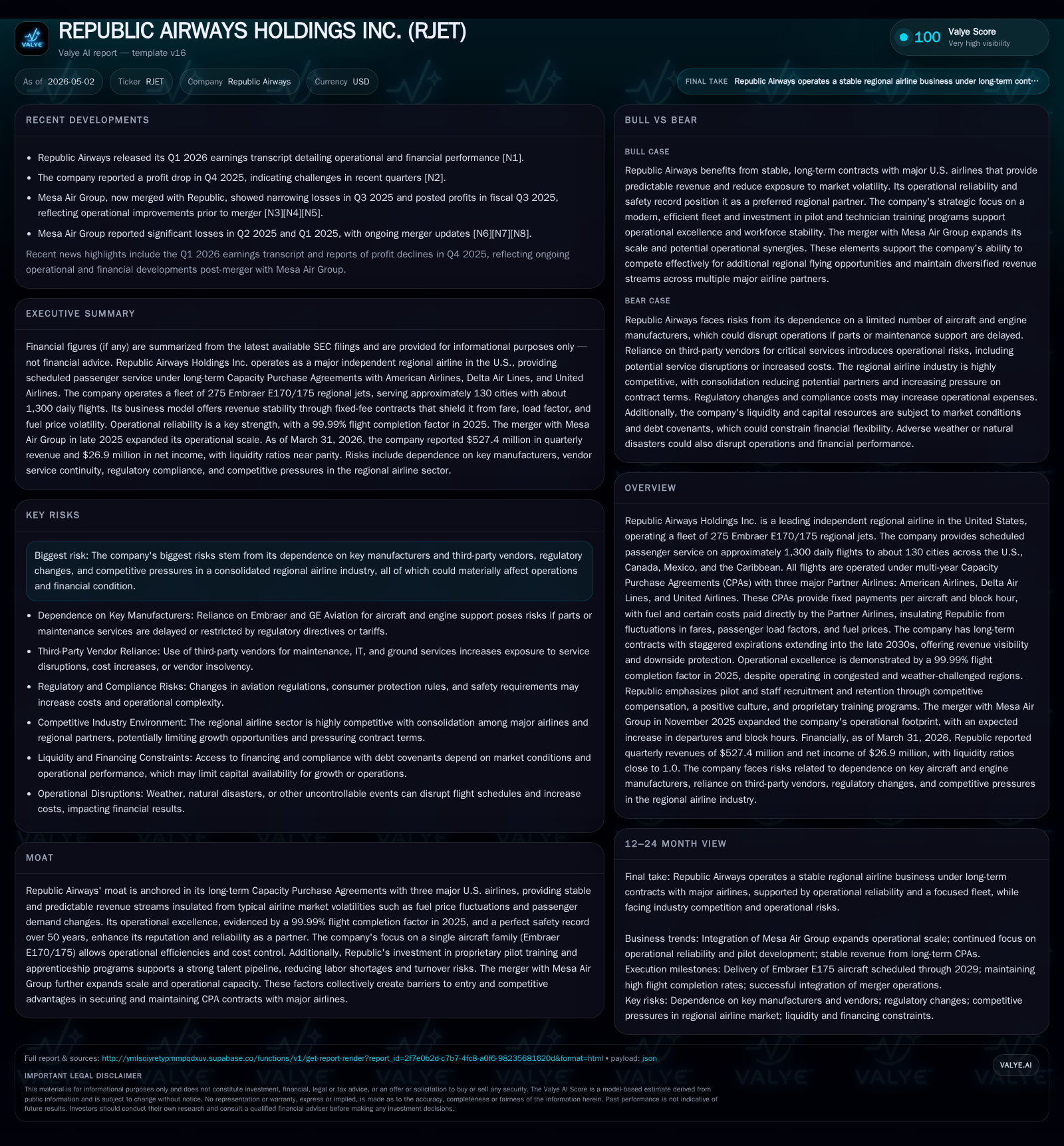
Republic Airways Holdings reported a strategic increase in block hours and fleet size following its merger with Mesa Air Group, positioning it as the second largest independent regional carrier in the U.S. Its business model, anchored by long-term Capacity Purchase Agreements with major airlines, offers strong revenue visibility insulated from fare and fuel volatility. However, contract revenue per seat mile declined notably, reflecting pricing pressure from partner renegotiations and evolving network mix. Operational improvements in costs and maintenance efficiencies partially offset these profitability headwinds. Key risks include reliance on aircraft OEMs, regulatory changes, and competitive dynamics within a consolidating regional airline market.
Recent Operating Update
Republic Airways Holdings filed its latest quarterly report on May 1, 2026, disclosing operational updates reflective of the merger with Mesa Air Group finalized late in 2025 [S2]. The key near-term shift is an anticipated approximate 24% increase in block hours for the full year 2026 compared to prior years, driven by leveraging Mesa's operational scale into Republic's network under multi-year CPAs with major airlines [S1][S2]. This ramp-up validates Republic’s strategic intent to grow capacity sustainably through purchased flying agreements rather than fare-dependent sales.
However, contract revenues per available seat mile (CRASM) have declined materially — around 33-35% year-over-year through the latter part of 2025 — mirroring partner airlines' pricing renegotiations or network realignments that favor lower-yield routes or segments [S15][S17]. The decline also signals pressure on unit economics despite higher overall activity levels.
In the most recent quarter ending March 31, 2026, contract revenues dropped nearly 30%, offset partially by pass-through revenues increasing about 15%, underscoring shifting revenue composition due to operational changes and expense pass-throughs under CPAs [S18]. Maintenance expenses also fell significantly due to streamlined aircraft management and retirements.
Business Model
Republic Airways operates as a regional feeder airline predominantly supported by Capacity Purchase Agreements (CPAs) with American Airlines (American Eagle), Delta Air Lines (Delta Connection), and United Airlines (United Express). These CPAs constitute the backbone of its revenue model: Republic provides capacity—operating Embraer E170/175 jets—while the mainline carriers handle scheduling, marketing flights under their brand names, set ticket prices, and absorb variable costs such as fuel [S1][S23].
Revenue streams are largely insulated from fluctuations in passenger fares or load factors; instead, Republic is paid fixed fees per aircraft operated per block hour plus recovery of certain expenses. This model mitigates traditional airline demand cyclicality risks but exposes Republic to contractual terms negotiated with partners.
Operating entirely a single-family regional jet fleet facilitates cost efficiencies: pilot training programs benefit from standardization; maintenance economies arise from parts commonality; and scheduling simplifies crew management. Moreover, Republic invests heavily in proprietary pilot training infrastructure—including a new aviation campus—to maintain operational reliability and mitigate labor shortages prevalent in regional aviation [S21].
The merger completed in November 2025 with Mesa Air Group further increases Republic's scale allowing for a combined larger footprint across regional flying contracts. As of year-end 2025, Republic's fleet totals approximately 275 E170/E175 jets dedicated under long-term CPAs with staggered expirations extending into the late 2030s. This diversification across three major carriers reduces customer concentration risk [S1][S23].
Industry Structure and Competitive Position
The U.S. regional airline industry is characterized by a few large players operating under capacity purchase agreements for mainline carriers. Regional airlines provide essential local access feeding passengers into global networks at hub airports but typically operate on thin margins governed by contract terms set by dominant partners. Regulatory scrutiny over safety and labor compliance imposes operational complexity.
Republic stands out as the second-largest independent regional carrier (excluding mainline affiliates) by fleet size and departures. Its relationships across three top-tier airlines contrast with some competitors who rely heavily on singular partnerships. The partnership mix helps mitigate individual mainline airline risk while bolstering negotiating leverage over time.
Moreover, Republic’s pristine safety record over five decades coupled with an exceptional flight completion factor (99.99% in calendar year 2025) reinforces its reputation for reliability—an essential competitive moat when partnering mainlines evaluate subcontractors for their feed networks.
Fleet homogeneity centered on Embraer’s E170/175 series supports operational excellence but ties the company’s fortunes closely to that aircraft manufacturer’s business continuity and ongoing airworthiness directives—areas identified as potential points of vulnerability if material disruptions occur [S1][S6].[Analysis: Fleet choice enhances cost control but creates supplier concentration risk]
Competition remains fierce among regional operators bidding to secure or retain CPA contracts amid mainline airline industry consolidation that may depress regional flying demand or alter aircraft size preferences—trends that could pressure future contract pricing or flying volume [S1][S6].
Growth Drivers
Capacity Expansion via Merger Synergies
Republic has concretely increased its scale through acquiring Mesa Air Group in late 2025. This transaction is projected to boost block hours flown circa +24% during fiscal year 2026 versus the prior period—a measurable indicator of expanding operational capacity within existing partnership frameworks [S1][S3]. The combined entity can optimize route networks, improve asset utilization, consolidate overhead functions, and offer more bundled flying packages to partner airlines.
Multi-Year Contract Stability & Revenue Visibility
Long-term CPAs underpin near-to-medium-term revenue predictability insulated from passenger traffic volatility or fuel price swings since partners assume variable costs directly. Contract staggering ensures continuous business flow while enabling periodic renegotiation opportunities that could capture improved economics if market conditions shift favorably [S1].
Operational Excellence & Talent Pipeline Investments
Republic’s investment in proprietary pilot training facilities addresses chronic industry-wide pilot shortages—a key operational risk factor—and supports workforce stability crucial for scaling capacity without prohibitive wage inflation or turnover-driven disruptions. Complemented by solid maintenance practices concentrated on one aircraft type reduces downtime risks enhancing scheduled reliability metrics attractive to partners [S21].
Geographic Diversification & Partner Mix
Serving roughly 130 cities across North America diversifies demand exposure away from localized economic shocks or regulatory changes at specific airports or states. Engagements with three major U.S. carriers reduce dependence on any single partner’s strategic priorities subject to competitive dynamics or alliance shifts [S23].
Risks / Watchpoints / Growth Constraints
Supplier Dependence & Regulatory Exposure
Dependence on Embraer for aircraft supply/support and GE Aviation for engines concentrates technical risk: any production delays or adverse FAA airworthiness directives impact operational availability directly. Potential tariff escalations related to imported Brazilian-made jets pose cost risks amid current uncertain trade policies between the U.S. and Brazil [S6][S12][S13][S28]. Environmental regulation tightening could raise operating costs via emissions compliance or de-icing restrictions at critical airports.
Contract Revenue Pressure & Competitive Tendering Environment
Contractual rates have exhibited significant declines recently—as seen in falling CRASM figures signaling compressed profitability despite higher block hours flown—indicating strong buying power of partner airlines over regional operators amid industry consolidation trends reducing flying volumes for regionals overall [S15][S17]
Third-Party Vendor Reliability Risks
Outsourcing critical maintenance functions & ground services introduces execution vulnerabilities if vendors have financial stress or fail regulatory requirements risking delays or cost overruns potentially harming reputation or margins [S1]
Capital Intensity & Leverage Profile
Republic ended Q1 2026 with $111 million cash & equivalents against reported total debt approximately $95 million as of September 2025, resulting in a net cash position that provides a liquidity cushion amid operating scale expansion [F1]. The current ratio was 0.94 as of March 31, 2026, reflecting working capital slightly below parity, which is typical for capital-intensive airlines.
Labor Market Dynamics & Talent Retention Challenges
Despite investments in training infrastructure lowering risk relative to peers, the tight U.S. pilot labor market remains fragile particularly if broader industry capacity expansion triggers wage inflation beyond contract offsets disrupting operating expenses assumptions
What to Watch Next
- Operational Metrics: Monitor quarterly block hours growth rates post-merger implementation reflecting integration success.
- Contract Renewal Negotiations: Watch expiration timelines between now and late-2030s for repricing outcomes especially with United’s large fleet share expiring soonest.
- Margin Trends: CRASM movements will signal if recent pricing pressure stabilizes or worsens.
- Capital Expenditure Guidance: Updates on fleet modernization plans given half-life of E170/E175 aircraft advancing.
- Regulatory Developments: FAA airworthiness directives affecting Embraer fleet or new tariff/regulation announcements impacting imported equipment costs.
- Labor Relations: Pilot hiring pipeline status including training center throughput informs potential labor constraints ahead.
Financial Profile Summary
Latest financial snapshot
| Metric | Value | Period |
|---|---|---|
| Cash & equivalents | $111mm | |
| 2026-03-31 | ||
| Current assets | $487mm | |
| 2026-03-31 | ||
| Current liabilities | $520mm | |
| 2026-03-31 | ||
| Current ratio | 0.94x | |
| 2026-03-31 |
Source: SEC companyfacts cache [F1].
Management continues guiding for growth based primarily on block hour increases not fare-based volume gains consistent with CPA model structure emphasizing stable contracted cash flows buffered from demand shocks but sensitive to negotiated rate adjustments impacting unit profitability margins.
This analysis is based solely on public regulatory filings as well as documented company disclosures through May 2026. It does not constitute investment advice or recommendations.
Disclaimer: This is research-only, informational analysis and not investment advice. It may include AI-generated interpretation and general industry context. Always verify important details using primary sources.

Comments