
Twilio Advances Integrated AI-Enhanced Cloud Communications Amid Usage-Based Demand Variability
Twilio’s latest Q1 results underline strategic execution on platform consolidation and AI investment against usage-driven revenue variability.
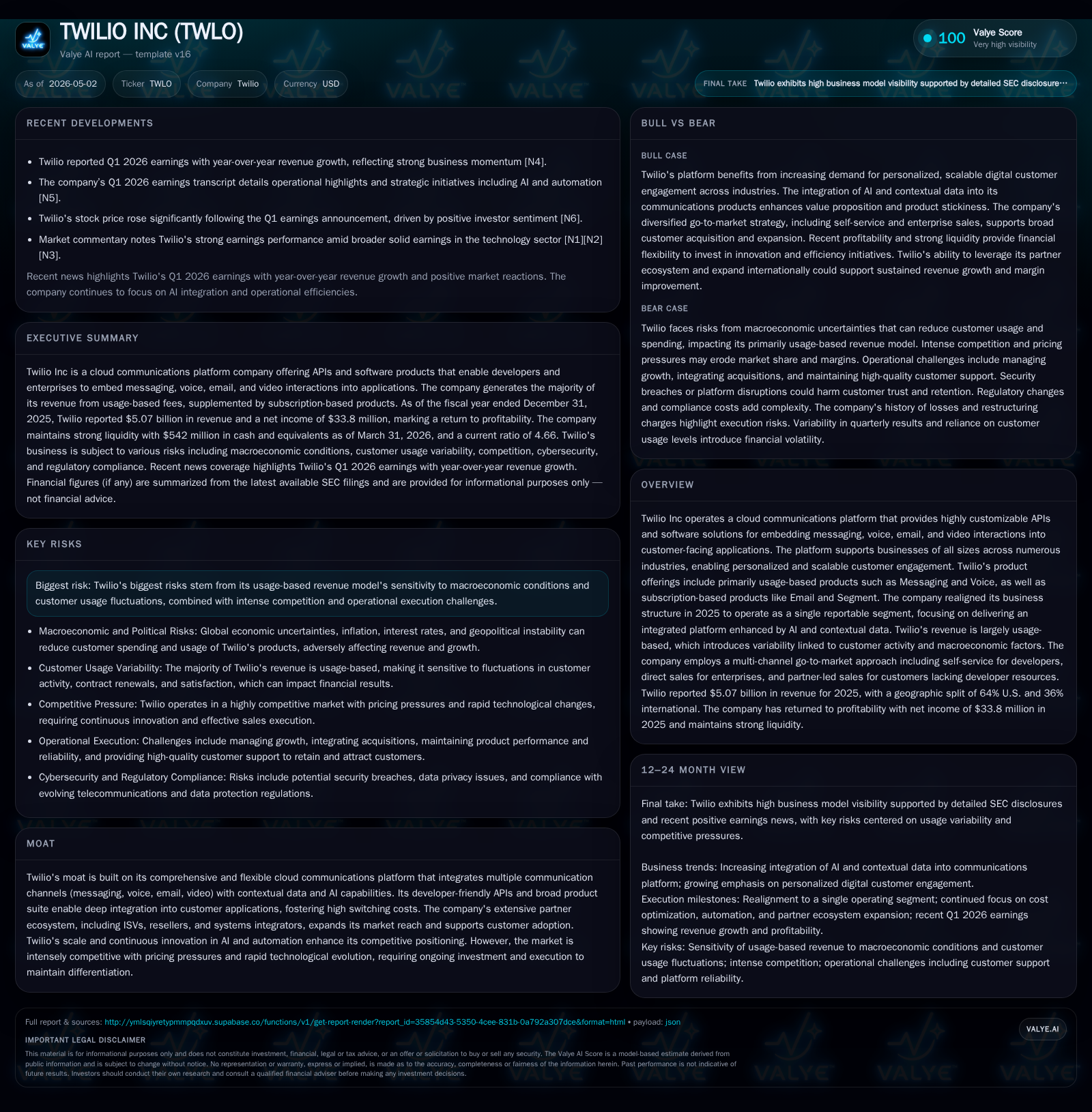
In its Q1 2026 filing, Twilio highlighted revenue growth driven largely by increased customer activity despite macroeconomic pressures affecting usage volumes. The company continues to consolidate operations into a single reportable segment post-2025 realignment, focusing on an integrated communications platform powered by AI and contextual data. Competitive pressures persist in the cloud communications market, but Twilio’s developer-centric APIs, multi-channel offerings, and partner ecosystem support durable customer engagement. Growth hinges on expanding product adoption, AI-driven innovation, and international penetration, while risks include sensitivity to customer usage fluctuations and ongoing regulatory compliance. Financially, Twilio maintains a strong liquidity position with a $4.66 current ratio and active share repurchases.
Recent Operating Update
Twilio’s Q1 2026 Form 10-Q filing [S2] reveals continued momentum with revenue growth reflecting increased product usage among both existing and new customers. The period saw adjustments such as the effect of incremental A2P fees introduced by a leading U.S. carrier in mid-2025 contributing to network provider cost inflation but also top-line growth. With the company having consolidated into a single operating segment by Q3 2025 following a business unit realignment [S1], management now emphasizes unified platform delivery enhanced by AI-driven contextual data analytics allowing more personalized customer engagements. Despite prevailing macroeconomic uncertainties impacting customer activity levels—a structural challenge inherent in Twilio's usage-based model—the firm reported profitability improvement compared to prior years [S2].
Business Model
Twilio’s core business revolves around providing cloud communications infrastructure via highly customizable APIs that enable embedding messaging (SMS), voice calls, email, and video interactions into diverse applications. These developer-friendly interfaces facilitate deep integration into customer-facing software solutions across industries from e-commerce to financial services.
Revenue is largely tied to volume consumption—customers pay based on their actual API calls or messages processed—augmented by growing subscription revenues from products like Email and Segment for customer data orchestration. This duality provides some revenue balance but usage-based pricing introduces quarter-to-quarter variability reflecting client engagement intensity influenced by broader economic trends [S1], [S2].
The company monetizes through:
- Usage-based fees: Charged per message sent, call made or API transaction executed.
- Subscription fees: For software modules providing advanced analytics, identity services, and marketing automation.
- Partner ecosystem contributions: Revenue facilitated through ISVs (Independent Software Vendors), resellers, and systems integrators expanding market reach beyond direct sales.
With the January 2025 reorganization dissolving prior segmented business units into a cohesive platform strategy [S1], Twilio aims to reduce friction in cross-selling capabilities and accelerate go-to-market synergies between product lines.
Industry Structure and Competitive Position
The cloud communications space is characterized by rapid innovation cycles and intense competition from peers like Vonage (Nexmo), Sinch, Bandwidth Inc., and Amazon Web Services’ communication APIs. Pricing pressure is prevalent due to commoditized underlying telecommunication costs paired with customer demand for seamless omnichannel engagement capabilities.
Twilio's moat stems from:
- Integrated multi-channel platform: Unified messaging, voice, email, video combined with customer data insights.
- AI augmentation: Leveraging machine learning for smarter routing, personalization, fraud detection enhancing downstream ROI for clients.
- Developer focus: Extensive APIs designed for ease of use foster high adoption rates among technical buyers incentivizing ecosystem lock-in.
- Partner network: Collaborations with ISVs and system integrators bolster distribution breadth.
While differentiation exists through continuous feature enrichment and scalability for enterprise clients needing customized solutions [S1], technology evolution demands sustained investment in R&D (~$1 billion annually) [S20]. Switching costs remain material due to embedded code dependencies though competitors seek disruptive price or product innovations.
Growth Drivers
AI Integration:
Twilio prioritizes embedding predictive and generative AI capabilities within its platform to enhance automation in customer journeys—from conversational bots to intelligent campaign optimizations—anticipating increased enterprise dependence on smart communications frameworks [S16].
Platform Consolidation & Cross-Sell:
The transformation into a single reportable segment aligns internal resources toward unified sales motions enabling existing customers to adopt deeper suites of products without duplication or segmentation barriers [S1].
Developer & Self-Service Expansion:
Growth in self-service developer signups supported by robust documentation and SDK tooling lowers cost per acquisition and captures emerging startup ecosystems globally.
International Market Penetration:
Broadening presence outside the U.S., particularly in APAC and EMEA markets where digital transformation accelerates demand for programmable communications [S1].
Partner Ecosystem Enhancements:
Increasing leverage of ISVs/resellers extends reach into verticals like healthcare or finance requiring specialized regulatory compliant communication solutions.
Risks / Watchpoints / Growth Constraints
Key risks articulated in recent filings [S2], [S1] include:
- Usage volatility: Macro cycles directly affect API call volumes causing lumpy revenue streams complicating forecasting.
- Competitive dynamics: Aggressive pricing strategies or new entrants using proprietary communication technologies might erode market share or margin.
- Regulatory complexity: Evolving telecom regulations (e.g., TCPA compliance) impose legal risks; failure either internally or by customers can trigger penalties or reputational damage [S24], [S18].
- Cybersecurity threats: Service disruptions or breaches at Twilio or its service providers can undermine trust.
- Execution challenges: Realizing synergies post-segment unification demands smooth organizational alignment; missteps could impede agility.
What to Watch Next
Upcoming milestones potentially impacting performance include:
- Sequential usage trends in core Messaging/Voice products revealing economic recovery strength or weakening demand patterns.
- Adoption rates for newly introduced AI-enhanced features signaling competitive differentiation success.
- Expansion progress internationally measured through regional booking metrics or localized partnerships announcements [N4], [N5].
- Management commentary on pricing power adjustments given rising carrier fees introduced since June 2025 [S20].
- Updates related to share repurchase activity under the $2 billion authorization which remains active through end of 2027 with ~$892 million capacity left as of Q1 [S8].
Financial Profile Summary
Latest financial snapshot
| Metric | Value | Period |
|---|---|---|
| Cash & equivalents | $542mm | |
| 2026-03-31 | ||
| Total debt | $993mm | |
| 2026-03-31 | ||
| Net debt | $451mm | |
| 2026-03-31 | ||
| Current assets | $3.4bn | |
| 2026-03-31 | ||
| Current liabilities | $740mm | |
| 2026-03-31 | ||
| Current ratio | 4.66x | |
| 2026-03-31 |
Source: SEC companyfacts cache [F1].
As of March 31, 2026 ([F1]): Twilio sustains solid liquidity supported by its working capital position with a strong current ratio above fourfold coverage — signaling minimal short-term solvency concerns despite nearly $1 billion total debt primarily composed of senior notes maturing in late decade [S21]. The company continues capital return programs including significant share buybacks ($1.1 billion repurchased through Q1) under board authorization demonstrating confidence in long-term value creation potential while balancing investment needs for R&D innovation [S8].
Operating margins have improved relative to historical losses with non-GAAP operating margin reaching ~18% as of year-end 2025 driven by scale efficiency gains despite elevated network costs linked partly to regulatory-induced carrier fee hikes introduced mid-2025 impacting gross margins [S26], [S20].
Disclaimer
This analysis is provided solely for informational purposes based on publicly available filings as of May 2026 and does not constitute investment advice or recommendations. Readers should conduct their own due diligence before making any financial decisions related to Twilio Inc.
Disclaimer: This is research-only, informational analysis and not investment advice. It may include AI-generated interpretation and general industry context. Always verify important details using primary sources.

Comments