
Trinity Biotech Advances CGM+ Amid Credit Covenant Challenges
Latest quarterly disclosures reveal financial covenant waivers amidst ongoing transformation and new product commercialization.
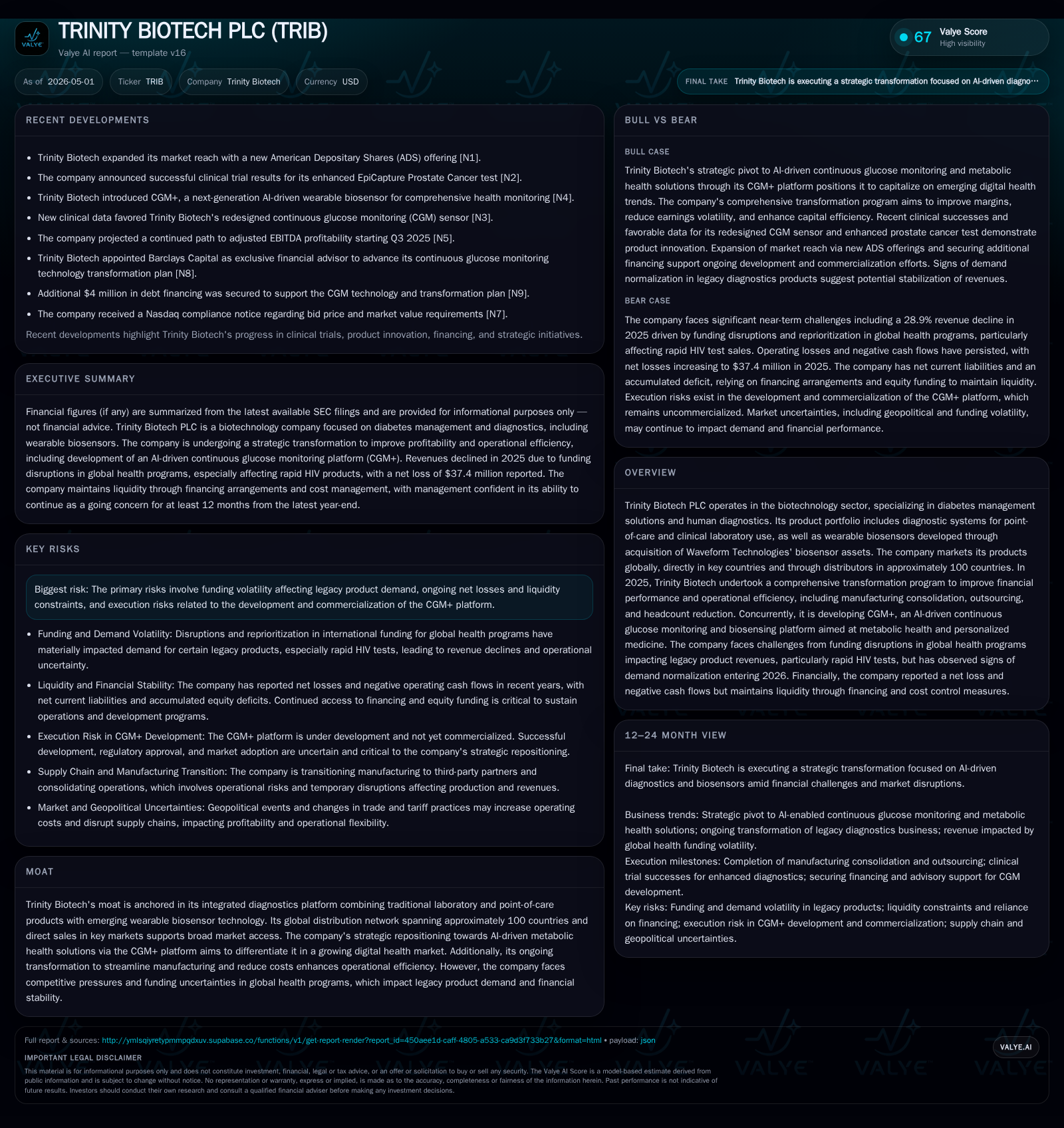
In its most recent quarterly update, Trinity Biotech secured a limited waiver on a key credit covenant and began capitalizing interest, signaling current liquidity pressure. Operationally, the company continues to advance its CGM+ AI-driven glucose monitoring platform and recently launched its Premier Hb9210 system in Brazil. Strategic transformation efforts including manufacturing consolidation and cost reductions have streamlined operations, positioning Trinity for growth despite near-term financial constraints. The company faces execution risk around new product adoption and funding volatility in legacy diagnostics, while maintaining robust distribution in approximately 100 countries.
Latest Quarterly Developments and Implications
Trinity Biotech’s latest quarterly filing dated March 25, 2026 ([S2]) signals heightened financial stress characterized by the granting of a limited waiver against covenant 8.15 within its senior credit agreement with Perceptive Credit Holdings III. The company disclosed the capitalization of interest accruing in March into the principal balance of debt—a common restructuring approach under cash flow pressure but indicative of constrained liquidity.
Operationally, positive momentum was demonstrated through two key developments reported in a March 16, 2026 filing ([S3]). First, Trinity embarked on the commercial rollout of its next-generation Premier Hb9210 HbA1c Column System following regulatory clearance in Brazil — an important emerging market with growing diabetes prevalence. Second, senior management's participation at the Advanced Technologies & Treatments for Diabetes (ATTD) conference in Barcelona underscores strategic emphasis on accelerating collaborations and commercialization pathways for its CGM+ platform.
Together these updates create a dual narrative: near-term capital constraints juxtaposed with tangible forward progress in innovation-led growth initiatives.
Business Model and Portfolio Strategy
Trinity Biotech operates as a commercial stage biotechnology enterprise focusing primarily on diabetes management diagnostics and human lab diagnostics ([S1]). Its revenue is derived from sales of diagnostic systems encompassing instruments and reagents used both at point-of-care and clinical laboratory settings. Recently bolstered by acquiring Waveform Technologies’ biosensor assets, Trinity is integrating wearable biosensor technologies—pivoting strategically towards continuous glucose monitoring products that leverage AI algorithms.
Revenue generation mechanics center around multiple channels: direct sales in markets like the US and Brazil where it maintains significant presence; distributor networks serve roughly 100 additional countries enabling broad geographic reach ([S1]). Product pricing incorporates per-unit reagent consumption alongside instrument placements; recurring consumables offer high-margin recurring revenue streams typical of diagnostic franchises.
The company has undergone a major structural transformation since 2024 aimed at enhancing operational efficiency. Measures include consolidating manufacturing footprints by outsourcing production to third parties, closing underutilized plants, relocating support functions to cost-effective regions, and streamlining headcount ([S1]). This repositioning intended to reduce fixed costs materially while simplifying operations.
Strategically moving beyond legacy diagnostics into digital metabolic health platforms via CGM+, Trinity seeks to create competitive differentiation through AI-enabled biosensors that provide continuous real-time monitoring coupled with predictive analytics—a growing trend aligned with personalized medicine frameworks.
Industry Context and Competitive Positioning
Trinity operates within the global diagnostics sector focusing particularly on diabetes care—an area witnessing secular growth driven by rising chronic disease prevalence worldwide ([S1]). The diagnostic market is characterized by rapid technological evolution favoring point-of-care convenience combined with laboratory precision complemented increasingly by wearable biosensors.
Competitive pressures stem from well-capitalized incumbents offering continuous glucose monitoring systems; success depends heavily on regulatory approvals across diverse jurisdictions, validated clinical performance, reimbursement support, and patient/provider adoption dynamics. Trinity's broad distribution network spanning approximately 100 countries provides notable access advantage but does not fully insulate it from pricing pressures exacerbated by funding volatility among government-backed global health programs impacting legacy product demand ([S1], [S21]).
Investment cycles in this sector are lengthy with significant R&D intensity. Emerging AI-driven diagnostic solutions require navigating complex regulatory pathways while building clinical evidence to establish efficacy versus existing standards.
Growth Opportunities in Metabolic Health and Diagnostics
Key growth catalysts lie significantly in the advancement of the CGM+ platform—a continuous glucose monitor enhanced by artificial intelligence targeting improved metabolic health management and personalization ([S3], [N2]). Participation at ATTD aimed at fostering strategic partnerships may facilitate accelerated commercial adoption through collaborative models engaging payers and providers.
The launch of Premier Hb9210 in Brazil marks an expansion into a large diabetic population requiring accessible yet reliable HbA1c measurement tools—a test critical for diabetes diagnosis and management. Success here could validate rollout strategies supporting further international expansion ([S3]).
Beyond diabetes markers, promising clinical results from enhanced prostate cancer test EpiCapture show diversification potential within oncology diagnostics contributing incremental revenue opportunities ([N1]).
Additional growth vectors include leveraging the streamlined manufacturing setup allowing scalability without proportionate fixed cost escalation; this capability supports volume-driven margin improvements as sales ramp.
Risks and Operational Constraints
Liquidity is a foremost concern underscored by recent covenant breaches related primarily to timing variability within HIV-associated revenues influenced by disrupted global health funding flows ([S2], [S10]). Persistent negative cash flows concentrated around losses exceeding $37 million annually challenge sustainability absent successful financing or material operational turnaround.
Execution risk around CGM+ is nontrivial; the platform remains under development/commercialization phases demanding sustained R&D investments amid capital constraints ([S1], [S21]). The competitive landscape intensifies as newer entrants roll out digital biosensor solutions; differentiation through technology must convert into tangible customer traction.
Moreover, dependency on fluctuating government/multilateral funding particularly impacts legacy rapid HIV products generating variable revenues—affecting cash flow predictability crucial for lender compliance ([S21]). Market adoption hurdles also relate to regulatory approvals outside initial jurisdictions and potential reimbursement delays.
Key Upcoming Catalysts and Performance Monitors
Investors should track regulatory milestones beyond Brazil for diagnostic instruments such as Premier Hb9210 as signals of geographic scale-up potential ([N2], [S3]). Progress updates from CGM+ commercialization pilots or partnership agreements post-ATTD conference will clarify roadmap feasibility.
Monitoring results from strategic equity fundraise efforts or amendments to credit facilities ahead of the January 15, 2027 term loan maturity will shed light on capital structure stability ([S16]). Additionally, evolving order patterns amid normalization from prior funding disruptions could serve as operational demand indicators ([S21]).
Current Financial Health and Capital Structure
As of December 31, 2024 ([F1]), Trinity reported current assets of approximately $41.1 million against current liabilities of about $32.1 million, resulting in a current ratio of 1.28, indicating moderate short-term liquidity. Cash and equivalents stood near $5.17 million, reflecting tight liquidity conditions.[F1] Despite increased operating losses ($37.4 million in FY2025) compared with prior years,[S1] management has substantially reduced fixed costs via its transformation program completed during 2025 ([S1],[S21]).
Debt arrangements revolve around a senior secured term loan facility with Perceptive Credit Holdings III. Recent filings confirm the company has obtained a limited waiver in respect of covenant 8.15 and is capitalizing interest accruing in March 2026 into the principal balance of the debt ([S2]).
All data cited are sourced from publicly filed SEC documents or reputable news sources as referenced.
Disclaimer: This is research-only, informational analysis and not investment advice. It may include AI-generated interpretation and general industry context. Always verify important details using primary sources.

Comments