
Grupo Aeromexico Advances on Recovery with Strategic Network and Loyalty Initiatives
Q1 2026 results reveal incremental traffic recovery and management’s equity purchases underscoring confidence amid operational headwinds.
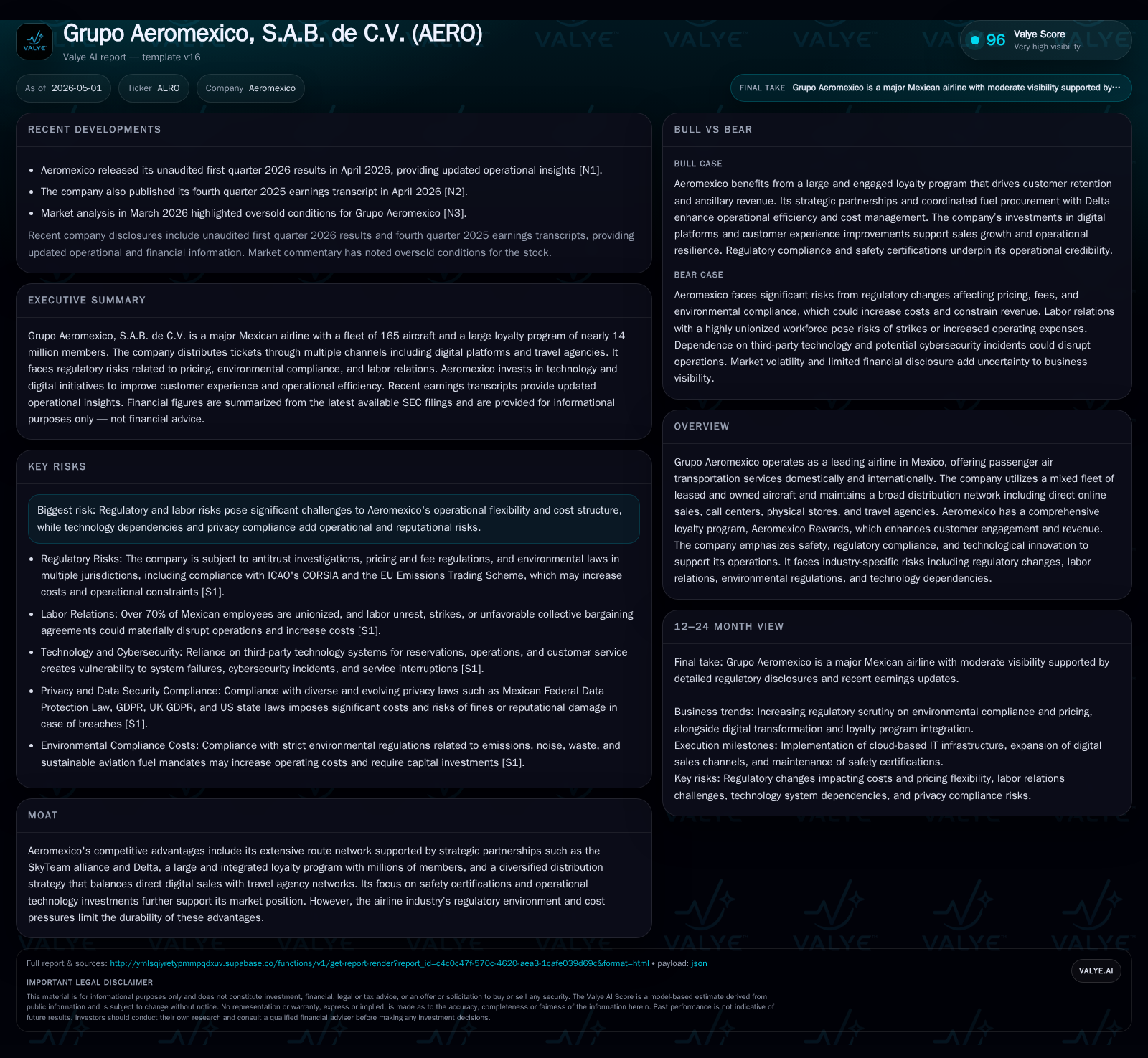
Grupo Aeromexico’s Q1 2026 performance signals cautious improvement in passenger traffic, coupled with insider share purchases reflecting faith in the company’s recovery trajectory. The airline’s business model leverages a mixed owned and leased fleet, a broad distribution network, and an integrated loyalty program, Aeromexico Rewards, to drive revenues across domestic and international markets. Strategic alliances, particularly within SkyTeam and with Delta Air Lines, underpin procurement cost efficiencies and route network advantages amid regulatory constraints. Growth hinges on expanding route permissions, scaling loyalty membership, and technology adoption, while risks primarily stem from FAA category limitations, labor relations complexities, and fluctuating jet fuel costs.
Q1 2026 Operating Momentum: Traffic and Management Confidence
Grupo Aeromexico’s latest interim update filed on April 23, 2026, [S2] provides a window into the operational environment at the start of the year. Passenger traffic reported monthly for January through March showed gradual but uneven recovery dynamics characteristic of the global airline sector's current cycle. While January indicated improvement compared to prior periods, March data introduced some softness potentially reflective of macroeconomic or regional travel disruptions [S2]. Notably, in March 2026, certain directors and executive managers engaged in share purchases [S3], a tangible confidence signal suggesting management views Aeromexico's recovery initiatives as yielding sustainable progress despite inherent sector cyclicality.
This combination of traffic data and insider buying suggests a near-term trajectory balancing persistence of traditional aviation headwinds with cautious optimism from leadership about Aeromexico’s strategic positioning within Mexico's aviation market.
Business Model Deep Dive: Revenue Streams, Fleet Mix, and Customer Engagement
Aeromexico’s business centers on passenger air transport across domestic Mexico routes as well as international destinations primarily in the Americas. Its revenue depends largely on ticket sales complemented by ancillary services bundled through its loyalty program [S1]. The fleet composition is a crucial operational element: the company maintains a hybrid model mixing owned aircraft with leases structured under IFRS16 accounting standards that use Incremental Borrowing Rates (IBR) varyingly weighted by asset type [S1]. This model balances capital expenditure flexibility against maintenance schedules that factor in asset useful lives ranging broadly between major overhauls typically spanning from 18 months to eight years [S1].
Distribution strategy encompasses direct online booking via website and mobile apps — which has grown increasingly significant representing over one-third of passenger revenue recently — alongside traditional call centers supporting multiple languages and an extensive physical travel agency network including nearly 5,000 general sales agents worldwide [S16], [S22]. This omnichannel approach targets cost efficiency through digital direct bookings while sustaining reach via established offline partners.
Central to Aeromexico’s customer retention efforts is Aeromexico Rewards, fully consolidated following the PLM acquisition in mid-2024 [S5]. This platform integrates customer engagement mechanisms offering payment flexibility using points for ancillary fees like baggage or seat upgrades [S16]. Loyalty membership growth continues to drive incremental revenues beyond core ticket sales.
Operational safety remains a flagship focus: The company upholds IOSA audit certifications renewed periodically—with expiration dates into late 2026/early 2027—and implements advanced safety systems conforming to ICAO standards through internal safety committees established since organizational restructuring post-Chapter 11 emergence [S1].
Industry Environment: Competition, Regulation, and Partnership Dynamics
As Mexico’s largest carrier by route network scale, Grupo Aeromexico’s competitive arena includes domestic rivals alongside regional low-cost carriers competing aggressively on price. However, its differentiated position stems from multi-national partnerships notably the SkyTeam alliance complemented by strategic bilateral collaboration with Delta Air Lines [S1]. The Delta partnership notably enhances fuel procurement capabilities internationally through coordinated bidding processes securing volume discounts—a key operational cost mitigant in an industry heavily exposed to jet fuel price swings [S1].
Regulatory complexity is pivotal: Aeromexico operates under constraints imposed by the Federal Aviation Administration (FAA) Category 2 designation for the Mexican Civil Aviation Authority following a downgrade in May 2021 due to compliance shortfalls against ICAO standards. This status limits expansion opportunities into the lucrative U.S. market by curtailing route additions or frequency increases until reinstatement to Category 1 is achieved via process improvements mandated at national aviation authority levels [S1],[S9]. Ongoing interaction with Mexican government aviation bodies aims at facilitating this restoration.
Environmental regulations further tighten operational boundaries. The phased rollout of CORSIA obligates airlines like Aeromexico to mitigate carbon emissions via purchase of carbon offsets or sustainability investments starting from voluntary pilot phases moving towards compulsory segments post-2027 [S9],[S10],[S21]. Additionally, EU emissions trading schemes apply selectively on European routes introducing incremental compliance costs.
Drivers of Growth: Network Expansion, Loyalty Program Strength, and Technology
Aeromexico’s growth blueprint relies on unlocking regulatory bottlenecks such as FAA category improvements that would free capacity for U.S. route expansion—the biggest single catalyst for top-line scalability given cross-border travel demand between Mexico and the United States.
Parallelly, scale-up of Aeromexico Rewards continues providing diversified revenue outside traditional ticket sales; enhancement initiatives include integrated point redemption options across more services and technological enhancements improving user experience online [S1],[N1].
Operational technology investments focus on cloud integration of IT systems enabling dynamic pricing models responsive to customer preferences alongside streamlined booking experiences allowing self-service itinerary adjustments—a critical differentiator in competitive mid-tier carrier segments [S16]. These technological enablers contribute directly to margin improvements by optimizing capacity utilization.
Joint procurement collaborations with Delta extend beyond fuel supply into broader cost control spheres potentially aiding in mitigating inflationary pressures locked in longer-term lease agreements negotiated at various IBR assumptions [S1].
Risks and Headwinds: Regulatory Compliance, Labor Relations, and Fuel Volatility
Among foremost risks is sustained FAA Category 2 status which caps growth potential for lucrative U.S.-Mexico air corridors; regulatory delays or shortcomings could materially cap revenue upside [S9],[S27]. Concurrently labor relations remain volatile with approximately 70% unionization among Mexican employees; labor contract renewals present negotiation risk points where strikes or unrest could disrupt operations given concentrated workforce segments such as pilots or cabin crew [S27].
Fuel price volatility exerts outsized influence on operating margins despite joint fuel purchasing programs due to exposure at international stations supplied under open bidding frameworks subject to global oil market fluctuations [S1],[S9]. Environmental compliance obligations tied to emerging regulations like CORSIA add cost uncertainty especially given nascent offset markets.
Furthermore regulatory scrutiny around consumer protection—including fee caps on ancillary charges like baggage—poses threats to profitable up-selling streams which have become integral under legacy fare unbundling trends across Latin America [S9]. Finally technology dependency introduces cyber-security risk exposures requiring constant infrastructural reinforcement amidst evolving threat environments [S8].
Monitoring Ahead: Key Milestones and Upcoming Catalysts for Execution
Key near-term checkpoints include progress updates related to Mexican Civil Aviation Authority conformity audits necessary for FAA Category 1 reinstatement which would unlock new route authorizations; shifts here will meaningfully influence growth forecasts.
Quarterly passenger traffic reports subsequent to Q1 will gauge whether early-year softness represents transient factors or systemic weakness.
Loyalty program membership growth statistics combined with ancillary revenue contributions will serve as proxies for customer engagement strength post-PLM integration.
Fleet adjustments via new lease undertakings or ownership changes informed by incremental borrowing rate variabilities could modulate capital intensity impacting future cost structures.
Finally watch for regulatory developments both domestic (consumer protection fees policy) and international (environmental mandates evolution) that could recalibrate operating conditions abruptly.
This analysis incorporates information available up to early May 2026 from SEC filings dated April 23 (6-K), March 17 (6-K), April 30 (20-F), plus verified public statements. It offers no investment advice but aims to elucidate Grupo Aeromexico’s operational status within its evolving industry context. All factual assertions are grounded explicitly in cited filings without speculative extrapolation.
Disclaimer: This is research-only, informational analysis and not investment advice. It may include AI-generated interpretation and general industry context. Always verify important details using primary sources.

Comments