
PTL Ltd Regains Nasdaq Compliance and Expands into Hong Kong Money Lending
Recent filings highlight PTL’s Nasdaq compliance recovery, strategic acquisition to diversify beyond marine fuel bunkering, and ongoing operational challenges.
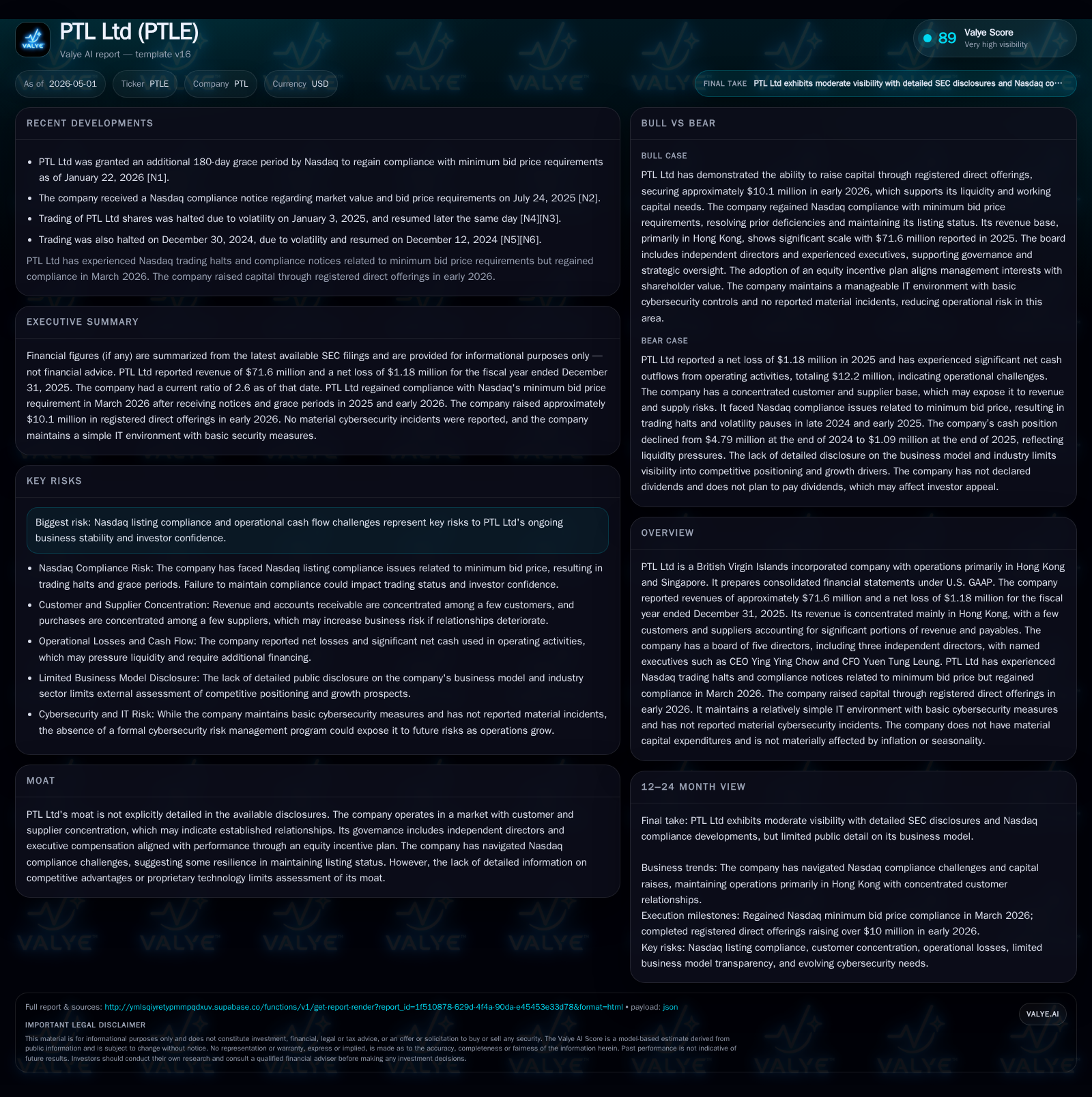
PTL Ltd, primarily serving the Hong Kong marine fuel bunkering market, regained compliance with Nasdaq's minimum bid price rule in March 2026 after previous deficiency notifications. The company reported a material revenue decline and a net loss for 2025 amid shrinking sales volumes and customer concentration risks. Seeking to diversify revenue, PTL is acquiring Twocap Limited to enter Hong Kong's regulated money lending sector, aiming to combine fuel supply and financing services. Operationally, the company faces internal control weaknesses and leverages capital raises from equity offerings to support working capital needs.
Recent Operating Update
PTL Ltd's most recent operating disclosure on March 16, 2026 confirmed the company's successful regain of compliance with Nasdaq Listing Rule 5550(a)(2) after the closing bid price of its Class A shares exceeded $1.00 for ten consecutive business days ending March 12, 2026 [S2]. This development closes a compliance challenge that began in mid-2025 when the share price dipped below this threshold. Achieving Nasdaq compliance improves PTL's profile among investors but follows a period marked by financial performance headwinds.
Earlier, on February 27, 2026, PTL announced it had entered into an agreement to acquire Twocap Limited, a Hong Kong-incorporated entity owning a subsidiary licensed under the Money Lenders Ordinance. The $100,000 cash acquisition aims to provide PTL with an immediate regulated entry point into Hong Kong's money lending sector without incurring licensing delays or costs [S3]. The move represents a strategic shift as management intends to leverage Twocap's license for offering trade finance products alongside its core marine fuel bunkering operations—potentially crafting an integrated service bundle tailored for maritime clients.
Business Model and Strategic Position
Historically, PTL Ltd has generated revenue predominantly from facilitating marine fuel bunkering services—essentially brokering and supplying fuels like marine diesel oil mainly within the Hong Kong region (accounting for ~95% of revenue in 2025) with minor contributions from Singapore [S1][F1]. Revenue is volume-driven based on metric tons of fuel delivered, subject to fluctuations in shipping activity and fuel pricing dynamics.
The firm's cost structure is tightly correlated with marine fuel expenditure—comprising the majority of cost of revenue—alongside agency fees, barging fees, cancellation charges, and survey expenses [S1]. Margins have been persistently compressed; gross profit totaled just under $0.9 million on $71.6 million revenue with a gross margin near 1.3% in fiscal year 2025 [F1], reflecting limited pricing power possibly due to contractual or competitive factors.
Revenue concentration is noteworthy: two customers contributed close to a quarter of total sales while five customers represented nearly 70% of accounts receivable balances as of December 31, 2025—the same dynamic applies on the supplier side where three vendors accounted for about two-thirds of purchases [S23]. Such concentration exposes PTL to client-specific credit risk and negotiating leverage imbalances.
Governance includes a board of five directors with three independents; key executives like CEO Ying Ying Chow oversee daily operations alongside CFO Yuen Tung Leung who also heads cybersecurity oversight—a function currently managed informally via basic IT hygiene rather than formal risk frameworks [S1][S21].
Industry Structure and Competitive Landscape
PTL operates within the marine bunkering sector focused on Hong Kong and Singapore ports—critical maritime hubs that serve international shipping lanes. The industry features relatively high barriers stemming from licensing requirements, supplier network access, logistical complexity related to safe fuel delivery, and fluctuating regulatory pressures especially concerning environmental standards.
Competition tends to arise from both local independent bunkering agents and larger integrated energy companies operating comprehensive fuel logistics chains. Customer relationships are influential since frequent repeat business from shipping operators drives volume stability.
However, PTL’s narrow geographic footprint limits exposure diversification but also suggests specialized local knowledge which may be valuable if leveraged correctly.
Growth Drivers
PTL’s growth potential is tied primarily to:
- Market recovery in maritime fuel demand: As global trade normalizes post-pandemic cycles or geopolitical disruptions ease, shipping volumes could increase fueling higher bunkering orders.
- Strategic diversification via Twocap acquisition: Entering money lending enables cross-selling opportunities by bundling financing solutions with fuel supply contracts—addressing working capital constraints for clients engaged in trade finance could differentiate PTL’s offering.
- Regulatory adherence improving investor confidence: Restoring Nasdaq compliance removes existential listing risks and could broaden access to future capital raising necessary for scaling operations.
Successful execution on these elements hinges on integrating new financial services capabilities without diluting core competencies.
Risks and Watchpoints
Significant risks facing PTL include:
- Concentration risk: Heavy dependency on few customers/suppliers increases vulnerability if major contracts are lost or payment defaults occur.
- Profitability pressure: Persistently slim gross margins coupled with SG&A expenses that more than double year-over-year (from approx $1.4M in 2024 to $2.75M in 2025) strain operational leverage [S1].[F1]
- Internal control deficiencies: Material weaknesses cited in financial reporting controls could impact accurate disclosures or create compliance burdens until remediated fully [S21].
- Liquidity sensitivity: Despite recent equity injections exceeding $12 million across registered direct offerings at dilutive prices (~$0.025/share), net cash used in operating activities surged drastically to negative $12.2 million in fiscal year 2025 compared to prior years suggesting operational cash burn concerns [S4][F1].
- New business execution: The money lending venture is nascent with limited disclosed details; risk exists around regulatory compliance costs, credit losses beyond estimates, and integration challenges disrupting focus from marine operations.
What To Watch Next
Key upcoming milestones or indicators by which PTL should be assessed include:
- Completion timing and initial performance metrics from Twocap acquisition – revenues booked post-consolidation; loan book size growth; delinquency rates.
- Quarterly updates on Nasdaq share price maintenance indicating sustained market support beyond mere technical compliance.
- Progress reports on internal control remediation efforts specifically around U.S. GAAP expertise expansion and IT policy implementations.
- New customer wins or expansions reflecting success in cross-selling financing products alongside traditional fuel sales.
- Working capital dynamics highlighted by accounts receivable turnover changes signaling collection effectiveness amid concentrated customer base.
Financial Profile Overview
Latest financial snapshot
| Metric | Value | Period |
|---|---|---|
| Current assets | $9mm | |
| 2025-12-31 | ||
| Current liabilities | $3mm | |
| 2025-12-31 | ||
| Current ratio | 2.6x | |
| 2025-12-31 |
Source: SEC companyfacts cache [F1].
For the fiscal year ended December 31, 2025:
- Revenue: $71.6 million declined sharply from prior year’s
$98 million reflecting lower fuel volumes (131k metric tons versus ~161k prior year) primarily concentrated in Hong Kong ports [F1][S1] - Gross profit: $0.9 million (approximate margin: 1.3%) down substantially amidst revenue contraction but stabilized by reduced fuel costs commensurate with lower sales quantity [F1]
- Operating loss: $(443k), narrower than $(4.75M) loss recorded prior year but still negative highlighting operating leverage challenges exacerbated by rising SG&A costs ($2.75M) dominated by administrative expenses including onboarding expenses linked with new initiatives [F1]
- Net loss: $(1.18M), driven by negative operating results compounded by interest expense ($730k) indicating debt servicing costs likely associated with past financing arrangements or working capital facilities [F1]
- Current ratio at fiscal year-end favorable at approximately 2.6x based on current assets of $8.63M against current liabilities of $3.31M suggesting liquidity adequacy under normal conditions but contingent on cash flow realization timing consistency [F1]
- Cash flows show significant deterioration: net operating cash usage surged negative $12.2M highlighting large working capital outlays including elevated accounts receivable balances [F1][S22]
- Equity raises through registered direct offerings aggregating ~$13 million during late 2025 through early Q1 2026 imply external funding dependence; proceeds targeted at vessel acquisition plans (not detailed), working capital bolstering, general corporate purposes including expansion ventures like Twocap acquisition [S4][S16]
- No dividends declared or planned emphasizing reinvestment focus amidst growth efforts constrained by profitability issues [S19]
Conclusion
PTL Ltd presents an intriguing case as a niche marine fuel facilitator entering nascent money lending services within the same regional client ecosystem aiming for synergies between commodity supply and trade finance products. Recent Nasdaq compliance restoration is positive for market credibility whilst capital raises provide short-to-medium-term funding buffers.
Nevertheless, sizable hurdles remain around expanding margin profiles given thin historical profitability combined with operational risks tied to high customer/supplier concentration and imperfect internal controls. Success hinges materially on effective incorporation of new financial service capabilities without compromising core bunker operations whilst steadily addressing governance frameworks critical for investor reassurance.
As such, monitoring detailed progress on Twocap integration outcomes alongside quarterly operating results will be pivotal to understanding if PTL can transition from survival mode toward sustainable commercially diversified growth.
Disclaimer: This is research-only, informational analysis and not investment advice. It may include AI-generated interpretation and general industry context. Always verify important details using primary sources.

Comments