
Digital Currency X Technology Advances Digital Asset Focus After EV Business Exit
Following the disposal of its loss-making automotive business, Digital Currency X shifts strategy to digital asset management with emphasis on data services and treasury activities.
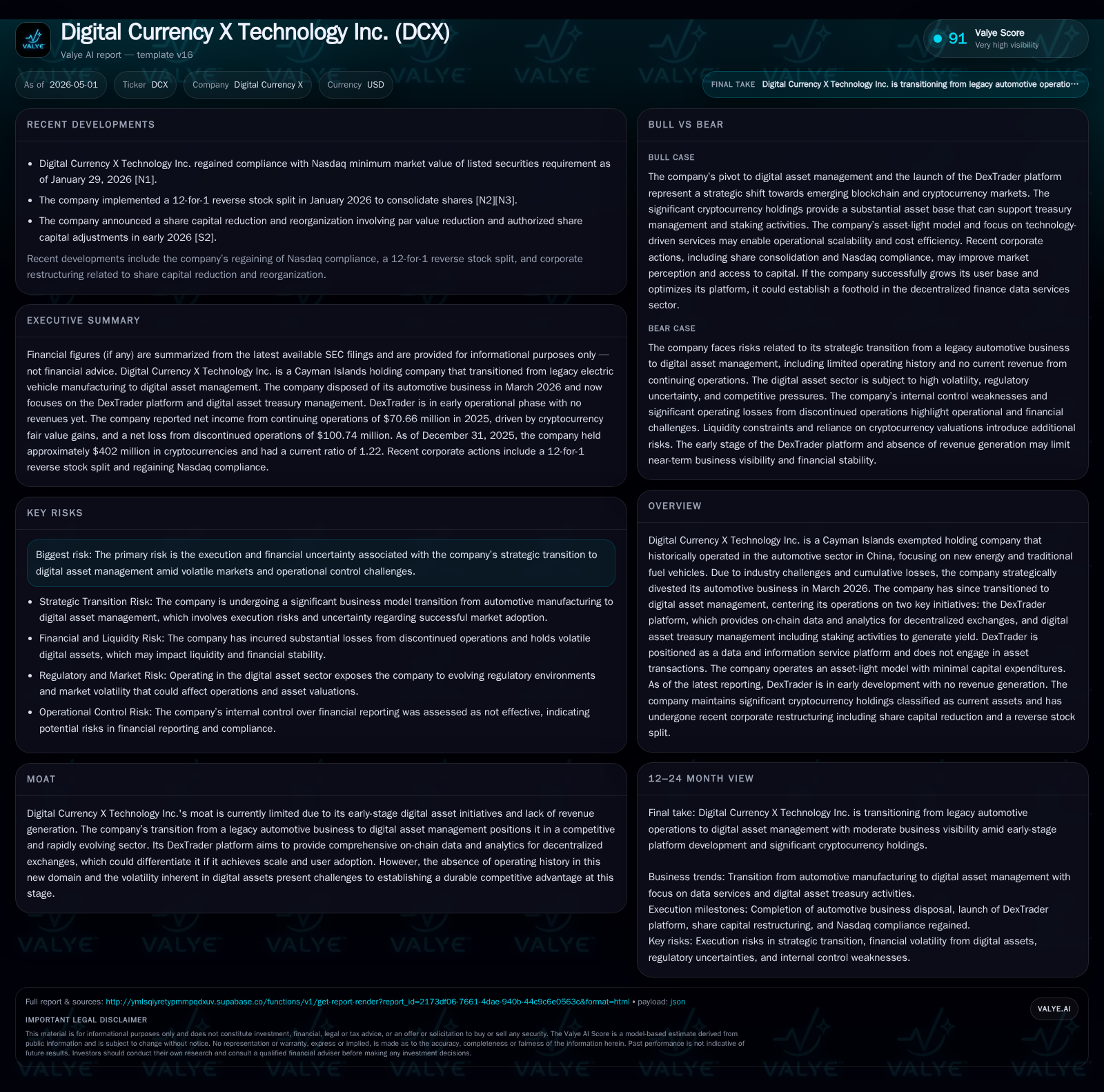
Digital Currency X Technology Inc. completed the divestment of its legacy electric vehicle manufacturing business in March 2026, marking a decisive pivot toward digital asset management. The company is now focused on developing DexTrader, an early-stage on-chain data and analytics platform for decentralized cryptocurrency exchanges, alongside staking and yield-generation treasury operations. While the transition offers potential optionality in a rapidly evolving digital asset sector, challenges remain around execution, revenue generation, and liquidity given the nascent commercial presence and significant legacy liabilities.
Recent Strategic Transition: Automotive Disposal and Capital Restructuring
In a material strategic shift, Digital Currency X Technology Inc. finalized the sale of its wholly owned legacy electric vehicle subsidiary, Chijet Inc., in March 2026 for a nominal consideration of US$1.00 [S3]. This transaction concludes the company's extensive exposure to the intensely competitive Chinese new energy vehicle sector—which had been incurring cumulative losses exceeding $100 million—allowing management to decisively cut off a persistent drain on financial resources. The disposal removes related assets and liabilities from consolidated statements starting Q1 2026 and classifies prior results as discontinued operations [S1][S3][S9].
Concurrently, the company announced an upcoming extraordinary general meeting scheduled for May 13, 2026, during which shareholders will vote on a comprehensive share capital reduction and reorganization plan [S2]. This proposal entails reducing par value per share drastically (from US$3.60 to US$0.0001), subdividing shares, canceling excess authorized shares, and transferring the resulting credit balance to distributable reserves to facilitate eliminating accumulated losses under Cayman Islands Companies Act provisions. The restructuring is critical to reset the capital base post-legacy write-downs and enable operational restructuring under a lighter balance-sheet footprint [S2].
This two-pronged recent development signals a clear break from prior automobile manufacturing ventures toward concentrating financial and managerial bandwidth exclusively on digital asset-related initiatives.
Digital Asset Management Focus and Business Model Evolution
Post-divestiture, Digital Currency X repositions itself as a Cayman Islands exempted holding company actively engaged in digital asset management technology [S1]. The business model currently revolves around two primary components: the DexTrader platform and treasury management with staking functionality.
The DexTrader platform is designed as an on-chain data and analytics terminal targeting global cryptocurrency traders specializing in decentralized exchanges (DEXs). It operates as a pure information service entity akin to traditional financial market data terminals without involvement in actual asset transactions or brokerage functions [S1]. This model minimizes transactional risk exposure but inherently limits revenue sources primarily to subscription or service fees once launched commercially.
Complementing this service offering is treasury management focusing on accumulating digital assets for yield generation through staking protocols—locking cryptocurrencies into consensus networks to earn rewards or interest. Such activity exposes the company to market price volatility but diversifies potential income beyond software subscription streams [S1][S22].
Digital Currency X’s shift delivers an asset-light operational model characterized by minimal capital expenditure requirements, focusing instead on technological infrastructure such as cloud-based systems supporting DexTrader’s development [S5]. While this reduces fixed costs substantially compared to prior capital-intensive manufacturing property plant & equipment investments, it also implies that scaling revenues depends heavily on user adoption rates and market dynamics.
DexTrader Platform: Product Positioning and Development Status
Launched in early 2026, DexTrader seeks to fill a niche within decentralized finance (DeFi) by aggregating real-time blockchain transaction data specifically from DEX platforms that operate without centralized intermediaries [S1]. By consolidating order book depth, trading volumes, price spreads, token liquidity insights, and historical analytics into one interface, it aims to replicate the role financial news/data terminals play for equities or Forex markets.
Currently in an early operational phase with no reported revenues yet, strategic priorities lie in refining product features based on user feedback while aggressively pursuing customer acquisition among crypto traders demanding transparent access to DEX market metrics—an area often criticized for fragmentation compared with centralized exchange data feeds [S1].
Exclusively providing data without facilitating trades insulates DexTrader from regulatory compliance complexities tied to custody or brokerage licenses but also constrains monetization exclusively to subscriptions or related analytic services.
Industry Structure: Competitive Dynamics in Digital Asset Data Services
The blockchain analytics space servicing decentralized exchanges is populated by both established players offering comprehensive DeFi dashboards (e.g., Dune Analytics) and emerging startups leveraging AI/ML enhancements. Key success factors include the granularity of proprietary real-time data feeds, latency performance, coverage breadth across multiple chain protocols, integration capabilities with trader workflows, and brand trustability given rising regulatory scrutiny surrounding crypto activities.
Given Digital Currency X’s nascent stage without scale or operating history in this domain, it faces formidable competition where network effects from active trader communities can entrench incumbents swiftly. Furthermore, pricing power remains uncertain; many comparable crypto-analytic tools offer freemium models or tiered pricing challenging pure subscription monetization unless differentiated meaningfully by feature innovation or exclusive datasets.
Regulatory developments globally continue injecting uncertainty into incentives for users adopting DeFi platforms broadly; although DexTrader’s non-transactional nature may mitigate direct regulatory burdens.
Growth Drivers: Opportunities in User Acquisition and Treasury Activities
User growth on DexTrader drives future revenue potential through paid subscriptions or premium analytics packages. Crucial near-term key performance indicators (KPIs) include active user counts, engagement frequency (daily/weekly sessions), conversion rates from free trials to paid tiers, retention metrics reflecting stickiness of analytic tools provided, and total addressable market penetration particularly among institutional crypto funds versus retail traders [S1].
On treasury operations, increasing volumes of staked assets expand yield earnings streams albeit subject to crypto price fluctuations that affect mark-to-market results reported within other income components. Effective asset allocation strategies optimizing between liquid cryptocurrencies and staking pools determine overall yield stability plus capital availability for operational needs [S22].
Positive momentum in global digital asset adoption trends underscores structural demand tailwinds; however uptake is sensitive to macroeconomic shocks impacting investment appetite across the crypto ecosystem.
Risks and Constraints: Execution, Market Volatility, and Financial Uncertainties
The strategic pivot entails substantial execution risk stemming from absence of historical revenue generation in digital assets coupled with operating losses carried over from prior automotive ventures (period losses >$100 million) that have impaired equity capital materially requiring share capital restructuring [S3][F1][S2].
Liquidity constraints are evident given a December 2025 cash balance near $3.9 million overshadowed by best-effort net debt approximating $93.0 million largely relating to legacy obligations—resulting in leverage requiring close monitoring especially as monthly cash burn depends heavily on payrolls for technology development plus professional fees tied to compliance/legal matters amid reorganization efforts [F1].
Crypto market volatility poses dual risks: firstly impacting valuation gains or losses recognized via fair value accounting of held tokens which materially swing non-operating income items; secondly influencing staking yields' predictability disrupting treasury performance forecasts [S22].
Additional risk factors comprise competitive pressure limiting pricing power or adoption speed for DexTrader; regulatory uncertainties around data privacy or crypto-related financial services potentially increasing compliance costs; plus inherent operational challenges scaling a technology startup under financial constraints.
What to Watch Next: Shareholder Vote, Product Milestones, and Liquidity Developments
Immediate focus centers on the May 13 shareholder meeting outcome approving the proposed share capital reduction/reorganization plan—a pivotal legal step enabling elimination of accumulated deficits thereby facilitating an improved balance sheet foundation post-transition [S2].
Operationally important will be any disclosures around initial traction metrics for DexTrader such as active user growth figures or rollout timelines for premium subscription launches signaling progress towards commercialization milestones.
Monitoring subsequent quarterly filings for updates on staking volumes managed via treasury activities alongside any shifts in cash flow burn rates will provide deeper insight into liquidity sustainability amid ongoing investment in platform enhancements.
Finally, external developments including evolving regulatory treatments of DeFi analytics platforms could influence long-term strategic positioning.
Latest Financial Snapshot
Latest financial snapshot
| Metric | Value | Period |
|---|---|---|
| Cash & equivalents | $4mm | |
| 2025-12-31 | ||
| Current assets | $867mm | |
| 2025-12-31 | ||
| Current liabilities | $709mm | |
| 2025-12-31 | ||
| Current ratio | 1.22x | |
| 2025-12-31 |
Source: SEC companyfacts cache [F1].
| Metric | (USD) Amount | (Period End) |
|---|---|---|
| Cash & equivalents | 3,942,000 | |
| 2025-12-31 | ||
| Total debt | 96,962,000 | |
| 2025-06-30 | ||
| Current assets | 866,684,000 | |
| 2025-12-31 | ||
| Current liabilities | 709,198,000 | |
| 2025-12-31 | ||
| Current ratio | 1.22 | |
| 2025-12-31 |
By year-end 2025, cash reserves stood at approximately $3.9 million against total debt near $97 million (mid-year figure), yielding estimated net debt close to $93 million indicating significant leverage inherited from prior automotive operations but currently under fire-sale restructuring focus [F1]. Management's forward-looking assessment suggests existing cash resources paired with strict cost control suffice to cover expected obligations over the next twelve months despite uncertain inflows from nascent digital asset ventures [S1][S6].
Disclaimer: This is research-only, informational analysis and not investment advice. It may include AI-generated interpretation and general industry context. Always verify important details using primary sources.

Comments