
TIC Solutions Expands Government Services Platform Post NV5 Acquisition Amid Contractual and Fiscal Constraints
The company integrates NV5 to broaden its capabilities serving U.S. government clients while managing revenue volatility tied to short-term contracts and budgetary risks.
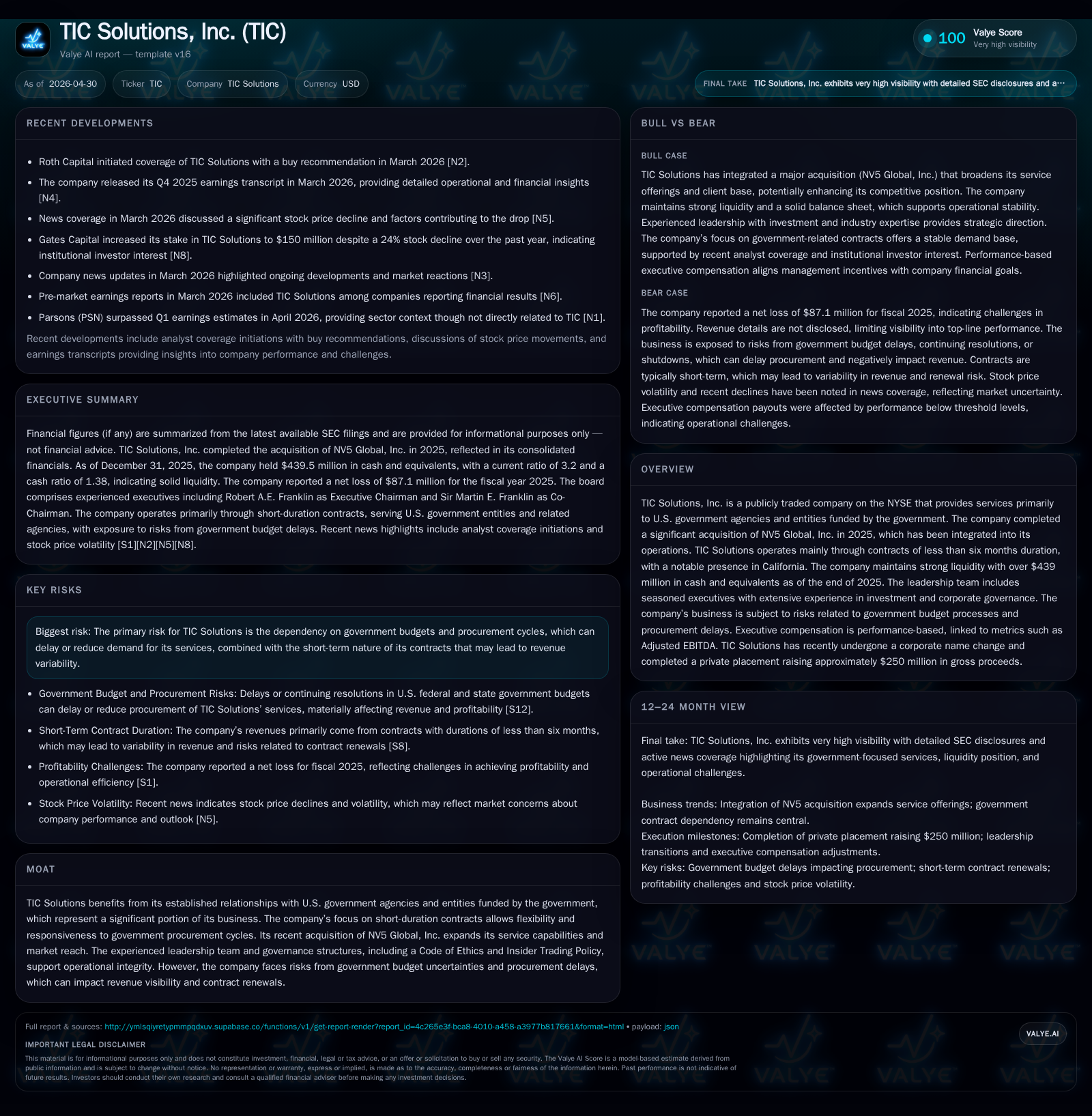
TIC Solutions, Inc. has recently completed the acquisition of NV5 Global, significantly broadening its service offerings and expanding its government-related contract base. Operating predominantly through short-duration contracts with U.S. federal and state agencies—especially in California—the company faces revenue variability linked to government budget uncertainties and procurement cycles. TIC’s business model emphasizes flexibility but depends heavily on public-sector funding rhythms. Strong liquidity supports operational resilience, while leadership transition and integration execution remain key near-term focus areas.
Recent Operating Update
TIC Solutions, Inc., formerly known as Acuren Corporation until an October 2025 rebranding, recently announced the completion of its acquisition of NV5 Global, Inc., a Delaware corporation [S3]. This strategic move extends TIC’s footprint and service offering portfolio primarily directed towards U.S. government agencies and entities funded by government resources. The pro forma combined financials released in March 2026 illustrate the company’s intentions to leverage this acquisition for enhanced scale and capabilities [S3][S8].
The latest quarterly disclosures from November 2025 confirm ongoing operational challenges typical of public sector service providers: revenues mainly derive from contracts under six months’ duration which inherently limits long-term revenue visibility [S2]. This exposes TIC to potential volatility tied directly to government budget approvals, particularly notable in key states such as California where state-level funding cycles impact project commencements [S2]. A planned CEO retirement effective March 31, 2026 adds a transitional layer to organizational stability; however, continuing consulting support mitigates immediate leadership risks [S26].
Business Model
TIC Solutions operates predominantly by contracting with U.S. federal government agencies along with a variety of state and local entities reliant on governmental funding [S1]. The company’s revenue model pivots on delivering specialized engineering, testing, inspection, and certification services that often underpin critical infrastructure projects or compliance needs.
Contracts are generally short-dated—less than six months—and abundant renewal activity dictates revenue realization. Customers pay for discrete project deliverables or ongoing services tied closely to regulatory or infrastructural requirements. This necessitates responsive operational agility and cost management to maintain margin integrity during fluctuating project intake.
Margins remain sensitive to project mix and pricing discipline given competition from both large federally favored integrators and niche regional specialists. The acquisition of NV5 aims to supplement TIC’s service breadth and geographic reach, potentially enabling cross-selling opportunities within the government infrastructure ecosystem [S3]. Executive compensation schemes anchored to Adjusted EBITDA incentivize management focus on profitability alongside growth [S1].
Industry Structure and Competitive Position
TIC Solutions inhabits a specialized niche within the broader government services landscape emphasizing testing, inspection, certification (TIC), engineering consulting, and related compliance facilitation. The industry is characterized by:
- High reliance on governmental procurement cycles subject to political budget approvals.
- Fragmentation among regional players versus consolidating national competitors.
- Increasing regulatory complexity requiring adaptive service expertise.
TIC benefits from established relationships with U.S. government agencies that confer switching-cost advantages and bidding leverage relative to new entrants [S1]. Nonetheless, competition remains intense from other firms with overlapping service capabilities or entrenched regional dominance.
The recent NV5 merger bolsters TIC’s competitive posture by expanding service lines into areas like program management and construction inspection—segments aligned with rising infrastructure investments under federal stimulus initiatives but still susceptible to macroeconomic fluctuations [S3].
Growth Drivers
- Post-Merger Synergies: Integration of NV5 is expected to unlock cross-selling channels across existing government accounts enhancing revenue per client.
- Government Infrastructure Spending: Federal initiatives targeting infrastructure renewal (e.g., civil engineering projects) provide an expanding addressable market particularly for project evaluation and oversight services.
- Contract Renewal Dynamics: Given the volume nature of short-term contracts, sustained high renewal rates will directly influence top-line stability.
- Geographical Penetration: Strengthened presence in California positions TIC favorably amid one of the nation’s largest state-funded infrastructure markets.
- Regulatory Complexity: Increasing regulatory scrutiny favors providers like TIC capable of navigating environmental compliance certifications.
Risks and Growth Constraints
- Government Budget Uncertainty: Continuing resolutions or shutdowns at federal or state levels can delay procurement cycles causing compressed contract awards impacting quarterly revenues [S2].
- Short Contract Duration: Contracts less than six months create episodic revenue streams limiting long-term visibility; failure to secure renewals may lead to sharp declines in reported revenues [S2][S9].
- Debt Load: As of year-end 2025, total debt stood at approximately $1.65 billion against $439 million cash reserves yielding net debt near $1.21 billion; this leverage level requires careful cash flow management especially during integration phases [F1].
- Integration Execution Risk: Realizing anticipated operational synergies from the NV5 merger within projected timelines remains uncertain [S9].
- Regulatory Compliance Costs: Health, safety, environmental regulations impose additional expenses that could erode margins if not effectively managed [S9].
- Leadership Transition: CEO retirement in March 2026 introduces management succession considerations though mitigated by transitional agreements [S26].
What To Watch Next
Investors and observers should focus on several near-term milestones:
- Quarterly Backlog Trends: Indicators of contract pipeline strength post-NV5 integration reveal demand resilience.
- Contract Renewal Rates: Sustained high renewal rates signal dependable revenue amidst inherent contract brevity.
- Cost Synergy Realization: Effective cost integrations evidenced by margin improvements would validate acquisition strategy.
- Government Budget Developments: Visibility into federal/state budget cycles affecting procurement timing remains critical.
- Leadership Succession Progress: Appointment of a permanent CEO post-March 2026 will influence strategic continuity perceptions.
- Regulatory Updates: Changes affecting environmental compliance requirements could reshape service demand dynamics.
Financial Profile Brief Summary
Latest financial snapshot
| Metric | Value | Period |
|---|---|---|
| Cash & equivalents | $440mm | |
| 2025-12-31 | ||
| Total debt | $1651mm | |
| 2025-12-31 | ||
| Net debt | $1212mm | |
| 2025-12-31 | ||
| Current assets | $1021mm | |
| 2025-12-31 | ||
| Current liabilities | $319mm | |
| 2025-12-31 | ||
| Current ratio | 3.2x | |
| 2025-12-31 |
Source: SEC companyfacts cache [F1].
At fiscal year-end 2025, TIC Solutions reported operating income loss of $17.1 million and a net loss of $87.1 million reflecting merger-related costs and integration expenses likely incurred during acquisition completion phases [F1]. The balance sheet maintained strong liquidity with $439.5 million in cash equivalents juxtaposed against total debt nearing $1.65 billion resulting in a net leverage position requiring prudent fiscal management [F1]. Current assets exceed current liabilities by over three times supporting favorable short-term solvency (current ratio approx. 3.2) [F1]. The company’s financial structure underscores flexibility but also highlights sensitivity to execution risks related to merged entity performance.
This analysis is based solely on publicly available SEC filings and related corporate disclosures without any endorsement or critique as investment advice.
Disclaimer: This is research-only, informational analysis and not investment advice. It may include AI-generated interpretation and general industry context. Always verify important details using primary sources.

Comments