
Grupo Televisa Sees Profit Margin Growth Despite Revenue Decline
Q1 2026 showed margin expansion driven by integration synergies despite a top-line dip led by satellite service declines.
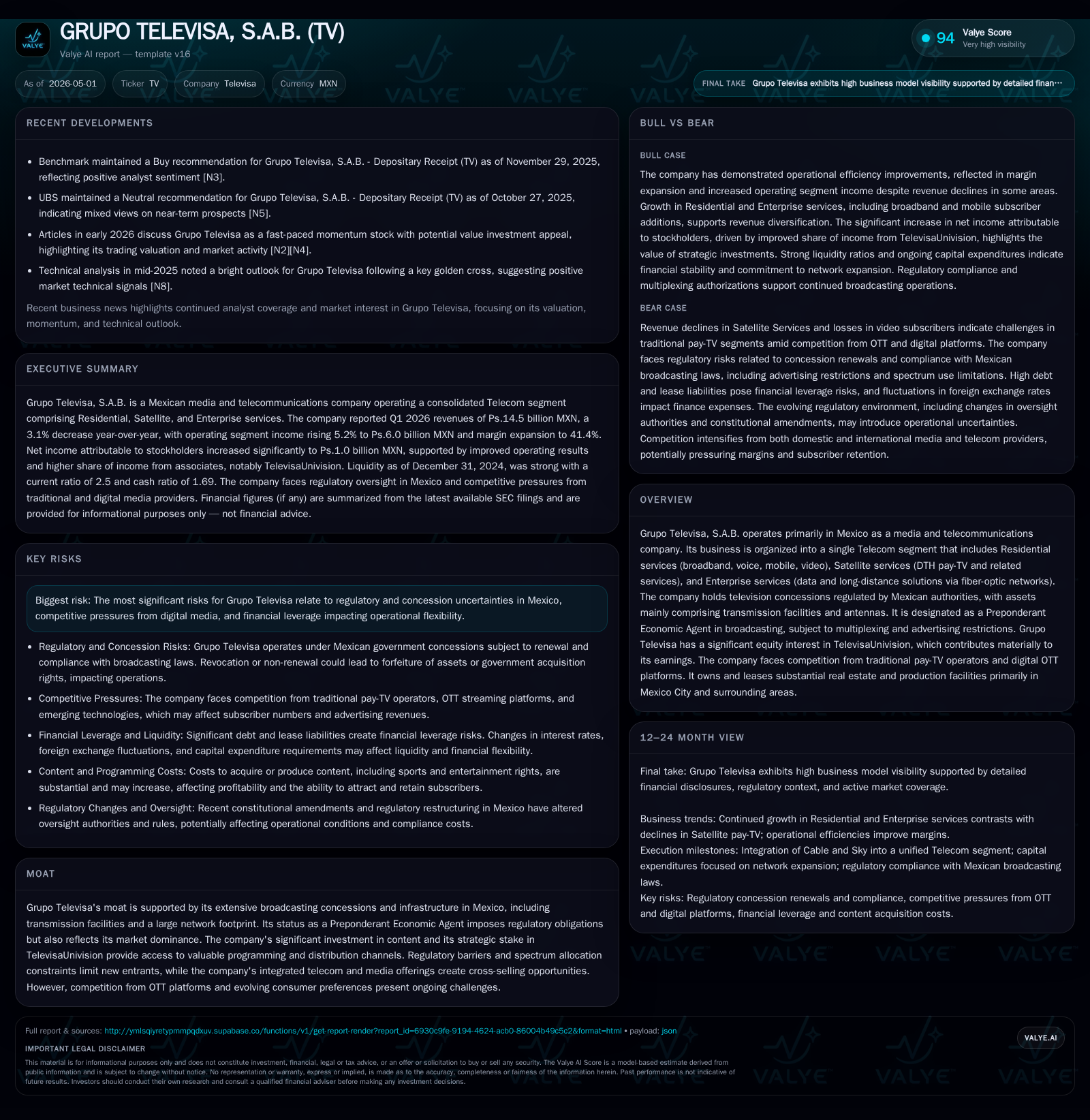
Grupo Televisa reported a 3.1% revenue decrease in Q1 2026 to Ps.14.5 billion, mainly due to falling satellite service revenues. However, operating segment income rose 5.2% with margins expanding to 41.4%, reflecting cost efficiencies from the consolidation of Cable and Sky into a unified Telecom segment. Continued fiber-to-the-home expansion and enterprise service growth underpin strategic prospects, while regulatory concession uncertainties and competitive pressures from OTT and satellite pose ongoing risks. The company maintains a leveraged but manageable balance sheet supporting its capital investment plan.
Q1 2026 Operational Update: Margin Expansion Amid Top-Line Pressure
Grupo Televisa's first quarter of 2026 illustrated a distinctive operational dynamic where revenue declined modestly by 3.1% year-over-year to Ps.14,512.5 million but operating segment income (OSI) nevertheless rose by 5.2%, yielding an expanded OSI margin of 41.4% — an increase of about 330 basis points [S2]. This juxtaposition underscores ongoing progress in cost discipline and operational efficiencies primarily credited to the strategic consolidation of the Cable and Sky satellite businesses into a single Telecom segment completed in late 2025 [S1].
The pronounced revenue pressure originated chiefly from Satellite Services where revenue fell sharply by nearly a quarter (-24.6%), driven by a base reduction in Revenue Generating Units (RGUs) of approximately 27.6%. This erosion is emblematic of structural challenges facing traditional direct-to-home pay-TV segments globally as consumers increasingly migrate to over-the-top (OTT) digital platforms [S2]. Yet these headwinds were partially offset by growth in Residential and Enterprise revenues: Residential revenues advanced slightly (+0.9%) aided by broadband subscriber gains sustained over four consecutive quarters, while Enterprise services accelerated robustly (+30%) through fresh contract awards in both public and private sectors [S2].
Operating cash flow margin held firm at about 24.2%, reflecting disciplined spending on opex and capex aligned with efficiency programs embedded in the newly integrated operational model [S2]. Collectively, these elements reveal early returns on the merger synergy efforts initiated across administrative functions and network operations between cable and satellite divisions.
Business Model Overview: Integrated Telecom Services Across Residential, Satellite, and Enterprise
Grupo Televisa generates revenue principally through its Telecom segment which integrates residential broadband, voice, mobile (including MVNO offerings), video services with enterprise data solutions harnessing fiber-optic infrastructure [S1,S2,S3]. Prior to late-2025, Cable and Sky operated as separate segments; the restructuring culminating in their reporting as one unified segment reflects consolidation around bundled offerings enhancing cross-selling potential and resource optimization [S1].
The business model focuses on recurring subscription revenues augmented by strategic investments in network capacity expansion including fiber-to-the-home (FTTH). In Q1 alone, the company upgraded roughly 1.5 million homes passed bringing total FTTH coverage over 20 million units — a footprint pivotal for delivering high-speed connectivity demanded by residential customers increasingly reliant on streaming and cloud services [S2]. Broadband subscriber count stood at about 5.7 million with steady net additions favoring value-conscious customer segments emphasizing retention.
Enterprise services complement residential offerings through provisioning of higher-margin specialized data solutions via extensive fiber assets servicing government institutions and commercial enterprises — an area showing tangible growth momentum evidenced by +30% revenue gains bolstered by new contracts awarded during the quarter [S2]. Meanwhile, mobile subscribership increased notably through MVNO operations tallying nearly three quarters of a million users adding close to 95 thousand net adds as Televisa leverages existing infrastructure to broaden its direct access reach without heavy incremental investment in spectrum or cellular towers.
Satellite services remain under duress as subscriber losses persist from fundamental shifts away from hardware-dependent pay-TV toward flexible OTT consumption despite Televisa’s position as a leading DTH operator within Mexico’s market landscape [S2].
Competitive Position and Industry Regulation: Benefits and Constraints of Concession Status
Grupo Televisa’s entrenched market position is buttressed by its extensive Mexican broadcasting concessions granting it unique rights over transmission facilities and spectrum usage regulated by the Federal Telecommunications Institute (Instituto Federal de Telecomunicaciones – IFT) and monitored by the Federal Telecommunications Commission (CRT). As a designated Preponderant Economic Agent — reflective of its historic dominance — Televisa faces multiplexing restrictions limiting channel capacities relative to competitors which modulate spectrum utilization strategies [S1].
The company has secured extensions on key integrated sole concessions extending terms up to the statutory maximum durations (generally up to thirty years for broadcasting concessions and twenty years for radio-electric spectrum) with conditions set forth for renewals including compliance mandates and fee payments overseen by CRT analysis within defined timelines [S1]. While no precedent exists recently for government recovery of granted spectrum citing public interest reasons, regulatory risks persist around concession renewals that can materially alter operational rights or impose new obligations affecting cost structures [S9].
Competition within Mexico’s telecom sphere intensifies with vigorous encroachment from other telecom operators authorized under LMTR provisions providing bundled broadband, VOIP voice services, OTT entrants eroding traditional pay-TV footprints plus increasing mobile network competition inclusive of emerging Low Earth Orbit (LEO) satellite internet providers offering alternative high-speed connectivity options challenging conventional cable broadband markets [S1,S9]. These trends necessitate continual adaptation in pricing strategies, content partnerships (notably Televisa's substantial stake in TelevisaUnivision providing valued programming ecosystems) alongside sustaining network quality enhancements.
Growth Drivers: Fiber-to-the-Home Deployment and Enterprise Service Expansion
Fiber network expansion remains central to Grupo Televisa’s growth strategy with over 20 million homes passed signaling scale adequate to cater large portions of urban/suburban Mexican population segments desiring reliable high bandwidth connections essential for IPTV streaming, cloud applications, remote working/schooling setups [S2]. Upgrade pace sustained at approximately 1.5 million homes quarterly evidences robust execution capacity underpinned by capital investments targeting operational scale benefits.
Broadband subscriber growth supplemented by focused retention tactics aimed at 'value customers' underscores resilience amidst broad industry disruptions that continue weighing down satellite subscribers. Mobile offerings through MVNO platforms exhibit strong subscriber traction nearing three quarters million users benefiting from Televisa’s flexible platform leveraging existing spectrum licenses indirectly without heavy capex burdens [S2].
Enterprise customers seek bespoke telecommunications managed services integrating fiber-optic capacity tailored for secure data transmission across corporate sites fostering cross-segment synergies related to cable backbone utility maximization yielding higher-margin revenue streams that grew dramatically (+30%) in the quarter anchored on newly closed deals spanning government entities and private sector contracts exhibiting accelerating demand for digital transformation support.
Integration-driven cost rationalization between legacy cable operations with Sky’s satellite-related systems unlocks improved operating leverage manifested as expanding OSI margins despite top-line softness suggesting progress on efficiency gains conducive to longer-term earnings quality improvement.
Risks and Headwinds: Regulatory Concessions, Satellite Decline, and Competitive Pressures
Regulatory uncertainty surrounding concession renewals constitutes a primary risk vector given Mexican law mandates renewal requests well ahead of expiry subject to compliance scrutiny as well as possible imposition of new conditions or fees that could impact operating economics or force asset divestitures if concessions are revoked [S1,S9]. Spectrum usage limits imposed on preponderant agents constrain multiplexing capabilities potentially restricting content diversity which historically provided competitive consumer differentiation.
The ongoing satellite subscriber base deterioration signals structural decline exacerbated by relentless OTT migration combined with competitive broadband access alternatives threatening legacy pay-TV profitability further complicated by consumer price sensitivity amid macroeconomic variability impacting discretionary spend behaviors [S2,S9]. Enhanced competition from mobile networks inclusive of MVNO models may erode voice/data bundles while LEO satellite entrants challenge fixed broadband pricing power particularly in underserved rural areas.
Contractual reliance on third-party content supply from TelevisaUnivision introduces execution dependency whereby any shifts in content strategy or disputes could disadvantageably affect programming attractiveness ultimately influencing subscriber acquisition/retention success across platforms integral to returns [S9].
Upcoming Catalysts: Monitoring Subscriber Trends, Network Investment Impact, and Regulatory Outcomes
Key near-term developments include:
- Tracking broadband subscriber migration onto FTTH network gauging value customer penetration against churn metrics signaling sustainable ARPU uplift opportunities.
- Satellite service wallet stabilization or acceleration of RGU losses informing strategic decisions over asset reallocation or cost containment priorities.
- Renewal outcomes for critical cable/satellite concessions under CRT jurisdiction which may alter the regulatory framework governing spectrum fees or multiplexing constraints shaping future competitive positioning.
- Continued capture of synergistic savings post-integration supporting margin enhancement trajectory weighted alongside capex discipline exercise effectiveness impacting free cash flow generation ability. These metrics will be pivotal barometers guiding corporate resource deployment choices amid evolving industry structural shifts influencing long-term viability.[S1,S2]
Financial Snapshot: Leverage Metrics and Liquidity in Support of Strategy
Grupo Televisa's consolidated net debt was approximately Ps.49.75 billion as of March 31, 2026, reflecting total debt and lease liabilities less cash, cash equivalents, short-term investments, and non-current investments in financial instruments [S2]. Cash and equivalents were reported at Ps.46.2 billion as of December 31, 2024, supporting operational liquidity consistent with a current ratio of approximately 2.5x, indicative of strong short-term solvency [F1].
Committed capital expenditure programs remain focused predominantly on property, plant & equipment expansions targeting enhanced network reach including fiber rollout capped at around U.S.$772 million annually per recent guidance emphasizing disciplined capital allocation aligned with profitability mandates [S2].
Disclaimer: This is research-only, informational analysis and not investment advice. It may include AI-generated interpretation and general industry context. Always verify important details using primary sources.

Comments