
Betterware de Mexico's Dual-Segment Strategy Faces Macro Pressures and Margin Challenges
Latest quarterly disclosures reveal ongoing tariff impacts and soft consumption temper revenue growth despite strong brand foothold.
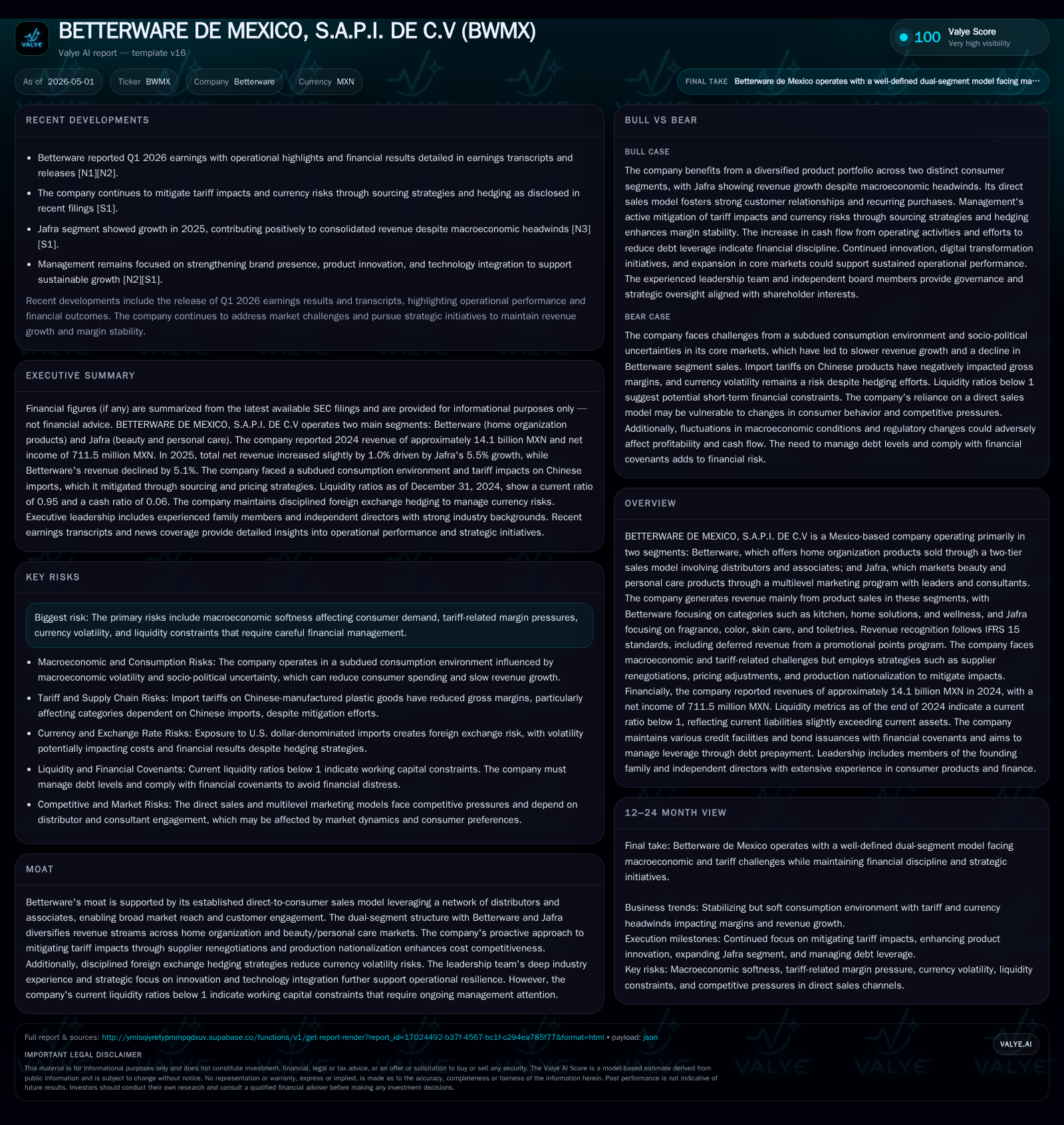
Betterware de Mexico reported mixed performance in early 2026, with its Betterware home organization segment contracting due to subdued consumer spending and tariff-related cost pressures. Meanwhile, its Jafra beauty and personal care segment showed modest revenue growth aided by improved sales orders and consultant engagement. Betterware's unique two-tier sales model and product diversification underpin its market presence, yet challenges remain from exchange rate volatility, liquidity constraints, and evolving consumption patterns in Mexico's lower socioeconomic segments. The company’s proactive pricing, supplier renegotiations, and production localization provide margin support moving forward.
Recent Operating Update
Betterware de Mexico’s most recent quarterly disclosure dated April 23, 2026 (Form 6-K) confirms ongoing macro challenges influencing operational results for the early part of the year [S2]. The company continues to operate in a stable but subdued consumption environment reflective of Mexican socio-political volatility and cautious consumer behavior concentrated in the C and D socio-economic segments targeted by its products. This tempered demand has impacted Betterware's home organization segment more significantly than Jafra’s beauty and personal care division.
Furthermore, tariffs on Chinese-manufactured goods—particularly plastics integral to Betterware’s product line—reduced gross margins by approximately 0.6% [S10][S11]. These costs were partially mitigated through supplier renegotiations, selective pricing adjustments introduced during the period, and initiatives aimed at localizing production within Mexico to reduce exposure to import duties [S10]. Exchange rate movements presented both risks and opportunities: the relatively strong Mexican peso against the U.S. dollar provided import cost relief given the high proportion of foreign currency–denominated procurement (~87% for Betterware segment), but also resulted in temporary inventory valuation losses on derivative hedges as of December 31, 2025 [S13][S16].
Business Model Overview
Betterware de Mexico operates primarily through two segments:
Betterware Home Organization: This segment offers kitchen ware, food preservation solutions, bathroom products, laundry & cleaning items, tech accessories, bedroom goods, and wellness products under the Betterware® brand. Sales are executed via a dual-tier distribution model consisting of distributors who receive weekly shipments from the company’s distribution centers and then deliver products directly to associates—independent salespersons tasked with final customer engagement [S1]. Distributors benefit from a two-week credit line to pay back for their inventory purchases.
Jafra Beauty & Personal Care: Jafra markets fragrance, color cosmetics, skincare, and toiletries through a multilevel marketing program comprising leaders (top-level distributors) and consultants (frontline sellers). Leaders receive a 30-day credit line to settle payments with Jafra. The segment operates with about ten levels of leaders/consultants facilitating decentralized customer reach [S1].
Revenue arises fundamentally from product sales minus discounts or adjustments recognized per IFRS 15 guidelines. Part of revenue is deferred relating to promotional points accumulated by distributors/associates redeemable against rewards; these are only recognized when actually redeemed (deferred revenue) [S1].
The revenue mechanics rely heavily on volume throughput driven by purchase frequency from salesforce members incentivized through catalog promotions (12 monthly catalogs for Jafra) targeting the "D" socio-economic segment in Mexico for Jafra products versus broader C/D tiers for Betterware [S1]. Pricing power is constrained but supported through continuous promotional activity and carefully managed catalog cycles.
Margins are chiefly influenced by cost of sales which include raw materials purchasing (substantial imported components), freight including air/maritime shipping costs, customs tariffs on plastics-heavy items (for Betterware), as well as provisions for defective inventory [S1][S25]. Selling expenses include catalog printing/design costs—material given their centrality in the direct sales model—packaging materials, marketing events, promotional rewards program expenses along with compensation for selling staff [S1]. Administrative expenses cover typical overhead plus technology investments supporting analytics-driven product development.
Industry Structure and Competitive Position
Betterware operates at the intersection of direct selling in home organization products alongside multilevel marketing in beauty & personal care. Its dual-segment approach offers natural diversification across consumer needs but also exposes it to distinct competitive dynamics:
In home organization (Betterware brand), competition includes traditional retail chains offering similar household goods but typically emphasizing physical stores or e-commerce platforms rather than socially-networked direct sales. Betterware leverages an extensive distributor/associate network providing social proximity advantages for penetration into lower-income tiers less served by modern retail formats in Mexico [F1][S1].
In beauty & personal care (Jafra), competition includes other MLM brands (possibly Avon or Natura-like regional players) as well as mass-market brands available via retailers or e-commerce. Jafra's multilevel structure incentivizes leader recruitment combined with direct selling which supports community-based loyalty though growth can be constrained by saturation risks common in MLM.[S1]
Tariff changes on Chinese imports potentially increase cost disadvantages versus local manufacturers or companies sourcing nearer suppliers; Betterware is responding by accelerating ‘production nationalization’ which should enhance long-term competitiveness [S10]. Foreign exchange exposure is significant due to dollar-denominated imports; disciplined hedging programs help moderate this risk though temporary losses on forward contracts arose in late 2025 [S13][S16].
Growth Drivers
Sales Force Expansion & Productivity: For Jafra especially, growth hinges on increasing purchase orders per consultant/leader enhanced by monthly promotional plans which have slightly increased order frequency (~8% rise in average monthly orders per consultant year-over-year) [S25]. Technology-enhanced tools for training and data analytics assist this productivity lift.
Localization of Supply Chains: By reducing dependence on tariff-exposed imports through supplier contractual renegotiations and establishing more manufacturing within Mexico (‘production nationalization’), Betterware seeks margin stability despite external cost pressures [S10].
Market Penetration into Socioeconomic Lower Segments: By focusing on Mexico’s C & D income tiers where formal retail access may be limited or less convenient, both segments exploit a structural growth opportunity leveraging personal networks rather than traditional retail channels.
Catalog-driven Promotions & Product Innovation: Regular cadence of new catalog launches with tailored offers provides cadence for purchase timing aligned with social selling models; investments into research & development enhance product mix relevance [S1][S11].
Foreign Exchange Hedging: Maintaining hedges covering expected inventory purchases through end-2026 reduces margin volatility related to peso-dollar fluctuations [S13][S16].
Risks / Watchpoints / Growth Constraints
Macroeconomic Volatility: Continued subdued consumption amid economic uncertainty curtails demand growth particularly in lower income brackets that represent core customers [S10].
Tariff-induced Margin Pressure: Despite mitigation efforts tariffs reduced gross margin by ~0.6%; any escalation could worsen profits if insufficiently offset [S10][S11].
Currency Fluctuations: Peso strength helps cost base but valuation losses from derivative hedges highlight FX volatility risk profile remains elevated requiring active treasury management [S13][S16].
Working Capital Tightness: The company reported a current ratio below parity (~0.95) indicating near-term liquidity constraints that could restrict operational flexibility or require reliance on revolving lines/bonds to meet outflows [F1][S4][S5][S16].
MLM Saturation Dynamics: For Jafra’s multi-level marketing channel growth depends heavily on fresh recruitment sustaining order volumes; saturation or attrition could slow topline expansion.
Competitive Landscape: Home & personal care sectors witness intensified competition both from modern retailers expanding into lower-income markets digitally as well as alternative MLM/network-marketing schemes.
What To Watch Next
Upcoming quarters will provide clarity on several key execution vectors:
- Quarterly top-line breakdowns differentiating segment contributions will indicate sustainability of Jafra’s recent sales improvements versus continuing pressure in Betterware segment.
- Progress toward production nationalization will be observable indirectly via margin recovery or stabilization metrics.
- Management commentary around tariff trends or new regulatory developments affecting imported inputs could signal future cost trajectories.
- Evolution of distributor/associate counts alongside average order size metrics will illuminate channel health.
- FX hedge coverage extensions beyond December 2026 due to rising currency volatility risk factors.
- Investment levels into technology platforms designed for field force enablement that supports longer-term scalable growth.
- Disclosure regarding financing costs especially bond yields relative to cash flows impacting liquidity buffers.
Brief Financial Profile Contextualization
As of latest filings ending December 31, 2024:[F1]:
- Revenue stood at approximately MXN 14.1 billion.
- Net income registered MXN 711 million demonstrating profitability despite industry headwinds.
- Cash & equivalents totaled MXN 297 million while current assets were MXN 4.54 billion against current liabilities of MXN4.76 billion yielding a below-unity current ratio at ~0.95 signaling working capital pressure. The firm relies substantially on operating cash flows from its two main segments with additional financing via bonds issued maturing over next several years bearing interest rates anchored on Mexican interbank rate plus spreads. Credit lines from major banks such as BBVA augment liquidity flexibility though management appears intent on deleveraging over time.
Disclaimer
This analysis is based solely on publicly available information including recent SEC filings up through May 2026 and aims to provide an informed operational view into BETTERWARE DE MEXICO S.A.P.I DE C.V.'s underlying business dynamics without offering investment advice.
Disclaimer: This is research-only, informational analysis and not investment advice. It may include AI-generated interpretation and general industry context. Always verify important details using primary sources.

Comments