
OIO Group Broadens Footprint with De Tomaso Acquisition Amid Circular Economy Focus
OIO's latest quarter marks a strategic pivot combining industrial waste recycling leadership with luxury automotive ambitions.
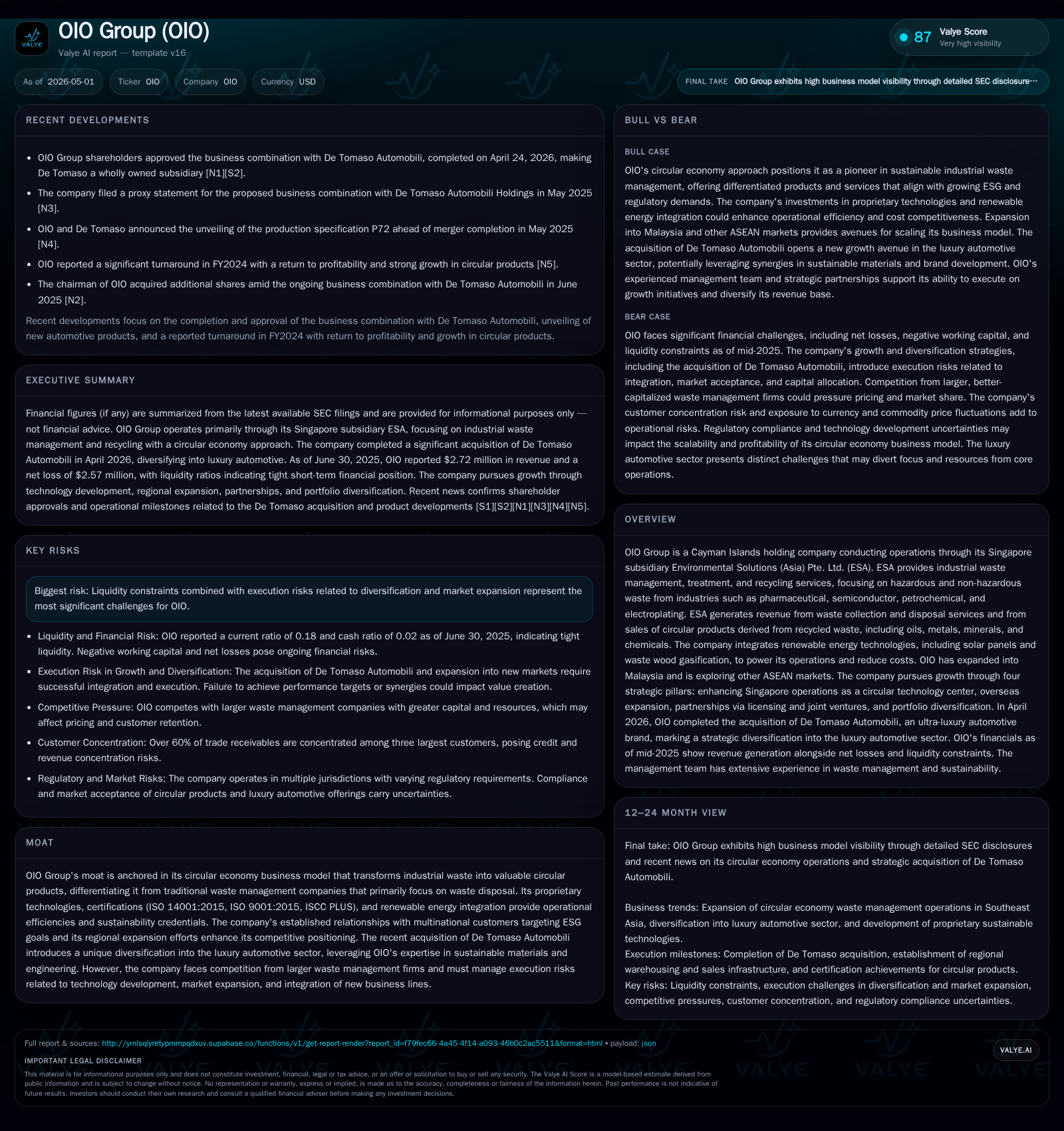
In April 2026, OIO Group completed the acquisition of luxury car maker De Tomaso Automobili, reshaping its corporate identity and strategic outlook. The transaction, coupled with a reverse stock split, reflects OIO's transition from a primarily Singapore-based circular waste management firm to a diversified enterprise focused on sustainable innovation across industries. Despite recent revenue softness and liquidity challenges, OIO leverages proprietary recycling technologies and expansion into ASEAN markets as core growth drivers. Maintaining competitive differentiation in industrial waste recycling while executing the integration of De Tomaso presents key operational risks to monitor.
Recent Operating Update
OIO Group finalized its transformative business combination with De Tomaso Automobili Holdings Limited on April 24, 2026 [S2], [S3]. This transaction repositioned OIO by adding a high-performance automotive brand known for luxury innovation to its existing circular economy platform centered around industrial waste recycling. Simultaneously, OIO effected a one-for-three reverse stock split designed to fulfill Nasdaq's minimum bid price listing requirements, commencing trading on the Nasdaq Capital Market under ticker "OIO" [S2],[S3]. Post-merger, the founder of De Tomaso became the largest shareholder with approximately 67.6% ownership. The governance structure remains under transition post-merger with plans to reconstitute the board and senior management to reflect the combined company’s new strategy [S2].
These developments signify a crucial inflection point as OIO broadens from its historical role as a Singapore-headquartered industrial waste recycler toward becoming a diversified public company with interests spanning luxury automotive innovation.
Business Model and Strategic Position
Operating primarily through Environmental Solutions Asia Pte. Ltd. (ESA), OIO's core business is industrial waste management specializing in hazardous and non-hazardous waste from factories in pharmaceutical, semiconductor, petrochemical, and electroplating sectors [S1],[S5]. ESA generates revenue from two main streams: fees for collection and disposal services charged to customers at rates competitive with peers, and sales/trading of recycled circular products including oils, metals, minerals, and chemicals sourced from treated wastes [S1],[S5]. This dual stream enables direct revenue capture both from traditional waste management demand and from value-added secondary material markets.
ESA incorporates renewable energy technologies such as solar panels and waste wood gasification systems to power its processing operations accurately reducing both costs and carbon footprint — reinforcing its alignment with Singapore’s Zero Waste to Landfill policy [S5],[S6]. The company's membership in industry associations like the Waste Management Recycling Association of Singapore and participation in United Nations Global Compact forums help deepen customer engagement focused on ESG goals [S1],[S5].
The recent acquisition of De Tomaso represents a strategic diversification into the luxury performance car market [S12]. While unlike its core waste business regarding product type or customer base, De Tomaso aligns conceptually through its emphasis on sustainable materials use and engineering innovation. OIO views this as an opportunity to leverage expertise in circular economy principles within an adjacent sector characterized by strong brand equity but niche volumes designed to preserve exclusivity [S1],[S12].
Industry Structure and Competitive Position
The industrial waste services industry typically competes on compliance assurance, reliability of hazardous material handling, geographic proximity to clients’ manufacturing bases, and increasingly on sustainability credentials. OIO differentiates itself through integrated circular solutions that transform industrial wastes into reusable commodities. Proprietary processes certified under ISO 14001:2015 environmental management standards alongside certifications such as ISCC PLUS elevate its positioning above traditional disposal-only competitors [N/A; Analysis based on S1,S5 context].
Competition includes larger multinational environmental services firms that may benefit from scale advantages or broader industrial service offerings; however, OIO's specialization in Asian manufacturing hubs like Singapore and Malaysia offers logistical advantages plus tailored solutions for complex wastes.
For De Tomaso’s segment within global luxury car manufacturing, competitors include established European marques supported by large automotive conglomerates exerting significant resources across branding, R&D, supply chain relations including exclusive materials sourcing—posing notable barriers for new entrants or smaller players emphasizing exclusivity over volume [S1].
Growth Drivers
Circular Economy Expansion:
OIO foresees structural demand drivers from escalating environmental regulations in Asia pushing manufacturers toward zero landfill policies incentivizing outsourcing hazardous waste management to certified circular specialists [S1],[S10]. Their proposition is bolstered by rising ESG investment appetites among multinationals seeking credible waste reduction partners.
ASEAN Market Penetration:
ESA’s subsidiary ESG Chemicals launched operations in Johor Bahru since late 2024 as a staging ground for regional growth beyond Singapore’s limited land capacity [S1],[S10]. Plans for market development include Indonesia's Batam free trade zone where local hazardous waste treatment options remain underdeveloped creating cost-saving potential against current practices shipping wastes off-island to West Java.
Technology Licensing & Partnerships:
To accelerate penetration into overseas jurisdictions without full facility builds, OIO intends licensing proprietary technologies or forming joint ventures facilitating technology transfer while sustaining control over critical processes [S10]. This approach enables faster scale deployment of its circular models amid regulatory variances.
Luxury Automotive Diversification:
The De Tomaso acquisition expands growth avenues into high-margin luxury automotive markets where limited production volume supports premium pricing structured around exclusivity—a contrast to potentially cyclical but steady industrial recycling revenue streams [S12],[S1]. Target vehicle deliveries (36 units FY2025 target missed; FY2026 goal is 74 units) will be key milestones linked directly to earnout shares issuance incentivizing delivery performance [S12].
Risks & Watchpoints
Liquidity & Covenant Breaches:
As of mid-2025 the Group reported negative working capital (~US$8.4 million) with current liabilities exceeding current assets by a wide margin resulting in a current ratio near 0.18 indicative of tight liquidity risk [F1],[S9],[S13]. The loan maturity by June 30, 2026 intensifies short-term refinancing needs.
Integration Execution:
Combining an industrial environmental services firm with a luxury automaker entails operational complexity including cultural integration, aligning disparate sales cycles (contractual recurring vs bespoke orders), brand cohesion challenges, plus financial reporting harmonization risk. Failure could dilute focus or strain resources.
Customer & Commodity Price Sensitivities:
Waste disposal income ties directly to customer production activities which are subject to macroeconomic cycles affecting manufacturing output volumes [S1]. Also commodity price volatility affects margins on recyclable product sales (e.g., zinc or precious metals) exposing earnings variability beyond service fees alone.
Regulatory & Market Competition:
Ongoing shifts in government pollution control rules or changes in cross-border waste shipment policies could either constrain or accelerate demand unpredictably. Larger incumbents may compete aggressively leveraging scale or bundled service offerings especially outside Singapore where ESA’s footprint is still developing.
What To Watch Next
- Governance Restructuring Updates: Watch for announcements detailing new board composition / senior management aligned with combined company strategy post-April 2026 merger [S2].
- Financial Performance: Quarterly metrics tracking post-merger revenue mix between ESA’s core business versus De Tomaso auto sales volumes will clarify integration progress.
- Liquidity Management: Funding arrangements around imminent bank loan repayment due mid-2026 should be monitored closely given low liquidity headroom noted at last reporting period [F1],[S9],[S13].
- Regional Expansion Execution: Progress on ASEAN market entries via Malaysia hub infrastructure scaling plus any joint venture/licensing deals reflecting multi-jurisdictional penetration ability will be key growth indicators [S10].
- Earnout Milestones: Delivery numbers against FY2026 targets set in acquisition agreement influencing potential additional share issuances tied directly to De Tomaso performance.
Financial Profile Overview
The most recent financial snapshot highlights subdued revenue trends matched with significantly increased net losses driven by rising operating expenses and depreciation charges during fiscal year ending December 31, 2025 [S22],[F1]. Revenue declined modestly by approximately $268k (-4.4%) versus previous year whereas net loss expanded over sixfold reflecting cost structure pressure amid ongoing investments supporting growth ambitions including renewable energy technology integration at ESA facilities [S8],[F1]. Despite generated positive cash flow from operations (~$0.3 million), overall cash reserves remain tight relative to current liabilities exceeding $9 million implying ongoing reliance on external financing sources alongside cash flow improvements contemplated by management plans [S11],[F1].
Management states confidence that existing cash plus anticipated operational cash flows will meet near-term working capital needs barring unforeseen disruptions but highlights dependency on capital market access or credit facilities for expansion funding or acquisitions beyond current commitments [S11],[F1].
This analysis is intended strictly for informational purposes based on the company filings up to May 2026. It does not constitute any investment advice or recommendation regarding OIO Group securities or their valuation.
Disclaimer: This is research-only, informational analysis and not investment advice. It may include AI-generated interpretation and general industry context. Always verify important details using primary sources.

Comments