
NovoCure’s Tumor Treating Fields: Q1 2026 Update Spotlights Operating Momentum and Clinical Advances
NovoCure’s Q1 2026 results highlight sustained revenue growth and critical clinical milestones underpinning its niche in oncology treatments.
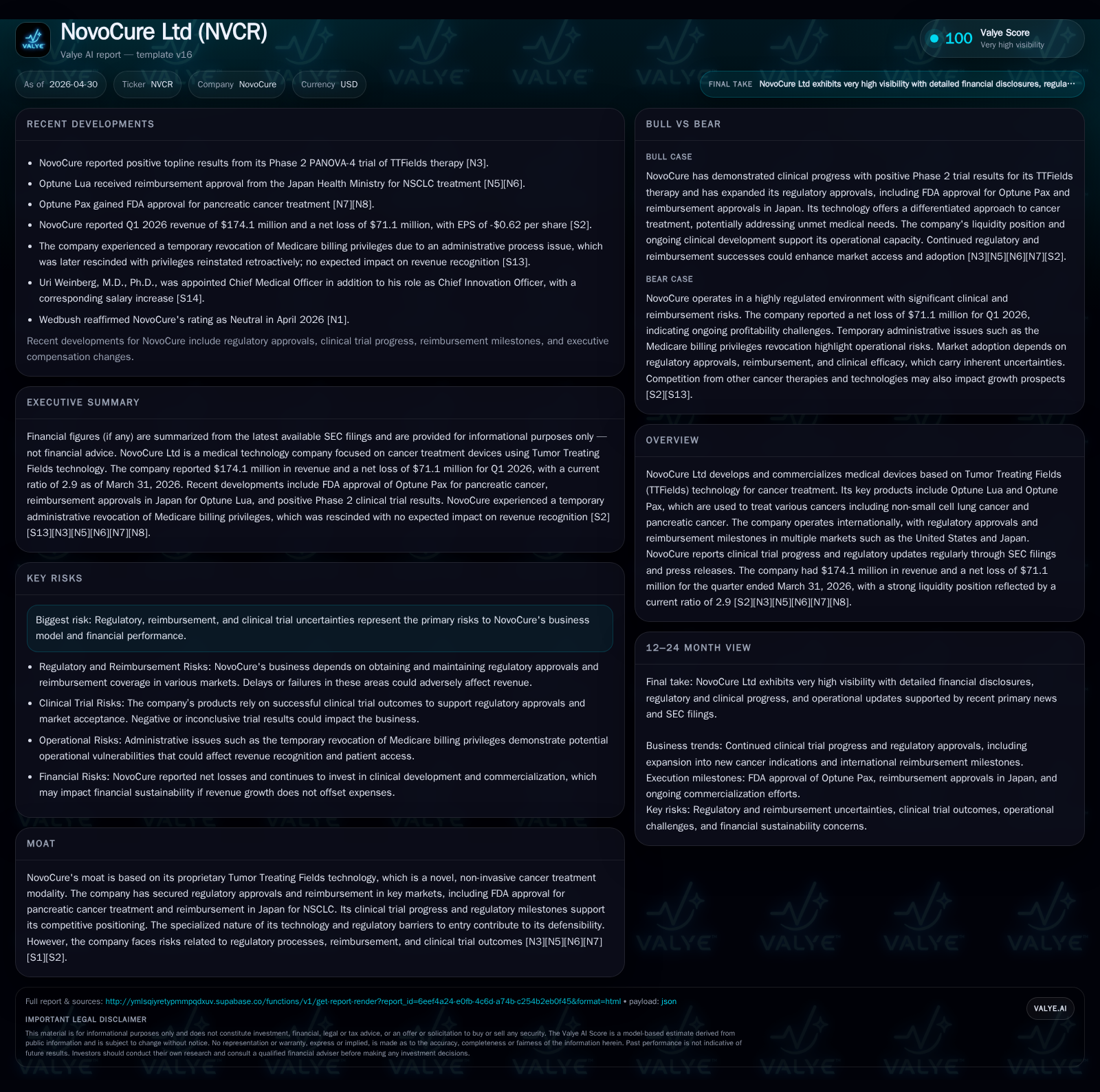
In Q1 2026, NovoCure Ltd demonstrated continued revenue momentum with $174.1 million, despite a net loss of $71.1 million, supported by a strong liquidity position and a healthy current ratio of 2.9. Key regulatory and clinical advancements including positive PANOVA-4 Phase 2 trial data and recent FDA approvals reinforce the commercial appeal of its TTFields technology in challenging cancers such as pancreatic and non-small cell lung cancer. While the company benefits from a differentiated cancer therapy with limited direct competition, risks remain centered on regulatory hurdles, reimbursement complexities, and execution in international markets. Upcoming trial readouts and approval milestones remain crucial near-term catalysts.
Latest Quarterly Results and Operational Highlights
NovoCure's first quarter of 2026 financial disclosures via the April 30, 2026 10-Q filing provide a clear view into its operational status amid an aggressive commercialization phase. The company reported revenues of $174.1 million for Q1 ended March 31, reflecting ongoing market acceptance of its Tumor Treating Fields (TTFields) devices [S2][F1]. However, this growth occurs alongside a net loss of $71.1 million, characteristic of its current phase investing heavily in R&D and global market expansion efforts [S3].
A liquidity snapshot shows cash and equivalents at $87.5 million with current assets at approximately $631.7 million against current liabilities around $217.6 million resulting in a strong current ratio of 2.9 [F1]. This indicates adequate short-term financial resilience to support continued operational scaling without immediate refinancing concerns.
The company also issued an 8-K concurrently detailing operational nuances reinforcing the momentum behind existing product lines as well as strategic direction focused on clinical validation pathways to broaden indications [S3]. This dual SEC communication underscores that NovoCure is balancing commercial traction alongside pipeline development effectively.
NovoCure's Business Model and TTFields Technology Overview
NovoCure’s business model centers on developing medical devices utilizing proprietary Tumor Treating Fields technology — low-intensity alternating electrical fields designed to disrupt mitosis selectively in cancer cells without systemic toxicity [S1][N7]. Its primary marketed products, Optune Lua and Optune Pax, directly target high unmet needs in oncology such as glioblastoma multiforme (GBM), locally advanced pancreatic cancer, and non-small cell lung cancer (NSCLC).
Revenue generation stems largely from device sales directly to healthcare providers including oncology centers and hospitals combined with service contracts encompassing patient support programs. Critical to adoption are reimbursement arrangements which shape pricing power; notably securing Medicare billing privileges in key markets is essential to translating clinical efficacy into commercial success.
The US FDA’s recent endorsement of Optune Pax for pancreatic cancer as a combination therapy with gemcitabine and nab-paclitaxel expands the revenue runway especially given pancreatic cancer’s historically poor treatment outcomes [S24]. In parallel, NovoCure has successfully gained reimbursement coverage in Japan for NSCLC indications marking robust international market penetrations [N7].
Competitive Positioning Within Oncology Device Landscape
NovoCure’s moat primarily derives from the novelty and proprietary nature of TTFields augmented by established regulatory clearances that are non-trivial hurdles in medical device oncology markets [S1][S4]. The technology positions itself uniquely between conventional chemotherapy/radiation therapies by offering a complementary treatment modality that mitigates systemic side effects.
Nonetheless, competitive challenges persist: entrenched standards-of-care such as combination chemotherapies remain dominant for many tumor types with large established provider familiarity; emerging alternative device-based oncologic interventions could erode share or influence reimbursement dialogues over time.
Pricing power is nuanced — while TTFields benefits from differentiation claims based on mechanistic novelty and favorable safety profiles, payer willingness-to-pay is heavily dictated by real-world effectiveness data plus comparative health economics assessments under complex reimbursement frameworks especially across geographies like Europe and Asia where pricing scrutiny is intense [S4][N3].
Growth Drivers: Clinical Trials, Market Expansion, and Regulatory Milestones
NovoCure's growth trajectory hinges notably on advancing clinical trial outcomes that validate broader label expansions beyond GBM. A significant recent catalyst is the Phase 2 PANOVA-4 trial which tested TTFields combined with atezolizumab (an immune checkpoint inhibitor) plus standard chemotherapy in metastatic pancreatic ductal adenocarcinoma (mPDAC). The trial achieved a statistically superior disease control rate (74.4%) versus historical controls treated only with chemotherapy (~48%), marking a meaningful efficacy signal for this notoriously lethal cancer type [N2][S11].
This clinical progress supports potential future claims expansion within difficult-to-treat solid tumors driving clinician confidence and payer interest.
Geographically, uptake in Japan following reimbursement approvals alongside anticipated filings in additional Asia-Pacific regions offers promising expanding revenue pools distinct from saturated western markets [N7][S10]. Concurrently, US FDA's green light for pancreatic indications increases addressable patient populations beyond neurology-focused oncology.
Commercial execution also focuses on leveraging these breakthroughs into incremental sales volume growth for Optune devices with parallel investments in patient support infrastructure aiming to optimize adherence—critical to therapeutic outcomes given the device operates over extended treatment cycles.
Risks and Challenges: Regulatory, Reimbursement, and Execution Factors
NovoCure faces several material risk vectors that could temper growth prospects or delay market penetration.
Regulatory risk remains paramount: approvals hinge on substantial clinical evidence often requiring protracted multi-phase trials sensitive to interim outcome variability or unforeseen adverse events potentially slowing label expansions or market entry timelines [S22]. Additionally, administrative challenges such as the early-2026 CMS billing privilege revocation temporarily impaired Medicare reimbursements causing estimated unrecognized revenue near $13 million monthly during the suspension period—though reinstatement was swiftly achieved this episode underscores procedural vulnerabilities impacting near-term cash flow visibility [S25][S26].
Reimbursement uncertainty extends beyond CMS dynamics; international payer heterogeneity mandates resource-intensive negotiation processes each varying by indication which could compress margins or delay full commercial exploitation particularly outside core US/Japan locales.
Execution risks inherent in commercialization include sustaining clinician education momentum required for TTFields therapy adoption given it represents a paradigm shift away from traditional cytotoxic approaches. Scale-up complexities around manufacturing ramp or supply chain constraints could also impact timely delivery amid demand surges.
Looking Ahead: Key Catalysts and Monitoring Points
Several upcoming events warrant close attention as they hold potential to recalibrate NovoCure’s growth outlook:
- Further readouts from ongoing pivotal trials across mPDAC subpopulations or NSCLC cohorts assessing overall survival or quality-of-life endpoints will crucially inform label extension potential [S3][S11].
- Regulatory submissions planned outside US/Japan especially Europe are key to unlocking new reimbursement territories internationally [S10].
- Quarterly commercial metrics such as patient initiations, device placements, renewal rates of support services will indicate market traction sustainability.
- Any shifts in CMS policy or payer guidelines especially relative to bundling or coverage terms require monitoring given their direct impact on revenue recognition cycle timing.
Tracking these data points enables distinguishing structural growth drivers from cyclical execution noise underpinning valuations.
Financial Snapshot: Liquidity, Revenue Trends, and Profitability Dynamics
Latest financial snapshot
| Metric | Value | Period |
|---|---|---|
| Cash & equivalents | $88mm | |
| 2026-03-31 | ||
| Current assets | $632mm | |
| 2026-03-31 | ||
| Current liabilities | $218mm | |
| 2026-03-31 | ||
| Current ratio | 2.9x | |
| 2026-03-31 |
Source: SEC companyfacts cache [F1].
The financial profile combines top-line growth indicative of expanding sales pipelines against ongoing investment-related losses typical within innovative oncology medical technology firms scaling globally. Solid balance sheet liquidity facilitated by no reported debt keeps funding runway intact supporting sustained R&D spend alongside strategic geographic expansion efforts.
Disclaimer: This analysis is based solely on the information available through SEC filings dated up to April 30, 2026 and verified company financial snapshots as of Q1 2026 end-date [F1], supplemented with reputable news sources cited herein without projecting forward-looking investment advice.
Disclaimer: This is research-only, informational analysis and not investment advice. It may include AI-generated interpretation and general industry context. Always verify important details using primary sources.

Comments