
Garrett Motion Advances Turbocharger Leadership Amid Industry Transition and Debt Constraints
Q1 2026 marks a period of strategic investment and cautious operational execution for Garrett as it navigates evolving powertrain trends and financial leverage.
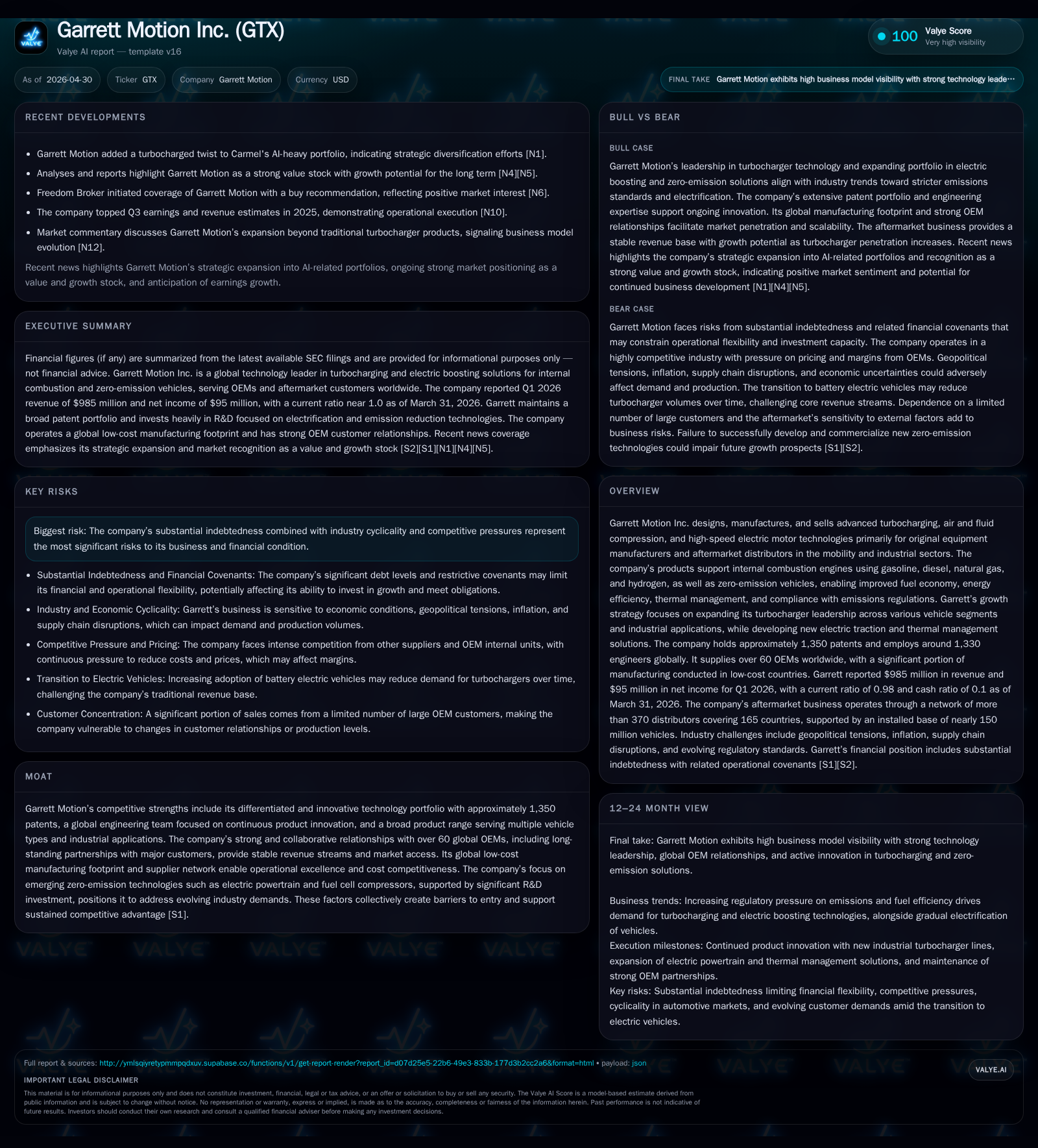
Garrett Motion Inc. reported steady operational progress in Q1 2026, maintaining leadership in turbocharging technology while accelerating R&D in electric and hydrogen compression solutions. The company’s broad OEM relationships and global manufacturing footprint strengthen its competitive position, though substantial indebtedness and macroeconomic uncertainties impose growth constraints. Key drivers include hybrid vehicle adoption, expansion into industrial markets, and commercial vehicle demand, balanced against risks tied to customer concentration, regulatory shifts, and elevated debt service obligations.
Recent Operating Update
Garrett Motion’s latest quarterly report for Q1 2026 reinforces its role as an industry leader amidst ongoing market transitions [S2][S3]. While the release did not signal material changes to risk factors from the previous year [S2], operational updates show continued execution on strategic priorities in turbocharging and advanced electrification technologies.
The company issued a press release confirming solid financial conditions with no unexpected deviations from its prior outlook [S3]. This stability comes during global supply chain volatility and macroeconomic uncertainties impacting automotive production broadly.
Business Model
Garrett Motion primarily generates revenue through the design, manufacture, and sale of turbochargers, air compressors, fluid compressors, and high-speed electric motors. These products enable increased engine efficiency and emissions compliance for internal combustion engines (ICE)—including gasoline, diesel, natural gas, and hydrogen variants—as well as components for zero-emission vehicles (ZEVs) like battery electric vehicles (BEVs) and fuel cell applications [S1].
Its business model leverages strong partnerships with over 60 original equipment manufacturers (OEMs), supplying componentry tailored to stringent OEM specifications across a broad range of passenger vehicles, commercial trucks, industrial sectors including marine propulsion units, stationary power generation (notably backup power for data centers), agriculture machinery, construction equipment, heating ventilation air conditioning (HVAC), and fuel cell systems [S1][S21].
Manufacturing operations are globally distributed across seven low-cost countries including China, India, Mexico, Brazil, Romania, and Slovakia enabling cost-efficient scale production without compromising quality or consistency. This aligns with the industry's need for 'design once – manufacture everywhere' given the centralized powertrain platform designs OEMs employ but produced locally to serve regional markets effectively [S1].
Revenue mechanics rest on OEM purchase orders which are generally open-ended but governed under negotiated terms specifying pricing adjustments tied to commodity costs or foreign exchange fluctuations. Margins are influenced by pricing discipline mandated by large OEM clients known to drive down supplier costs over program life cycles. The aftermarket represents a smaller but stable revenue source at approximately 14% of sales providing additional volume upside outside new vehicle launches [S11][S26].
Industry Structure and Competitive Position
Within the approximately $10 billion global turbocharger market that Garrett dominates by scale and technology leadership [S1], competition is intense. Competitors range from regional suppliers to vertically integrated automotive divisions within large OEMs themselves. Additionally, emerging players backed by private equity or venture capital target innovative electric compressor components challenging incumbents in advanced zero-emission tech development.
Garrett’s moat is underpinned by its expansive intellectual property portfolio containing ~1,350 patents covering proprietary high-speed motors, oil-free foil bearings enabling durability at extreme RPMs, sophisticated control software enhancing efficiency gains, power electronics critical for E-Powertrain solutions—elements that represent significant barriers to entry due to extensive RD&E investment demands and engineering know-how required [S1][S17].
Robust customer relationships enhance visibility into platform lifecycles supporting stable revenue streams though concentrations exist: top three customers—Stellantis (12%), BMW (11%), Ford (~11%)—collectively account for about one-third of sales raising dependency risks if any contract losses occur [S11][S17].
Global manufacturing presence not only delivers cost advantages but reduces geopolitical trade risk exposure relative to less diversified competitors. However internal pressures such as compliance with complex environmental regulations globally also impose operational overheads necessitating continuous investment [S13][S22].
Growth Drivers
Emissions Regulation Driving Turbocharger Demand
Increasingly stringent emissions legislation particularly in Europe, North America, India and parts of Asia incentivizes turbocharger adoption in hybrids/re-range extender EVs (REEVs) along with natural gas-powered vehicles requiring boosted combustion efficiency to meet fuel economy targets. Turbochargers allow downsized engines without sacrificing power output which aligns tightly with emission reduction goals across passenger cars and commercial fleets [S1][S20].
Expansion into Industrial & Marine Applications
New product lines targeting larger turbochargers (e.g., Garrett MEG series) intended for marine propulsion systems and data center backup generators diversify revenue beyond traditional automotive. These markets prioritize efficiency gains to control operating costs under tighter emissions frameworks creating sizable addressable opportunities complementing core mobility businesses [S1][S21].
Electrification Technologies Investment
Half of Garrett’s RD&E spends are committed to developing Electric Compression (E-Boosting) and E-Powertrain components aimed at electrified mobility including fuel cell air compressors vital to future hydrogen economies. Although many projects remain pre-commercialization stage with uncertain timelines or adoption rates they represent crucial long-term innovation bets positioning the company as a potential leader as ZEV penetration accelerates globally [S17][S21].
Aftermarket Channel Utilization
A stable recurring revenue stream arises from aftermarket sales providing spare parts replacement volumes independent of new vehicle production cycles offering some counter-cyclicality to revenue streams in periods of new model ramp delays or production slowdowns [S11][S26].
Risks / Watchpoints / Growth Constraints
High Leverage & Financial Covenants
As of March 31, 2026, Garrett Motion reported total debt of approximately $1.44 billion and cash and equivalents of $142 million, resulting in net debt near $1.3 billion [F1]. The current ratio stood at 0.98x, indicating tight liquidity conditions [F1]. These customers also wield substantial pricing leverage driving margin compressions especially during industry downturns or competitive bidding scenarios potentially impacting profitability adversely [S14][S22].
Industry Transition Pace Uncertainty
The speed of the global shift towards full battery electrification is a key uncertainty; accelerated BEV adoption could erode demand structurally for internal combustion-based turbochargers thereby compressing traditional high-margin product lines sooner than anticipated. Conversely delayed regulation changes could reduce urgency around emissions solutions negating near-term advantage. Successful commercialization of electric compression remains speculative; failure would impair future growth prospects warranting prudent monitoring [S1][S8].
Geopolitical & Supply Chain Risks
Operations spread across multiple countries expose Garrett to tariffs, trade tensions (notably US-China relations), fluctuating currency impacts, regulatory complexities including GDPR compliance costs posing risk layers disrupting production continuity or inflating costs unexpectedly [S15][S23][S22].
What To Watch Next
- Quarterly bookings trends across key regional platforms indicating hybrid versus BEV mix evolution.
- Market adoption velocity of Garrett’s E-Powertrain compressor technologies including pilot commercialization announcements.
- Updated guidance around aftermarket sales growth contributing to revenue diversification.
- Any amendments or covenant waiver negotiations relating to existing debt facilities signaling changes in financial flexibility.
- Customer contract wins/losses with Stellantis or BMW impacting topline visibility.
- Expansion progress of the MEG turbocharger line targeting marine/industrial sectors.
- Regulatory developments potentially influencing emissions standards affecting product demand dynamics.
- Management commentary on supply chain challenges reflecting macroeconomic developments through FY2026 earnings calls.
Financial Profile Summary (Q1 2026)
Latest financial snapshot
| Metric | Value | Period |
|---|---|---|
| Cash & equivalents | $142mm | |
| 2026-03-31 | ||
| Total debt | $1437mm | |
| 2026-03-31 | ||
| Net debt | $1295mm | |
| 2026-03-31 | ||
| Current assets | $1375mm | |
| 2026-03-31 | ||
| Current liabilities | $1406mm | |
| 2026-03-31 | ||
| Current ratio | 0.98x | |
| 2026-03-31 |
Source: SEC companyfacts cache [F1].
| Metric | Value | Period End |
|---|---|---|
| Cash & Equivalents | $142 million | |
| 2026-03-31 | ||
| Total Debt | $1.437 billion | |
| 2026-03-31 | ||
| Net Debt | ~$1.3 billion | |
| 2026-03-31 | ||
| Current Assets | $1.375 billion | |
| 2026-03-31 | ||
| Current Liabilities | $1.406 billion | |
| 2026-03-31 | ||
| Current Ratio | 0.98 | |
| 2026-03-31 | ||
| Latest Annual Revenue | $891 million | |
| 2025-12-31 | ||
| Latest Net Income | $84 million | |
| 2025-12-31 | ||
| This balance sheet reflects tight liquidity conditions close to unit coverage thresholds; cash generation will be critical to sustain operations while funding large R&D outlays required for transition technologies. |
Disclaimer: This analysis is based solely on publicly disclosed SEC filings as well as current available financial data without projecting future performance or providing investment advice.
Disclaimer: This is research-only, informational analysis and not investment advice. It may include AI-generated interpretation and general industry context. Always verify important details using primary sources.

Comments