
Fathom Holdings Faces Nasdaq Compliance Challenge While Strategizing Growth
Fathom Holdings confronts a Nasdaq stock price deficiency notice amid ongoing portfolio realignment aimed at driving future growth.
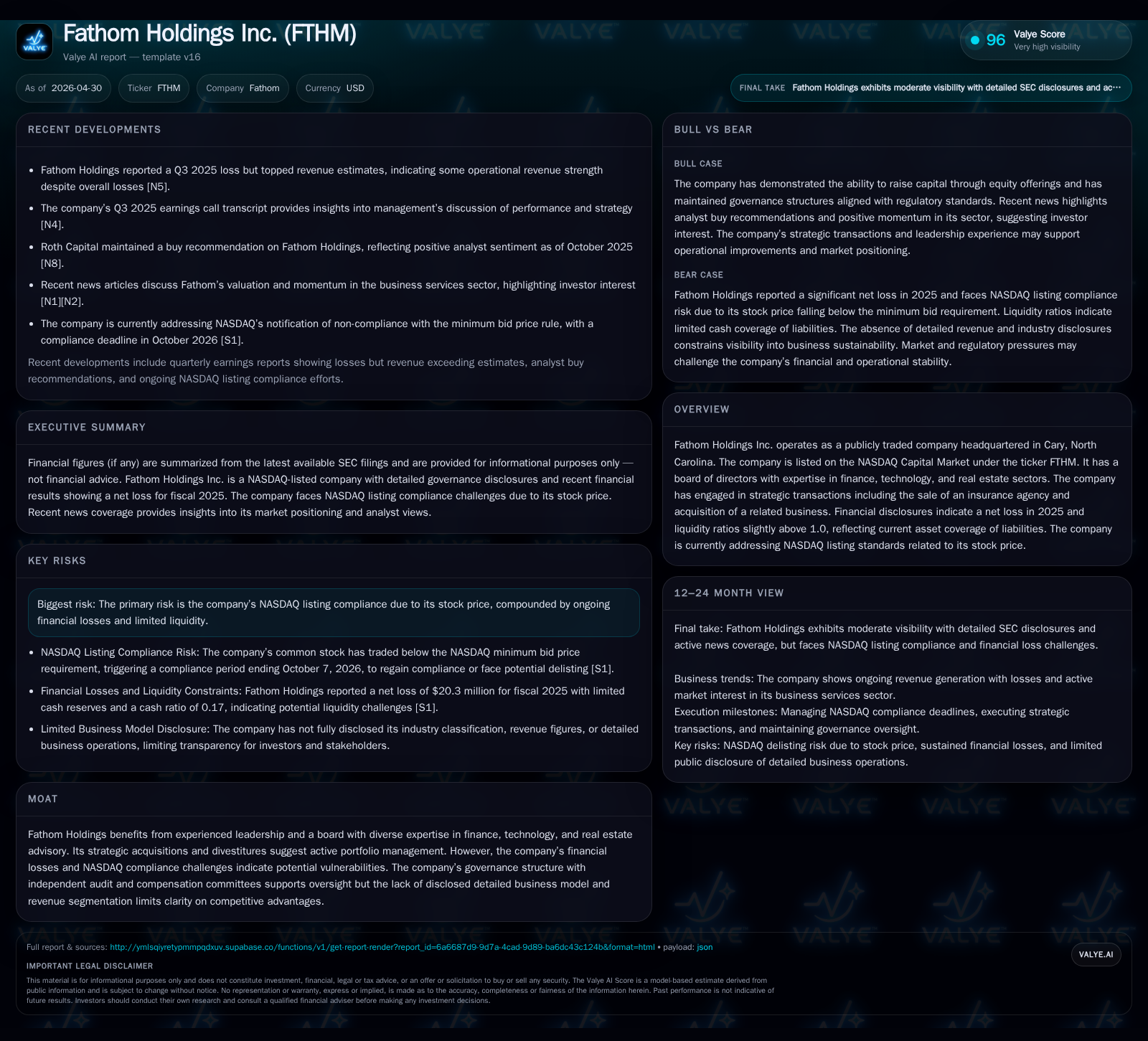
In April 2026, Fathom Holdings received a Nasdaq notice for failing to maintain the minimum $1.00 bid price, initiating a critical compliance period through October. Concurrently, the company pursues strategic portfolio shifts including the divestiture of its Dagley Insurance Agency and acquisition of Hometown Heroes LLC, reflecting active management of business lines. Despite these moves, Fathom remains under pressure from persistent net losses and tight liquidity coverage with a current ratio just above 1.0. Regulatory risks and financial constraints constitute material headwinds, though the leadership team’s experience and focused acquisitions offer potential pathways for stabilization and growth.
NASDAQ Stock Price Compliance Issue: Recent Developments and Implications
Fathom Holdings Inc. disclosed in its April 2026 Form 8-K that Nasdaq notified the company that its common stock traded below the minimum required bid price of $1.00 per share for 30 consecutive business days ending shortly before April 10, 2026 [S3][S4][S6]. This formal deficiency triggers a compliance period extending until October 7, 2026 during which Fathom must restore its bid price above $1.00 for ten consecutive trading days to regain good standing without further remedial actions.
If Fathom fails to meet this recovery threshold by the deadline, it may qualify for an additional 180-day extension conditional upon meeting other Nasdaq requirements excluding the bid price rule itself—often necessitating measures such as reverse stock splits. The notice places immediate regulatory risk over Fathom’s market presence with potential delisting implications influencing liquidity, investor confidence, and capital access.
Management has acknowledged this challenge and is evaluating remediation alternatives but there is no assurance compliance will be restored within the allotted timeframe [S3][S6]. Maintaining Nasdaq listing status is essential not only for market visibility but also for supporting future equity financing capacity.
Corporate Strategy: Divestitures, Acquisitions, and Portfolio Management
Fathom’s recent strategic maneuvers reflect an active portfolio reshaping approach aimed at focusing resources on higher-growth or more synergistic segments while pruning non-core operations. In May 2024, Fathom completed the sale of its Dagley Insurance Agency operations for a total consideration of $15 million structured across closing payment plus two subsequent annual installments [S7]. The divestiture follows rationalization efforts to sharpen business focus and reinforce liquidity.
Concurrently in September 2024, through its wholly owned subsidiary IntelliAgent, Fathom acquired Hometown Heroes LLC from an insider shareholder with significant ownership interest in Fathom itself. The modest purchase price financed partly upfront with subsequent installments suggests an acquisition designed to complement existing tech-enabled service offerings within the real estate ecosystem [S7][S8][S10].
Additionally, the company raised approximately $5 million in September 2024 via senior secured convertible notes sold to existing insiders including board members—further indicating strategic financing aligned with restructuring efforts [S7]. These transactions collectively underscore management's priority on portfolio realignment as both foundation and catalyst for longer-term growth.
Business Model Overview: Revenue Streams and Customer End Markets
Public disclosures limit granular detail on Fathom’s revenue segmentation; however, it is evident that Fathom operates primarily in business services intertwined with technology solutions oriented towards real estate markets. Revenue likely derives from brokerage activities facilitated by proprietary platforms alongside insurance-related services prior to divestiture.
The company monetizes through commissions on transaction volume generated by its broker network augmented by technology-enabled process efficiencies and ancillary services integrated via acquisitions like Hometown Heroes LLC [S1]. The use of subscription or usage-based pricing models common in real estate tech likely impacts recurring revenues.
Margins are pressured by investments in technology infrastructure, customer acquisition costs paid via marketing fees (sometimes involving related parties), and overheads associated with personnel and corporate segments. Operating losses recorded in recent periods suggest current scale or pricing power is insufficient to cover fixed costs fully [F1].
The sector comprises traditional brokerage firms competing against hybrid/tech-enabled models as well as stand-alone real estate tech vendors offering CRM, lead generation or transaction management tools.
The fluidity of brokerage commission structures creates inherent cyclicality linked to housing market dynamics while tech adoption can depend on agent receptivity often influenced by ease-of-use versus incumbent platform entrenchment. Regulatory factors such as licensing requirements or data privacy rules may impose operational constraints but currently do not appear as direct barriers.
Despite experienced leadership guiding corporate governance with independent committees ensuring oversight integrity [S1], Fathom operates at a scale still vulnerable relative to larger incumbents or fast-growing pure-play tech competitors who possess deeper pockets for innovation investment. This limits structural competitive moats especially given continued net losses constraining reinvestment capacity.
Growth Opportunities: Strategic Drivers and Adoption Catalysts
Growth prospects for Fathom hinge largely on successful integration and scaling of recent acquisitions targeting complementary service verticals enhancing client lifecycle capture within real estate ecosystems. Expanding market penetration via cross-selling bundled offerings could incrementally boost volume throughput if agent adoption accelerates.
Operational efficiencies leveraged through tech enablement—streamlining transaction workflows or automating manual tasks—offer margin improvement avenues although potentially requiring upfront investment before payback accrues. Aligning incentive structures with key stakeholders including agents and brokers through equity participation programs could foster retention strengthening recurring revenue stability.
Market sentiment drivers reflected in recent positive analyst commentary around one-year performance comparisons signal external optimism if underlying fundamentals improve supported by management’s strategic clarity articulated during earnings communications [N2]. However accelerated growth depends on addressing balance sheet constraints so that capital allocations can fund innovation roadmaps effectively without exacerbating liquidity stress.
Risks and Constraints: Listing Compliance, Financial Health, and Market Dynamics
Foremost among risks confronting Fathom is its ongoing NASDAQ listing compliance issue arising from sustained sub-$1.00 share prices placing it at delisting risk absent corrective actions before October deadline [S3][S6]. Delisting would severely impair public market liquidity and deter institutional capital engagement.
Financially, operating losses totaling approximately $15.6 million in operating income shortfalls culminating in net losses beyond $20 million constrict free cash available for organic expansion initiatives or buffer against economic fluctuations [F1]. Liquidity coverage remains tight with current ratio roughly near unity (1.06), signaling limited cushion between current assets ($35.9 million) versus liabilities ($33.9 million) risking funding gaps if collections are delayed or unexpected expenses arise [F1].
Externally driven housing market volatility impacting transaction volumes could exacerbate cyclical downturns hitting top-line adversely given dependency on brokerage commissions impinging grow-or-die dynamics common in sector peers. Additionally low public float partly held by insiders restricts tradable shares adding volatility dimension.
Upcoming Milestones and What Investors Should Monitor
Investors should track several critical events signaling inflection points for Fathom’s trajectory: notably the NASDAQ bid price compliance deadline on October 7, 2026 which will determine exchange listing continuity barring timely remediation moves such as reverse splits or share consolidations [S3][N1].
Performance updates post integration of Hometown Heroes LLC will shed light on successful expansion execution effectiveness while any announced expansions or partnerships leveraging this subsidiary may broaden relevance.
SEC filings scheduled periodically will provide transparency into financial health trends including margin evolution and cash flow metrics enabling assessment of runway sufficiency against burn rate benchmarks established previously.
Market reception reflected in quoted share prices trending toward regain thresholds will serve as actionable demand cue confirming adaptive market confidence aligned with strategic progress reviews discussed during reported shareholder dialogues or earnings releases [N2].
Latest Financial Overview: Liquidity, Debt, and Profitability Metrics
Latest financial snapshot
| Metric | Value | Period |
|---|---|---|
| Cash & equivalents | $5.8mm | |
| 2025-12-31 | ||
| Total debt | $5.6mm | |
| 2025-12-31 | ||
| Net debt | -$0.187mm | |
| 2025-12-31 | ||
| Current assets | $35.9mm | |
| 2025-12-31 | ||
| Current liabilities | $33.9mm | |
| 2025-12-31 | ||
| Current ratio | 1.06x | |
| 2025-12-31 |
Source: SEC companyfacts cache [F1].
As per latest annual data ending December 31, 2025, Fathom reports substantial operating deficits driving net loss nearing $20 million alongside modest positive cash reserves of approximately $5.8 million balanced against roughly equivalent levels of total debt at approximately $5.6 million producing near-neutral net-debt positioning (-$187K) [F1].
This financial snapshot supports narrative highlighting current challenges yet preserving optionality grounded in manageable debt exposure provided operational stabilization ensues promptly.[F1]
This analysis reflects information sourced directly from SEC filings including latest quarterly statements (Form 10-Q dated November 12, 2025), recent event reports (Form 8-K dated April 16, 2026), amended annual report (Form10-K/A dated April30,2026), companyfacts database points updated as of March/April2026 along with relevant public news analysis articles cited where appropriate.[S1,S2,S3,S4,S6,S7,S8,S10,F1,N1,N2]
This memorandum is prepared solely for informational purposes consistent with Valye analysis policies; it does not represent investment advice or recommendation.
Disclaimer: This is research-only, informational analysis and not investment advice. It may include AI-generated interpretation and general industry context. Always verify important details using primary sources.

Comments