
UNITED BREWERIES Advances Governance, Confirms Dividend Policy, and Leverages Digital Growth Across South America
CCU strengthens board oversight and shareholder returns while capitalizing on its diversified beverage portfolio and digital innovation amid regulatory challenges.
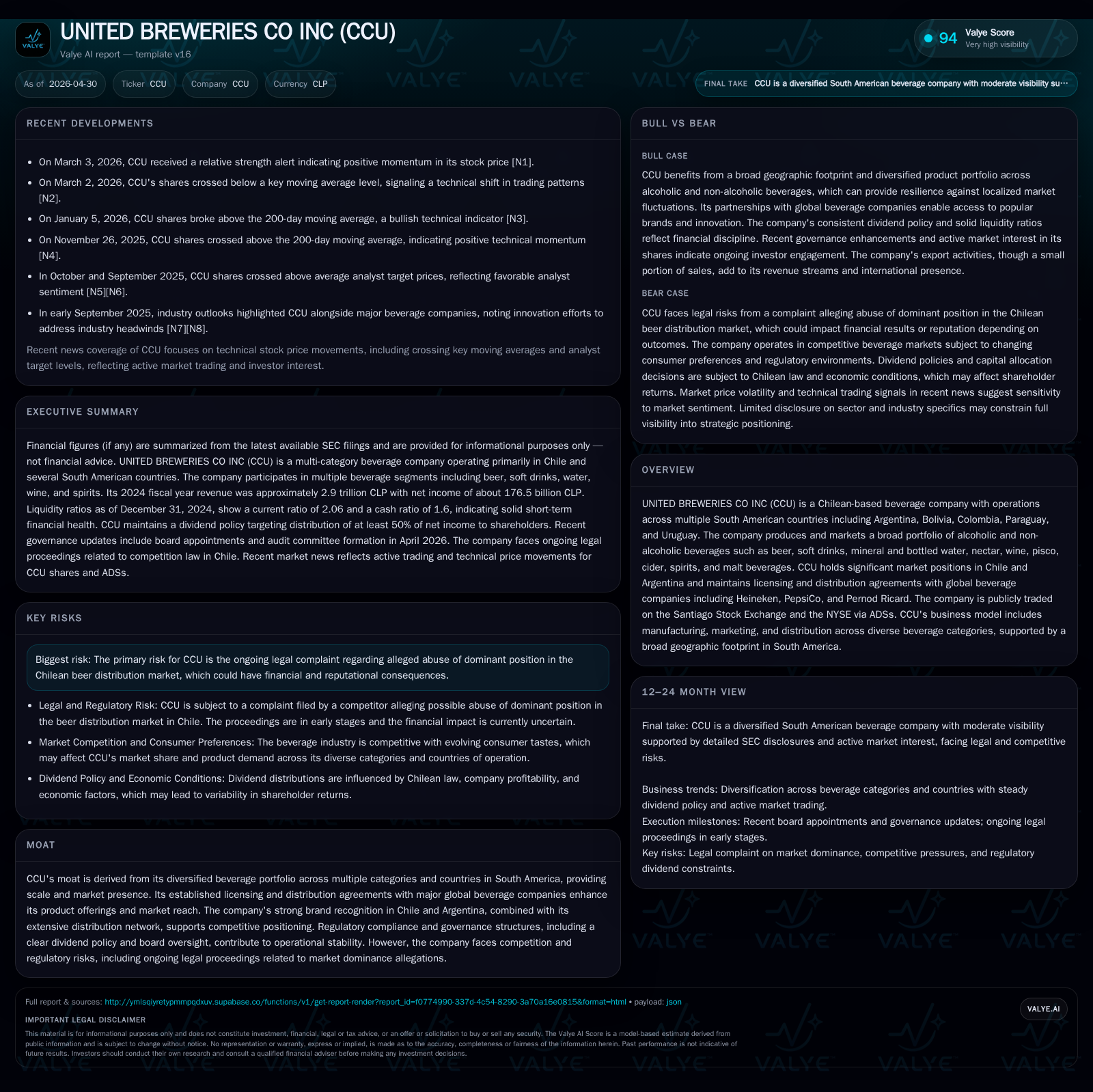
In April 2026, UNITED BREWERIES CO INC (CCU) implemented key governance changes including new appointments to the board and audit committee aligned with Sarbanes-Oxley compliance. The company approved a final dividend based on 2025 net income, reinforcing its commitment to stable shareholder returns. CCU’s multi-category beverage operations span six South American countries, supported by strategic licensing partnerships and ongoing investments in digital platforms and production assets. While facing an early-stage competition complaint in Chile, the company’s strong liquidity and operational initiatives underpin its growth trajectory.
April 2026 Governance Enhancements Bolster Oversight
At the ordinary shareholders’ meeting held in mid-April 2026, UNITED BREWERIES CO INC (CCU) restructured its board to strengthen governance frameworks [S2]. Marie Agathe Lemoine Porte was appointed as an independent director under Chilean Law N°18,046 article 50 bis and named Carlos Molina Solís and Rodrigo Hinzpeter Kirberg as members of the directors committee alongside herself. Pablo Granifo Lavín assumed the chairmanship with Carlos Molina Solís as vice-chairman. Both Lemoine Porte and Molina Solís joined the Audit Committee in alignment with Sarbanes-Oxley Act requirements, enhancing financial oversight capabilities. Hinzpeter Kirberg serves as an observer member of the committee. These changes reinforce transparency at a time when global investors emphasize rigorous corporate governance for foreign private issuers.
Simultaneously, shareholders approved Final Dividend No. 272 charged against fiscal year 2025 net income attributable to equity holders [S3]. The dividend amounts to CLP 74.52679 per share or CLP 149.05358 per ADR payable beginning April 24th to shareholders recorded as of April 18th. This affirms CCU's dividend policy targeting distributions of at least 50% of IFRS net income annually [S9], signaling steady shareholder returns amidst evolving market conditions.
Business Model: A Diversified Beverage Conglomerate Across Latin America
CCU operates as a vertically integrated beverage company manufacturing, marketing, and distributing alcoholic and non-alcoholic products across Chile, Argentina, Bolivia, Colombia, Paraguay, and Uruguay [S1][S2][S3]. Its portfolio spans beer—its core category—alongside soft drinks, mineral/bottled water, nectars, wine, pisco, cider, spirits, and malt beverages.
The company leverages scale advantages from multi-category operations anchored predominantly in Chile where it holds market leadership in beer. In Argentina it ranks as the second-largest brewer. Strategic licensing agreements with internationally recognized partners such as Heineken Brouwerijen B.V., PepsiCo Inc., Pernod Ricard Chile S.A., Seven-up International enhance product offerings without incurring significant R&D expenses [S1]. This hybrid model balances proprietary brands with licensed portfolios mitigating country or category-specific risks.
End-to-end control over production facilities—including brewing plants—and distribution networks enables quality assurance while optimizing margins through direct retail logistics.
Competitive Positioning: Market Leadership Supported by Digital Innovation
Within South America's fragmented beverage industry landscape characterized by intense competition and regulatory scrutiny, CCU maintains a strong foothold through dominant shares in key categories [S1][F1]. Its heritage brands enjoy consumer loyalty especially in Chile’s beer market which commands significant expenditure.
The company invests heavily in supply chain infrastructure dedicated to ensuring efficient delivery across urban and rural channels—a critical differentiator that establishes durable retailer relationships [S4].
Digital transformation efforts have introduced proprietary platforms such as 'Mi Carro' (B2B sales) launched in 2021 and 'La Barra' (B2C e-commerce), enabling data-driven commercial strategies uncommon among regional peers [S1][S4]. These platforms enhance sales forecasting accuracy using AI algorithms developed since 2019 while streamlining logistics.
Regulatory risks persist given ongoing competition complaints alleging anti-competitive behavior within Chile’s beer distribution segment; although early-stage proceedings limit immediate impact visibility [S1], they introduce potential constraints on pricing power or operational practices.
Growth Drivers: Technology Integration and Regional Expansion
CCU’s growth strategy centers on accelerating technology adoption combined with geographic expansion throughout Latin America [S1][S4]. Since updating operational platforms beginning in 2019 with AI-based tools for sales optimization and forecasting improvements, the company has expanded proprietary digital ecosystems supporting commercial agility.
Capital expenditures planned for 2026 total approximately CLP 160 billion focusing on brewing production assets (CLP 78 billion), returnable packaging (CLP 29 billion), marketing cold-chain infrastructure (~CLP14 billion), and distribution assets predominantly within Chile [S4]. This investment sustains core market strength while facilitating scalable platform deployment regionally.
Strategic joint ventures executed since early-2024 increased majority stakes in Paraguayan distributors AV S.A. and Distribuidora del Paraguay S.A., expanding CCU’s footprint into emerging consumption markets fueled by growing middle-class demographics [S6].
Licensing partnerships provide access to premium international brands broadening portfolio appeal without heavy development costs.
Risk Factors: Legal Proceedings and Market Volatility
CCU faces notable regulatory risk from a complaint filed by Cervecería Chile S.A. alleging possible abuse of dominant position in Chile's beer distribution market [S1]. While proceedings remain nascent without quantified financial impact yet disclosed by management, reputational risks coupled with potential regulatory sanctions represent meaningful uncertainties affecting competitive dynamics.
Additional risks include macroeconomic volatility across Latin America impacting raw material costs due to currency fluctuations and inflationary pressures potentially dampening discretionary spending on premium beverages.
Supply chain vulnerabilities—especially for specialty ingredients used in categories like pisco or craft beers—and evolving health regulations or taxation policies targeting alcoholic beverages could pressure margins or volumes requiring responsive management.
Execution risks also attend digital transformation initiatives where platform adoption speed must align with targeted operational efficiencies.
Near-Term Catalysts: Dividend Distribution and Monitoring Digital Adoption & Legal Developments
Upcoming milestones include execution of the approved dividend payment commencing April 24th reinforcing cash flow discipline central to investor confidence metrics [S3]. Quarterly updates will provide indicators on the adoption trajectory of digital sales platforms ‘Mi Carro’ (B2B) and ‘La Barra’ (B2C), serving as barometers for commercial digitization success supporting incremental revenue growth [S6][S4].
Developments related to the Chilean competition tribunal complaint will be critical; timing around hearings or rulings could materially influence outlook given potential operational or strategic restrictions arising from alleged anti-trust violations [S1].
Further progress on capex deployment focused on production line modernization within flagship markets will be monitored alongside potential expansion opportunities via joint ventures or acquisitions within the region.
Financial Position: Solid Liquidity Supports Investment Capacity Amid Steady Cash Flows
As of December 31st, 2024—the latest fully reported snapshot—CCU held cash & equivalents totaling approximately CLP 707 billion against current liabilities near CLP 860 billion yielding a current ratio of about 2.06 times indicative of comfortable short-term liquidity [F1].
Operating activities generate annual cash flows between roughly CLP 239 billion to CLP 294 billion over recent years supporting both operational needs and capital investments [S6][F1].
Debt covenants are met comfortably with leverage ratios well below limits alongside an interest coverage ratio exceeding minimum thresholds detailed within bond agreements [S5], underpinning CCU’s capacity for continued investment funding largely financed through internally generated resources.
Capital allocation balances steady dividends—approximately half of net income distributed—with substantial reinvestment into production assets essential for sustaining competitiveness amid sector evolution [S8][F1].
This analysis is based exclusively on information available through April 2026 SEC filings without speculative extrapolation beyond documented facts. It highlights UNITED BREWERIES CO INC's recent governance enhancements, dividend policies, operational strengths including digital transformation initiatives balanced against identifiable legal risks within its core markets.
Disclaimer: This is research-only, informational analysis and not investment advice. It may include AI-generated interpretation and general industry context. Always verify important details using primary sources.

Comments